…do you see religion as a kind of social glue, or do you see it as a disastrously stupid collection of bad ideas? If you are in the latter camp, you’re a New Atheist.
I think any readers I have know I’m inthe latter camp. Just wanted to make that clear for everyone, because it seems from his post that many believers actually believe what they say they do – and this has surprised at least one finger-wagging atheist. Well, go figger!
My father was a chemical engineer. In the last year of his life he was reading Stephen Hawking’s “A Brief History of Time.” He used to talk my ear off about black holes and the speed of light. I was more interested in listening to the Misfits, growing my hair out, and skating the local mini ramps. But his enthusiasm was contagious.
I remember him telling me that a person traveling on a space ship at the speed of light would age more slowly than a person on Earth. I remember him telling me that nothing — not even light — could escape from a black hole. He was fascinated, electrified by these ideas. And he wanted to electrify me with them as well.
Some of what he said must have registered with me, though, because a few years ago I found myself in a quandary about those same two subjects: black holes and light speed. Memories of him came flooding back to me, and I suddenly wished I had paid more attention when he spoke. Then it occurred to me that I could simply read a book and find out for myself.
The book I read shocked me much as Hawking’s book must have shocked my father two decades ago. It was amazing: here was a book so rich in information, so eloquent in explanation and so unpretentious in its delivery that I couldn’t believe it was that easy. Could the secrets of the universe really be available to someone with no background in science or mathematics, and for the price of a paperback?
What a discovery! (The book, by the way, was “Cosmos” by Carl Sagan). A window opened and the fresh air of inquiry filled the room. You could find out nearly anything you wanted to know just by opening a book. I’d just discovered what goes by the moniker of “popular science” writing.
The funny thing was that I was no stranger to books. I’d worked in bookstores for years but routinely snubbed the science section. I’d always considered it one notch above psychology (yawn). Today it’s the first place I go when I enter a bookshop, and I comb the shelves with alacrity for exciting new writers.
My love of science writing is manifestly a love of science writers. They’re the ones who translate the complexities and intricacies of science to a general public (how I reviled the general public in those days, too!) and make it the stuff of page-turners. I may never have an advanced understanding of chemistry or physics, but there are dozens of writers capable of explaining the structure of DNA and quantum tunneling who make me feel as if I do. This is no easy task.
When I read about carbon dating (Earth is about 4.5 billion years old), universes popping into existence from nothing, probabilities and the evolution of species I long to share my increasing knowledge with my father. Knowledge increases wonder, and there’s no danger of running out of either in the world of scientific discovery. It seems every day we hear about some new milestone: an “Earth-like” exoplanet revolving around a nearby star, fossil fish with feet, and a particle that moves faster than light (alas, a false alarm).
Science has a reputation as being boring, difficult and elitist. Who doesn’t conjure up an image of nerds in white coats and Coke-bottle glasses, puttering about and torturing mice in a sterile lab? But the reality is rather different. Just consider the word “revolution.” It comes from Copernicus, the man whose revolutionary idea was that the Earth revolves around the sun. Galileo was tried — and condemned — by Inquisition enforcers for his adherence to Copernican cosmology. Only later did the word enter political jargon and become more or less synonymous with “upheaval.”
Science has always been at the forefront of social progress. It is perhaps no coincidence that the Founding Fathers were all scientifically literate men, if not scientists themselves. Nor should it be surprising that totalitarian regimes are fundamentally anti-scientific. The beauty of science is that free inquiry is required for it to work. It is fundamentally a liberal enterprise whose archenemy is dogma.
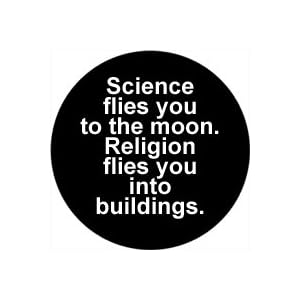
This is because it seeks truth: not truth as we wish it to be, but truth as things are. And this is why science and religion are (despite many attempts to reconcile them) largely incompatible. Religion is a set of fossilized ideas. What was “true” two millennia ago is just as “true” today. It resists change. Science, on the other hand, thrives on it. It is not a heresy to challenge the most established ideas in science; it’s de rigeur. It’s how progress is achieved.
I began this piece by talking about my father. Now that I’m a father I think about him often. He wasn’t a perfect man. He could be extremely difficult at times, had a bad temper and often meted out punishment that outweighed the offenses. Of course, it’s nearly impossible for me to be objective about him. But in the last years of his life he was able to ignite in me a passion for knowledge that I hope to pass on to our daughter. And that’s what I call progress.
I’ve just finished reading Jacob Bronowski’s exhilarating Ascent of Man (1973). It had been on my mental bookshelf for a while, and I’m glad I finally got around to reading it. In his introduction, Richard Dawkins states that there is a memorable passage on nearly every page of the book, and he’s right. I haven’t underlined (virtually – I read it on my Kindle) a book so much in ages. Apart from a few quibbles I had with his repeated use of “the birth of Christ” as a time-marker (it seems out of place in a book celebrating the ascent of reason and science), I was taken on a kind of magic carpet ride of the human intellect. Bronowski was a master of communicating exceedingly difficult ideas to the uninitiated, a tradition whose most brilliant star was arguably Carl Sagan.
Here is a beautiful passage about the education of the young:
“Of course there were great civilisations. Who am I to belittle the civilisations of Egypt, of China, of India, even of Europe in the Middle Ages? And yet by one test they all fail: they all limit the freedom of the imagination of the young. They are static, and they are minority cultures. Static, because the son does what the father did, and the father what the grandfather did. And minority, because only a tiny fraction of all that talent that mankind produces is actually used; learns to read, learns to write, learns another language, and climbs the terribly slow ladder of promotion.”
This passage is followed by another a few pages later, which I think sums up Bronowski’s views rather well:
“Knowledge is not a loose-leaf notebook of facts. Above all, it is a responsibility for the integrity of what we are, primarily of what we are as ethical creatures. You cannot possibly maintain that informed integrity if you let other people run the world for you while you yourself continue to live out of a ragbag of morals that come from past beliefs. That is really crucial today. You can see it is pointless to advise people to learn differential equations, or to do a course in electronics or in computer programming. And yet, fifty years from now, if an understanding of man’s origins, his evolution, his history, his progress is not the commonplace of the schoolbooks, we shall not exist. The commonplace of the schoolbooks of tomorrow is the adventure of today, and that is what we are engaged in.”
Wow, this theocratic call-to-arms by Baroness Warsi slipped right by me! She’s actually proud to be leading “the largest ministerial delegation from the United Kingdom to the Vatican” ever (that is, to a “country” which despises everything modern liberal democratic states hold dear in favor of totalitarian theocracy.) Her tactic is to pretend that religions are all friends with one another and that the big bad wolf is militant secularism. Sound familiar? Those pesky secularists, always poking fun at wholesome religious craziness!
Go ahead and read the piece. It’s funny if you don’t dwell on the fact that she’s a representative of the UK government who wants to mainline religion back into politics – just like the good ol’ days. And Warsi gets a bit nasty, too, when she asserts:
“[Secularism] demonstrates similar traits to totalitarian regimes – denying people the right to a religious identity because they were frightened of the concept of multiple identities.”
I wonder if Warsi has reflected on the fact that the Vatican – which she is so proud to visit – signed concordats with both Nazi Germany and Fascist Italy, and supported every fascist regime in Europe throughout World War II (when they pragmatically thought the future of Europe would be fascist). No, I bet she hasn’t thought much about that one.
Warsi loopholes her way out of this, however. She reassures us secularists, “I am not calling for some kind of 21st century theocracy.” She’s just calling for more respect for religion. That’s reassuring. But why should religion get our respect without earning it? That’s not clear from her article. She’s too caught up in her ridiculous revivalism.
Well, I finished A Universe From Nothing, and the “nothing” business was cleared up in the end.
***SPOILER ALERT***
Apparently “nothing is unstable” is a fundamental principle which gives rise to the inevitability that out of nothing something will eventually arise. Nothing can’t stay nothing for long, it seems. For me this is still a bit like poetry; I’m not having much luck envisioning total emptiness, bereft even of space. I keep thinking, “How do I begin to think about that?” Krauss himself admits that talking about “why is there something rather than nothing?” can seem a bit like counting the angels on the head of a pin (a favorite pastime of medieval theologians). The difference is, of course, that “physicists can count their angels and can get it right to the nearest angel in a total of 10 billion.” That last phrase is from Richard Dawkins’ afterword.
I’m reading Lawrence Krauss’s new book, A Universe From Nothing (every so often I enjoy punishing myself by trying to figure out what cosmologists are learning about the cosmos). About the first half of the book is setting up the main premise, which is that things – particles, bagels, universes – can indeed spring forth from, well, nothing. At first I was confused, because Krauss uses “nothing” to mean both “empty space” and “nothing, not even empty space.” Not being a cosmologist or theologian, I can get my head around empty space, but I have trouble picturing the concept of absolutely nothing. I mean, if even space-time is absent, then what are we to do?
My impression is that this works mathematically and theoretically (which is good), but how can a human being even conceive of this kind of nothingness? It’s not a blank slate; there simply is no slate. Then, through something called “quantum fluctuations”, a slate appears. Then, after about 13.5 billion years, Shakespeare. It’s mind-boggling.
I haven’t finished the book yet, and I’ve just gotten to the meat of the matter, so perhaps this deep, disturbing nothingness is adequately explained further in the book. But right now I’m depleting my store of imagination trying to figure out where quantums are fluctuating if there is no longer any where for them to fluctuate in.
Every time I go to the supermarket there’s an African man selling socks in the parking lot. It’s not always the same man, but he always has the same approach: “Hello, my friend…” after which he goes on to coax handouts through a combination of smiles, hand gestures and appeals to the goodness of god.
Sometimes I give him spare change. Once I gave him a banana, for which he seemed genuinely grateful. I’m sorry for his predicament (he’s likely a refugee from a war-torn land), but I try not to let myself become an easy target for people begging for money, either. Maybe this is a holdover from my New York days.
Recently we had a brief conversation. It went like this:
“Hello, my friend!”
“Hey.”
“Ah, god is good, is he not?”
“No, he’s not. Maybe you should thank people who have helped you out, not god.”
“But doesn’t god help you, my friend?”
“He’s never done anything for me.”
“Why don’t you believe in god?” he asked, puzzled.
“Because he doesn’t exist!” I said gleefully. I made sure to smile, too, so he could be sure that he was speaking to a happy atheist. Then we got in the car and drove off.
Later, I asked my wife if I’d been too hard on the man. She replied that he came from Africa and had seen who knows what horrors before embarking for Europe. He may have lost his family and possessions along the way. He’d probably come from a country where life was hell, and seen things that would make us shudder. My little quip wasn’t going to cause a breakdown in him.
Fair enough. I wasn’t going for that, anyway. I was just expressing mild outrage at the idea of a person who depends upon the kindness of strangers but can’t thank them directly. Instead, he thanks “god” — the same all-powerful god, no doubt, who surveys his perpetually war-trashed African homeland with such an approving grin.
One of the things that most galls me about religious faith is its willingness to attribute the good stuff to an omnipotent, benevolent god while completely ignoring the bad stuff. If a godhead is omnipotent, then it’s responsible for everything — good, bad and ugly — that occurs under its auspices. But benevolence doesn’t account for evil, or even for splinters. So what’s up?
To quote Dan Barker, author of Godless: How an Evangelical Preacher Became One of America’s Leading Atheists, “We may as well say that god is sshhffhgtyrh.” That is, senseless.
Now back to reality. Yesterday we had lunch at a restaurant in central Assisi. After a stunning finale of cannolo filled with chocolate mousse and candied kiwi fruit, we sauntered outside to find the car. The street was packed with people surrounded by their dogs, police and a group of priests. One man was dressed as a Templar.
“What’s happening?” I asked my wife. “Oh, they’re getting their dogs blessed.” “Their dogs?!” I snapped. “This is just too much.”
As we navigated the crowd to get to our car, I picked up on a few lines of the blessing. They were thanking god for all his great works, etc. I mumbled something incendiary. My wife elbowed me. I grunted. She sighed. We walked.
My wife and I had both had many dogs as pets while growing up. With one exception, not a single specimen of those docile animals died a natural death. Cars and poison wiped them all off the face of the Earth. I remember vividly the evening our dog Sasha was run over in the middle of a busy street about a mile from our house. It was in 1987, and I was twelve. She died of internal bleeding during the night. We never got another dog; losing them is too painful.
So excuse me if I can’t see the benevolence of a divine plan in all of this. (The same holds true, of course, for humans. A hundred may die in a plane crash, but the believer will thank god for a single survivor. It’s a twisted kind of logic.) I ask myself, “How can intelligent people let themselves think like this? Don’t they realize it either makes no sense, or else leads to a highly questionable moral stance?” I guess they train themselves not to think about it. They compartmentalize. This here, that there.
Reality is painful. Bad things happen to good people, and good things to bad people. Beloved pets die horribly beneath the weight of oncoming vehicles. Family members disappear from life before you get to say goodbye. Others wither away under pitiless diseases. Neither believer nor unbeliever is spared. In a sense, the only thing we know for sure is that we die.
Italian novelist Primo Levi, standing in the death-line at Auschwitz, felt it was petty to ask god to spare him if it meant sending another person to die in the ovens in his place. Such a request would be at the very least incoherent. Each time I reflect on that scene — one of near-absolute hopelessness and human evil — I smile at the courage of an honest intellect. A person may be degraded, stripped of property, livelihood and family, starved, turned into slave and then sent off to die in an oven. But still, that person will not cede to the intellectual crime of incoherence. He will not petition a personal god who would allow such a place as Auschwitz to exist.
God — the traditional, loving, bi-polar monstrosity of biblical imagination — can no longer afford the rent in our little world. I think it’s time we evicted him for good.
This is an optical illusion – via Michael Shermer. Don’t stare at it for too long or you might begin to feel dizzy.
This radial sunburst illusion is known as the Asahi figure, and the researchers analyzed people’s eyes while they stared at it, and a number of other similar optical illusions. And just as if they were staring at an actual light source, their pupils contracted.
A friend and I have been discussing gnu atheism and various concomitant topics on a loooong Facebook thread recently. The following paragraphs have been lifted from one of my comments. I felt they were worth sharing here (others, of course, may feel differently.)
Religion, I think, is a bad thing. It is bad because it asks its adherents (and it claims adherents when they are too young to question it) to subscribe to fanciful, illogical and superstitious ideas which it calls “truth.” It invents a cosmic scenario which is divisive, and plays a high-stakes game with humanity. It teaches believers they possess absolute truth with absolute faith. It offers a poor substitute for ethics (e.g. the 10 commandments) and prizes obedience over skepticism. It is, in a word, illiberal.
Liberal religion is a fine thing on paper, and I agree most religious people ascribe to some gradation of liberal religion – the Unitarian Universalists and Humanistic Jews being two examples I admire. But essentially these are religions without beliefs, without god and without “religion.” The more seriously you take your bible or qur’an, the more illiberal you are likely to get in your beliefs and observance. The scriptures themselves are illiberal beyond belief; to take them seriously is a dangerous game (I know because I tried it). So what’s left when the illiberal aspects of religion are stripped away? Essentially nothing which anyone would recognize as “religion.”
Religion has the uncanny power to take a bunch of already-existing prejudices, biological factors and bad ideas and exacerbate them to the nth power. Religion has been the main obstacle to progress since humanity began thinking scientifically. It still is. It’s a bastion of anti-scientific thinking. It offers nothing of value that couldn’t be had elsewhere, and emphatically does not make humans behave better (as most religions would have it.) So why let this “major aspect of human culture” off the hook so easily? Atheists, secularists and freethinkers should demand that religion earn their respect; instead, it often appears that respect is a default position adopted out of the unwillingness to offend the sensibilities of religious friends and family (however liberal in their belief and practice). Religion doesn’t get a free pass. It’s been revoked. And it’s about time, too, I’d say.


 Marc Di Martino