Every time I go to the supermarket there is a guy selling socks in the parking lot. It’s not always the same guy, but he always says the same thing: “Hello, my friend…” and then elicits handouts with a combination of smiles, hand gestures and appeals to the goodness of god.
Sometimes I give him spare change. Once I gave him a banana, for which he seemed grateful. I’m sorry for his predicament (he’s likely a refugee from a war-torn place), but I try not to let myself become an easy target for people begging for money, either. Maybe this is a holdover from my New York days.
Today we had a brief conversation. It went like this: “Hello, my friend!”
“Hey.”
“Ah, god is good, is he not?”
“No, he’s not. You should thank people who have helped you out, not god.”
“But doesn’t god help you, my friend?”
“He’s never done anything for me.”
“Why don’t you believe in god?” he asked.
“Because he doesn’t exist!” I said gleefully. I made sure to smile, too, so he could be sure that he was speaking to a happy atheist. (Maybe secretly I was hoping he’d take a swipe at me. To his credit, he didn’t.) Then we got in the car and drove off.
Later, I asked my wife if I’d been too hard on the man. She replied that he came from Africa and had seen who knows what horrors before embarking for Europe. He may have lost his family and possessions along the way. He’d probably come from a country where life was hell, and seen things that would make us shudder. My little quip wasn’t going to cause a breakdown in him.
Fair enough. I wasn’t going for that, anyway. I was just expressing mild outrage at the idea of a person who depends upon the kindness of strangers but can’t thank them directly. Instead, he thanks “god” – the same all powerful god, no doubt, who surveys his perpetually war-trashed African homeland with such an approving grin.
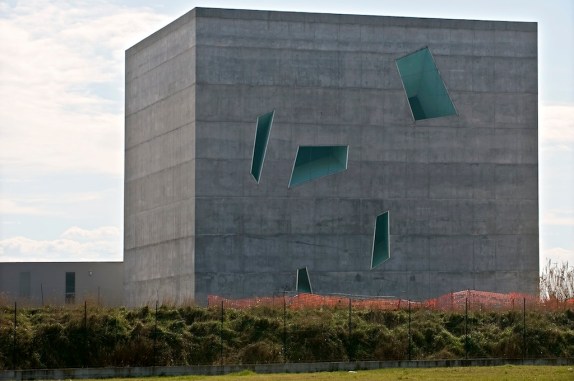
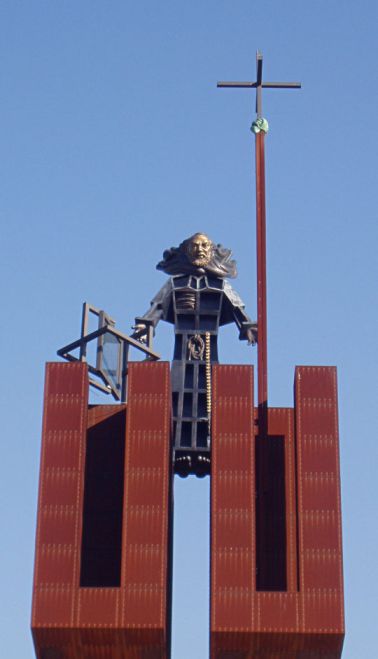
I’m always tired of people yapping about how wonderful Italy is because it’s full of beautiful old churches. Well, it’s just as full of terribly ugly modern churches. The kind which make you shiver, the ecclesiastical equivalent of the Yugo. I posted some photos of one of them here. There is even a blog devoted to them: bruttechiese. Here are some others.
My wife: “What are we going to tell Melissa about Santa?” Me: “Oh, I don’t know. How about nothing?”
This question is the latest in a string of “What are we going to tell…?” questions we’ve been patiently addressing for years, since before we even decided we wanted children. It’s a natural consequence of holding non-traditional views on a number of life-and-death issues.
I imagine many parents don’t worry about such things and just tell their kids what they were told by their parents. Propagating the Santa myth is effortless; it seeps in culturally (unless you live in a place like Iran). Fighting it, however, takes grit.
Why fight such a harmless tall-tale, anyway? What’s wrong with the jolly old mensch from the North Pole, who — in an improbable 24-hour arc — manages to deliver presents to all the good boys and girls the world over? Let’s look first at that tiny adjective, “good.”
He sees you when you’re sleeping
He knows when you’re awake
He knows if you’ve been bad or good
So be good for goodness sake!
Here we have an iconic portrait of Santa Claus as Big Brother: he’s always watching, waiting for you to slip up so he can vengefully mete out due punishment. Compare with Psalm 139:
It is you who know when I sit and rise,
you fathom my thoughts from afar.
I submit there is essentially no difference in these two verses, one a pious hymn penned over two millennia ago by an unknown hand, and the other a hit song written by Haven Gillespie in 1934. And they’re both downright creepy if you ask me (the Psalm ends with a declaration of “utter hatred” for the Lord’s enemies). Why would any sane parent want their children to live in fear of an omniscient being? We’ve decided not to teach our daughter to believe in such a god, so why substitute that with Santa’s Secular Thought Police?
Moving on, there’s the issue of lying to children. Is it moral? Bertrand Russell once wrote, “There is no excuse for deceiving children. When … they find their parents have lied, they lose confidence in them and feel justified in lying to them.” And lying it is. Every parent knows perfectly well that the Santa story is just that, a story, and all of them know it’s a matter of time before the kids figure it out for themselves.
That said, secular parenting author Dale McGowan writes, “Santa Claus … is the greatest gift a rational worldview ever had.” McGowan sees Santa as a dry run for God. He argues in a spirited essay that if children are encouraged to apply logical thinking to the Santa story, maybe they can learn to apply it across the board. And once they realize it’s hooey, the balloons will begin bursting one by one in a triumph of skeptical inquiry.
I don’t recall the moment when I realized there was no Santa Claus. Maybe my parents never played it up much at home. For me Santa was that obese fellow in a red suit at Hunt Valley Mall surrounded by fake snow and bad lighting. The smell of glazed ham and cheese wheels from the nearby Hickory Farms store must’ve hinted at something artificial. Kids aren’t stupid — they know baloney when they smell it.
Then again, I understand the practical use of Santa — much like God — in frightening children into obedience. If you can get youngsters to believe that there is someone watching them while they sleep, reading their thoughts, taking extensive notes and evaluating their performance, then you have a pretty good chance of keeping them in line — for a while.
I also realize that children need to fantasize and develop a vibrant imagination. We are a story-telling species, after all. But I think there is a difference between giving them free reign to blur the line between fantasy and reality and actively promoting deception. I think Santa belongs to the latter category; and, say, Pinocchio to the former. (No parent ever tells their children that the boy with the long nose is going to come in the window once a year and bring them gifts, do they?)
My wife’s question remains, though: What are we going to tell Melissa? As a parent who’s also an incurable rationalist, both Russell and McGowan persuade me. But all those discussions over what to teach our daughter about the world (“We have to tell her something!”) are giving way to a broader principle: teaching her to think for herself. Do that, I argue, and the rest will take care of itself. Do that and we won’t have to lie to her. Do that and she’ll be better prepared for a future of hustlers and hucksters.
Parents can make use of the Santa myth either way. We can use it to pave the way for a life of credulity, or we can use it to turn our children into thoughtful, independent people capable of sniffing out a proverbial slice of baloney.
If we can’t ignore Santa, then we might as well own him.
Liberi di non credere
By Raffaele Carcano
Editori Internazionali Riuniti, 2011. 379 pages (in Italian)
The PD should be advocating a more secular agenda.
Raffaele Carcano, who heads the UAAR, Italy’s association of atheists, has written a vademecum on the current state of secularity in Italy. Here the reader will find no philosophical arguments for atheism, no attacks on religious belief or even a catalogue of indecent behavior by the Catholic Church and its hierarchy. Instead, Carcano guides the reader through the routine abuses of the rights of non-believing citizens: from the suppressed atheist bus campaign in Genoa to the Lautsi vs. Italy ruling that crucifixes in public classrooms are not in violation of freedom of conscience, the hand of the Vatican is never far from the puppet theater of Italian politics.
Secularism is on the rise, however. Non-affiliated Italians, according to a recent study cited, represent nearly 20 percent of the population and the number is growing. Compare that figure with the only two percent belonging to minority (non-Catholic) religions and you realize they represent a fair slice of the citizenry. Yet they have almost no voice or visibility. Moreover, their rights are trampled by such institutional perversions as the “8 per thousand” religious tax (income tax routed to the Church), Catholic religious teaching in public schools, and the ostentatious display of (exclusively) Catholic symbols in public spaces. Add to this the tendency of Italian media to pander to the Catholic Church and report every grunt and groan of its leaders uncritically.
Then comes the political class, to which the author devotes two full chapters, serving up an analysis of the near-total abandonment of secular causes to which few politicians — right or left — give more than lip service. In fact, the Democratic Party takes the brunt of the criticism for being practically the only center-left party in Europe that doesn’t lift a finger to advance a secular agenda. The only parliamentarian noted for her devotion to secular causes is Emma Bonino, who was shot from both sides during her 2010 campaign for the governorship of Lazio.
The Italian situation is contextualized throughout the book with reference to the European Union and the United States, even going back to ancient times (the first recorded book burning, according to Carcano, was of the “impious” Greek author Protagoras). The tone is sober, but not without the appropriate irony. The reader comes away with the impression that Italy is less a modern secular nation than a kind of milquetoast theocracy. Non-believers may no longer be tortured or burned for their impiety, true, but they are consciously marginalized and proselytized to by a cynical political class and their hubristic clerical bedfellows. Which, one might add, is nothing to be proud of in the 21st century.
The Turin Shroud just won’t go away. The Telegraph has two articles (at least presenting different sides of the issue, which you would never read in an Italian newspaper) about a group of Italian scientists who claim the shroud is “authentic”. Funny word, that. Authentic what? Authentic fake, or authentic burial shroud of a man who lived around the beginning of the Common Era?
Whenever I read of scientists confirming miracle stories, I begin thinking either they aren’t very serious about science or they’ve been duped by personal faith. One thing you almost never hear about Jesus iconography is that no one has anything other than a speculative idea of what he may have looked like. There are no contemporary headshots of him. So, even if this were indeed Jesus’ actual burial shroud, how could we ever know such a thing? What evidence could possibly corroborate such a hunch? None. None at all.
Yet the Turin Shroud won’t die. Thankfully, it inspired a tweet I am proud to have tapped:
Here is a suggestive photo I took this morning of the sunrise. I suppose it might look like a nuclear explosion or an alien attack (or the second coming), but it’s just the effect of light and cloud filtered through a not-so-powerful Samsung camera.
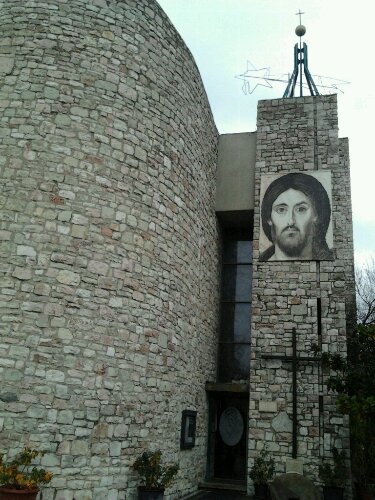
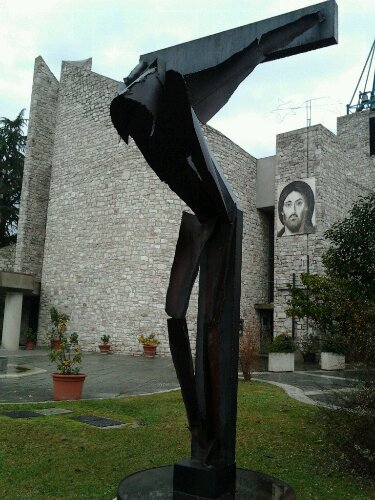
Here’s a positively Orwellian church in Umbria. I’d be totally creeped out if I were a kid growing up here and every day had to pass this staring visage. I suppose that’s the point: good old time thought police. Check out the scrap metal crucifix on the lawn outside.
I wanted to share this wonderful (and disheartening) cartoon. Anyone who has ever been to Italy has noticed that Catholic churches are far grander than any other structures. It’s no mystery that immense amounts of public money are funneled directly to the Vatican through various fiscal mechanisms such as the 8 per mille tax when they aren’t forked over directly for maintenance and the construction of new churches. Churches which are getting emptier every year, one might add. In these hard economic times, the grand old churches which make Italy such a quaint country-sized museum are beginning to look rather suspect.
"Italian towns"
Here’s Mark Twain on the Milan Cathedral (from The Innocents Abroad):
Howsoever you look at the great cathedral, it is noble, it is beautiful! Wherever you stand in Milan or within seven miles of Milan, it is visible and when it is visible, no other object can chain your whole attention. Leave your eyes unfettered by your will but a single instant and they will surely turn to seek it. It is the first thing you look for when you rise in the morning, and the last your lingering gaze rests upon at night. Surely it must be the princeliest creation that ever brain of man conceived.
The building is five hundred feet long by one hundred and eighty wide, and the principal steeple is in the neighborhood of four hundred feet high. It has 7,148 marble statues, and will have upwards of three thousand more when it is finished. In addition it has one thousand five hundred bas-reliefs. It has one hundred and thirty-six spires—twenty-one more are to be added. Each spire is surmounted by a statue six and a half feet high. Every thing about the church is marble, and all from the same quarry; it was bequeathed to the Archbishopric for this purpose centuries ago. So nothing but the mere workmanship costs; still that is expensive—the bill foots up six hundred and eighty-four millions of francs thus far (considerably over a hundred millions of dollars,) and it is estimated that it will take a hundred and twenty years yet to finish the cathedral. It looks complete, but is far from being so. We saw a new statue put in its niche yesterday, alongside of one which had been standing these four hundred years, they said. There are four staircases leading up to the main steeple, each of which cost a hundred thousand dollars, with the four hundred and eight statues which adorn them. Marco Compioni was the architect who designed the wonderful structure more than five hundred years ago, and it took him forty-six years to work out the plan and get it ready to hand over to the builders. He is dead now. The building was begun a little less than five hundred years ago, and the third generation hence will not see it completed.
Now doesn’t that sound like a colossal waste of resources to you?



 Whenever I read of scientists confirming miracle stories, I begin thinking either they aren’t very serious about science or they’ve been duped by personal faith. One thing you almost never hear about Jesus iconography is that no one has anything other than a speculative idea of what he may have looked like. There are no contemporary headshots of him. So, even if this were indeed Jesus’ actual burial shroud, how could we ever know such a thing? What evidence could possibly corroborate such a hunch? None. None at all.



 Marc Di Martino