Samuel Menashe, 1925-2011

Poet Samuel Menashe died on August 22, 2011. He was a friend of mine in my New York days, and I’ll always remember him fondly. He was a very old school kind of person. He lived alone in a walk-up apartment on Thompson St., in Greenwich Village. He’d wander into New York bookshops and start reciting his poetry to complete strangers, which was how he sold his books. He had a gentle voice, a wild shock of white hair and a congenial presence. He’d sit for hours talking about the war, William Blake and the Hebrew Bible. His poems were “concise” (his term), mostly condensed into few lines of concentrated musicality. Below is a poem I wrote about him. I was told my a mutual aquaintance that he read it and enjoyed it. Goodbye, Samuel.

Samuel Menashe Reads at the Harvard Club

You’re reading your poems at the Harvard Club
in New York City. The hall, rimmed with oak,
sputters a dying light suffused with thick
brown shadows, like intellectual antelope
gazing at their reflections on the wall.
You can’t believe you’re here.
Poems leapfrog
from your throat (already you’re older
than most of the old men in attendance here)
poems so short that if you miss a word
you miss the point. I listen, neither
graduate of Harvard nor university-bred,
but a young man seeking encouragement
from an elder such as you. Invited here,

I hold your book open and read along
but the light is bad. My clothes are shot. No tie
is knotted in the hollow of my neck.
My shoes, the worn-out patent leather ones
from the J. Crew catalog, are more like husks
that hug my feet.
In private, you told me
to give up poetry and dedicate
myself to writing narrative instead.
“No one reads poetry,” you said.

Certainly you spoke from experience.
They used to snicker when you’d ramble in
off 47th St. to the Gotham Book Mart.
“Here comes the poet Samu-el,” they’d joke.
“C’mon,” I’d say, “He’s really not so bad.”
You’d stop and talk about the war, recite
Blake and the Hebrew Bible (KJV)
and then your own compacted prosody
which stopped the tourists in their tracks. “A pot
poured out fulfils its spout,” your voice
intoned. Then you’d explain, to the stupefied
clientele, what the poem really meant
based on its lingustic roots (“the pot
fills up the spout, fulfilling it etc.”)
You’d sign their books before they’d even bought:
“To Jo, from Canada. Best, Samuel.”

That said, your poems are now canonized
in the Library of America.
You snagged the “Neglected Masters Award”
the kind of name you always called yourself
alluding to the New Yorker and “Talk of the Town”
the only place they’d publish you back then.
You felt yourself a curiosity
in your hometown, an underdog, the last
of your generation, a congregant
of Homer’s, the Greek café long since shut down.

What more could anybody do for you?
Your wish-list is complete, you have become
a famous poet with a style, to boot.
Menashesque. I can almost hear it said
in college classrooms, by professors younger
than I am, too obliviously young
to have attended the Nutcracker with you
at Lincoln Center.
Wedged between Masters
and Michelangelo, your volume rests
on my bookshelf. I flip through it, recalling
your evening reading at the Harvard Club
ten years ago. Like Emerson, you blurred
the distance between poetry and faith,
the kind one has in literature, not God.

That evening you gave your best performance.

© Marc Alan Di Martino 2011

_____

 Published in Italian Americana, Winter 2011

Apikoros and proud of it!

Here’s my favorite Jewish atheist joke, c/o Leo Rosten:

A brilliant young student goes to an old, learned rabbi and defiantly exclaims, “I must tell you the truth! I have become an apikoros. I no longer believe in God.”

“And how long,” asks the elder, “have you been studying Talmud?”

“Five years,” says the student.

“Only five years,” sighed the rabbi, “and you have the nerve to call yourself an apikoros?!…”

• Apikoros is a rabbinical term for unbeliever, skeptic, agnostic, atheist.

That Ricky Gervais cover

I’m not so sure I’d go with calling this “blasphemous”, because the concept of blasphemy has become entirely meaningless to me. It certainly is excellent, though. Bravo, Ricky! Via Friendly Atheist.

Bye bye birdie

Tim Farley has the scoop on the Mabus arrest. He was a notorious spammer who even spammed me on Twitter (I guess that means I’m a true skeptic now).

He would spend hours at it. For example, on February 25th I found 25 separate accounts he used. Based on the timestamps of the posts, he started around 7:30am, and posted more or less continuously until about 10am. He continued somewhat more slowly until noon, when I presume he took a break for lunch. He resumed at 3pm, and posted until 9pm that night. I counted almost 700 tweets. And because of the way Twitter was deleting each account (and all its output) when they noticed the spamming, all of that output from that day was gone within minutes. Disappeared.

It’s really a great story. Read the whole thing.

Bringing up baby

When my mother in law decides it’s time to let us know her opinion, I try to restrain myself. Her latest op-ed began with the time-honored incipit, “Feel free to ignore me, but…” She then swiftly descended into a tirade about how we’re damaging our daughter by speaking to her in two languages.
I replied, “So you think it’s better if we wait 10 years, then pay for expensive private lessons with an English tutor? What planet are you living on?” I might have expected some opprobrium of the traditionalist variety (“What do you mean you’re raising her without any religion?”), but I hadn’t anticipated this kind of nitpicking. Since when is a learning second language considered hazardous to cognitive development?

I didn’t grow up bilingual. My parents spoke three languages between them, but I was raised speaking — and understanding — only American English. There was a half-hearted attempt to offer some Italian, but it mostly boiled down to the kind of language one uses in conjunction with a stubbed toe. I got pretty good at the bad words, at the expense of all the rest.

In my twenties I began to bemoan my status as a monolingual American. I’d taken four years of Spanish in high school, but had just gotten by with a C average. I wondered what had happened to that other language I’d almost learned, and which was closer to home — Italian. I might still learn it, I thought.

So I found an Italian language school a few blocks from my Manhattan apartment, dropped the cash and began studying. Immediately I decided to memorize the first canto of the Divina Commedia — in Italian. Without really knowing what I was saying, I recited the first 20 or so lines before my class one evening. “Nel mezzo del cammin di nostra vita…” The teacher — a bold Florentine beauty — listened, stunned. (Now that I understand the words, however, I can no longer recall the verses.)

After a year or so I stopped going to classes. I desperately needed to save money. My then-girlfriend and I were breaking up after a quarrelsome four-year relationship, and I was set on living alone (for the first and last time in my life). Not long after, I left for Italy; my Italian has improved dramatically ever since.

I’ve now taken four years of Hebrew, and studied Yiddish independently. I speak neither language well, but I do have a general grasp of both, which is more than I’d have thought possible a decade ago.

When my wife and I decided we were ready to have a child, we had varying opinions on all aspects of child-rearing — all, that is, except the desire to raise our daughter as bilingual. And that’s a point on which we won’t cede ground to anyone: not family, friends or the public opinion that governs so much parental decision-making in Italy.

It’s taken some discipline, but I’ve gotten in the habit of speaking to our daughter Melissa primarily in English. When we’re alone, that’s all she hears from me. And, after three weeks in the United States, she’s begun approximating the English names for preferred objects: duck is “duh”; water is “wawa”; cantaloupe is “catabu.” She’s now added “nonno” and “nonna” to her repertoire, in perfectly pronounced Italian. That’s bilingualism in action.

I remain perplexed by my mother-in-law’s cavalier attitude. When I asked her to explain her resistance, she went on about confusing messages. “It’s like one of you is saying ‘yes’ and the other ‘no.'” When I asked her about the sources of this insight they turned out to be predictably nonexistent.

Maybe she should meet some of the people we know who were raised bilingually, and who are raising bilingual kids. When I sent out my feelers on Facebook, I got a bunch of very enthusiastic responses — not one of which expressed the least bit of concern that we were “confusing” Melissa.

One friend even told me about her son, who was born deaf. Her Italian doctors — who had cured her son’s deafness through an implant — instructed my friend to speak only Italian to her son, saying two languages would only confuse him. She’s convinced the advice was a needless setback. Now her son is learning English, slowly but surely, with the help of his younger brother.

On a different note, another friend observed that her daughter not only started speaking later than other kids her age, but understands less. She attributes this to her bilingualism. I’ve heard from others along similar lines.

A quick Google search yielded a treasury of articles with a recurring theme: “People used to think bilingual children were slow/confused/challenged, but new research shows…” Basically, it seems to show that some children are slower than others in certain things, but likely not for reasons related to their bi- or multilingualism.

That sounds like good news to me.

From The American

Science vs. religion

I just wanted to get this down before I forgot it:

• Science is like walking into a pitch-dark room with a small, powerful flashlight. You may not see much at first, but it may stop you from stumbling. Slowly, painstakingly you’ll begin to form a pretty good idea of where you are.

• Religion is like walking into that same room with a glow-in-the-dark Lightsaber. Sure, it feels cool, but you keep swinging away at invisible phantoms. And the light cast is too weak to actually see by. May the force be with you!

All are not equal before the law

The Italian Chamber of Deputies decided it didn’t want to dignify homosexuality by approving a law that would make hate crimes against gays punishable. On. Fabrizio Cicchitto of the PDL explains:

We’re not homophobic. Our position is basically this: we consider gays citizens equal to everyone else. For precisely this reason we contest every legal attempt at differential treatment which would thereby admit and accentuate diversity, which is in substance unconstitutional.

Which isn’t true at all. They don’t consider gay citizens “equal to everyone else.” It’s for this reason that gay marriage is still illegal here (among other forms of discrimination). They’re taking cues from the Vatican, of course, which has perfected the art of discriminating while playing the victim. They cry out about the tyranny of minorities, about how if you give them an inch they take a mile, that the majority (read, “Catholic heterosexual majority”) are somehow in danger of a rabble that wants wants wants…equality.

It’s always the same story: Italian politicians will not risk going against “Catholic values” for fear the Vatican will…what, exactly? What are they afraid of? That they’ll ask a nuncio to come home from his plush quarters down the street? That they’ll get “serious” – always a sign that someone has managed to piss off the Privileged Few? That the Catholic masses will be mobilized to take action against them? And when has that ever happened?

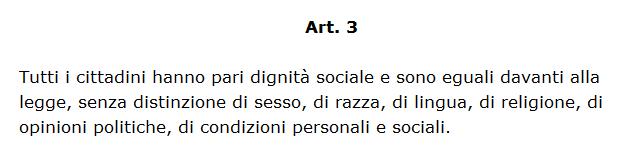
The Italian Constitution has this to say:

(“All citizens have equal rights and are equal before the law, without distinction by sex, race, language, religion, political opinion, or personal or social condition.”)

All of which sounds great, but isn’t true, either. (Notice, for instance, it doesn’t mention “sexual orientation.” Maybe that’s grouped under “personal/social condition.”) That’s why in every courtroom in Italy there is a huge wooden crucifix above the words, “The law is equal for everyone.”

But we know this is a lie, too. Just ask Judge Luigi Tosti.

How do you say “facepalm” in Hebrew?

h/t R.S.H.T.

Yaakov Swisa, founder of FaceGlat – an ultra-orthodox Jewish version of Facebook – has this to say:

“People who are God-fearing and care about their children’s education – cannot tolerate the ads and pictures one sees on the regular Facebook. I personally know people who have deteriorated spiritually because of all kinds of things they were introduced to there.”

You mean people who believe in a neurotic, psychopathic deity can’t deal with ads for, say, vacation houses in Croatia? (I just took a quick look to see what Facebook was offering me.) What’s wrong with them?

As for their children’s education, does Swisa really think Facebook offers tutorials on the theory of evolution, the age of Earth or any of those frighteningly atheistic things normal people learn about in school? No worries!

If people can’t have fun on FaceGlat and meet some interesting folks – or even converse with their own spouses – then what the hell are they doing there? Aren’t there enough morality police in Mea Shearim already?

Postcard from Ectoville

Spooked out

In June we made our first trip to the United States with our baby daughter. After a trying week at the beach, we settled into a rented cottage immersed in the lush green of Hanover County, Virginia. Cows grazed next door. A family of chickens wandered over the grass to visit us each morning. In the evening, an industrious spider materialized on the porch, spinning its web anew, only to vanish by dawn.

By the standards of small town Virginia, we immediately became local celebrities. (My sister compared us to Jennifer Aniston, who is reportedly dating a man whose mother lives nearby.) A buzz built up around us: “The Italians are here!” We brought them real Parmigiano cheese (compare with “parmesan”), olive oil from Umbria (compare with “Goya”) and taralli laced with fennel (incomparable). We didn’t want to disappoint anyone.

The pinnacle was Ashland’s July 4th parade. My brother-in-law was named honorary parade marshal, giving him and his family had the right to ride in a horse-drawn carriage with the mayor — an exciting prospect for my 10-year-old niece.

The whole town — except the misanthropes, if there are any — gathers yearly along Main St. to watch inventively named “brigades” march from one end of the township to the other. We saw the Lawn Chair Brigade composed of people doing a kind of Full Monty routine with, well, lawn chairs. There was also a Latin brigade, whose members mouthed the Roman greeting “Salve” and sported white togas. A man pedaled an old-time penny-farthing and an eccentric doctor marched on stilts. Then there was the patriotic dog contest…

The next day, my sister gave me a copy of the Richmond Times-Dispatch. “Look,” she said, “you’re in the paper!” And there I was, looking on as the antique Big Wheel rolled along, part of the annual crowd. It’ll make a nice clipping for the family archive.

But it was a meeting at the barbecue the night before that most struck me. Over a plate of South Carolina peach cobbler, in an enormous, white antebellum home, I met a woman who introduced herself to me as a “ghost-buster.” I soon learned that she had cleansed the place where we were now standing of ectoplasm. It was a perfect setting for the conversation that followed.

I kindly probed as to just what is was that she did. Given the choice between a rational, materialistic explanation and a paranormal one, she told me, one should always choose the latter. “Why close oneself to the possibilities?” she said.

As I patiently listened to tales of angels and spirits I began wondering if there was anything she didn’t believe in. I proposed unicorns. Maybe they were making the strange puttering noises that came from the attic. She dismissed the thought. Given her credulity, I wondered how she could shut out unicorns.

It was a weird conversation, hung with dusty spider webs, creaky staircases and relics of haunted house lore. She even spoke of a mysterious “third” dimension (spooky!). But when she knocked on a wooden bookcase we’d both been leaning on and announced, “This isn’t real,” I decided that further inquiry was pointless. Where do you go from there?

To save any embarrassment, I came clean. I told her I was skeptical, that I didn’t believe in angels, demons or the paranormal in general. I told her there was not a shred of evidence for any of the things she’d described. As she’d been frank with me, I’d return the favor. We parted amiably, returning to our respective beer coolers.

I love visiting Ashland. It’s like some long lost town in an America that probably never existed except on celluloid and the covers of the Saturday Evening Post. An overwhelming feeling of innocence, of childhood, creeps up on me.

Now that I have a daughter I’m coming to better appreciate innocence. Think about it: here is a human being with almost no sense of danger. She trusts people. She’ll put anything into her mouth. We, her parents, must keep watch over her lest she tumble down a flight of stairs or swallow a tack. I’ll be happy when Melissa is a jaded cynic, though; innocence is dangerous. It isn’t meant to last.

This observation illustrates the way I look at Ashland. Every time I visit, I wonder if it will still be the same. When will it morph into just another Richmond suburb? When will it shed that special cocoon of simplicity that so fascinates me, and which Ashlanders work to protect?

The moment we move into town, no doubt.

Published in The American

Spousal advice

My wife ripped this off and handed it to me. “You’ll appreciate it,” she said. I think she meant I might learn something from it.