Europe, less secular than you think

It sometimes surprises Americans to learn that “secular” Europe isn’t as secular as it might seem. It has less to do with Italians attending church on Sunday (which they do in ever-fewer numbers) than just how pervasively the state ensures Europe’s religious infrastructure. Europe has no American-style church-state separation. Even two of the world’s most secular nations — Denmark and Sweden — have state-funded churches.

Italy gave up Roman Catholicism as its official state religion in 1984. In its place came the obligatory “8 per mille” (eight one-thousandths) religious tax, which permits the state to apply .8 percent of all taxable earnings to charitable religious works.

But the “8 per mille” concept so bewilders taxpayers that most don’t even bother choosing who gets their “donations.” In a recent poll conducted byOcchiopermille, a website created by the Italian Union of Rationalist Atheists and Agnostics (UAAR), 60.4 percent of a sample of 2,000 people said they simply ignored the question of where the money should go. Another 4.07 percent choose the state, while 34.56 percent indicated the Catholic Church. This in a country that’s often labeled “95 percent Catholic.”

At first glance the “8 per mille” sounds reasonable, even fair. Eight one-thousands of what you earn is a pretty small amount of money, right? And you get to choose your confession (if you have one), right?

Well, yes and no.

The form is friendly if you’re Jewish, Waldensian, Adventist, Catholic, Lutheran or a member of the Assemblies of God. But what if you’re Muslim, Hindu, Buddhist, Methodist, Wiccan or one of thousands of other religious confessions? None of these religions are represented on tax forms. They can’t receive your money (at least not your tax money.)

What if you happen to be an atheist, agnostic, or simply don’t want to participate in tax structure dedicated to supporting religion? You can give your money to the state. But based on UAAR polling figures only about four percent of Italians actually choose that option (just as well, since the state turns funnels a part these earnings to none other than the Catholic Church). The 60 percent who stand pat probably do so because they have no idea what they’re expected to do or why it matters. The Italian state is notoriously corrupt, which doesn’t make contributing to it particularly appealing.

So what happens if you don’t choose? The state distributes the income in proportion to the percentage of people who actively choose a specific confession. That works out to roughly 87 percent for the Catholic Church, 10 percent for the state, and about three percent split by the other five confessions allowed to partake. In essence, the Catholic Church ends up with the lion’s share of the money, about €1 billion a year — even when most people don’t explicitly want them to have it.

It’s an elegant system, at least in the way viruses may be said to be “elegant.”

But how does the Catholic Church spend the money? On the poor and needy, surely? As Raffaele Carcano writes, in the magazine L’Ateo:

“The billion euro that the Church obtains thanks to the 8 per mille is destined for things like the salaries of priests, the building of new churches, etc. for which the state already provides financial help. Nonetheless, the annual report of the CEI (Italian Episcopal Conference) is succinct, opaque and doesn’t mention the enormous amount spent on the relentless ad campaigns… misleading ads, focused as they are exclusively on charity and relief in developing countries, on which only a fifth of the received funds is spent.”

Carcano concludes:

“The picture is so negative that the UAAR has no choice but to intensify its information campaign… the 8 per mille is an authentic calamity for non-believers…who have to pay to explain a mechanism that discriminates against them in every way.”

For the skeptical UAAR, the discrimination consists in citizens being forced to finance a religion that is not theirs, which they do not want, and which discriminates against them at every opportunity.

As bleak as this reality may be, the website Concordat Watch suggests that the situation in Germany isn’t much better:

“In Germany church and state are interwoven such that the sacrament of baptism automatically places you in a tax category. That ceremony can oblige you later on to pay taxes to the church and force your employer to withhold church tax prepayments from your income. In 2010 this brought the German churches €4.794 billion. The only way to end this is to formally leave the church.”

In Switzerland “church tax is levied by each canton for the religious groups it recognizes. And it’s not just people who have to pay. In 18 of the 26 cantons firms must also subsidize the churches, even though they’ve never been baptized and they can’t leave the church. This is now being challenged by a computer specialist who belongs to no church himself, but must still pay church tax for his one-man company. In September 2010 the Swiss Supreme Court ruled that [the law] was constitutional and now he is taking his complaint before the European Court of Human Rights.”

Given the European court’s March ruling that the presence of crucifixes in Italian schools was perfectly consonant with secular principles and didn’t violate the European Convention on Human Rights, I wouldn’t get my hopes up that legal challenges are going to get very far any time soon.

Published in The American
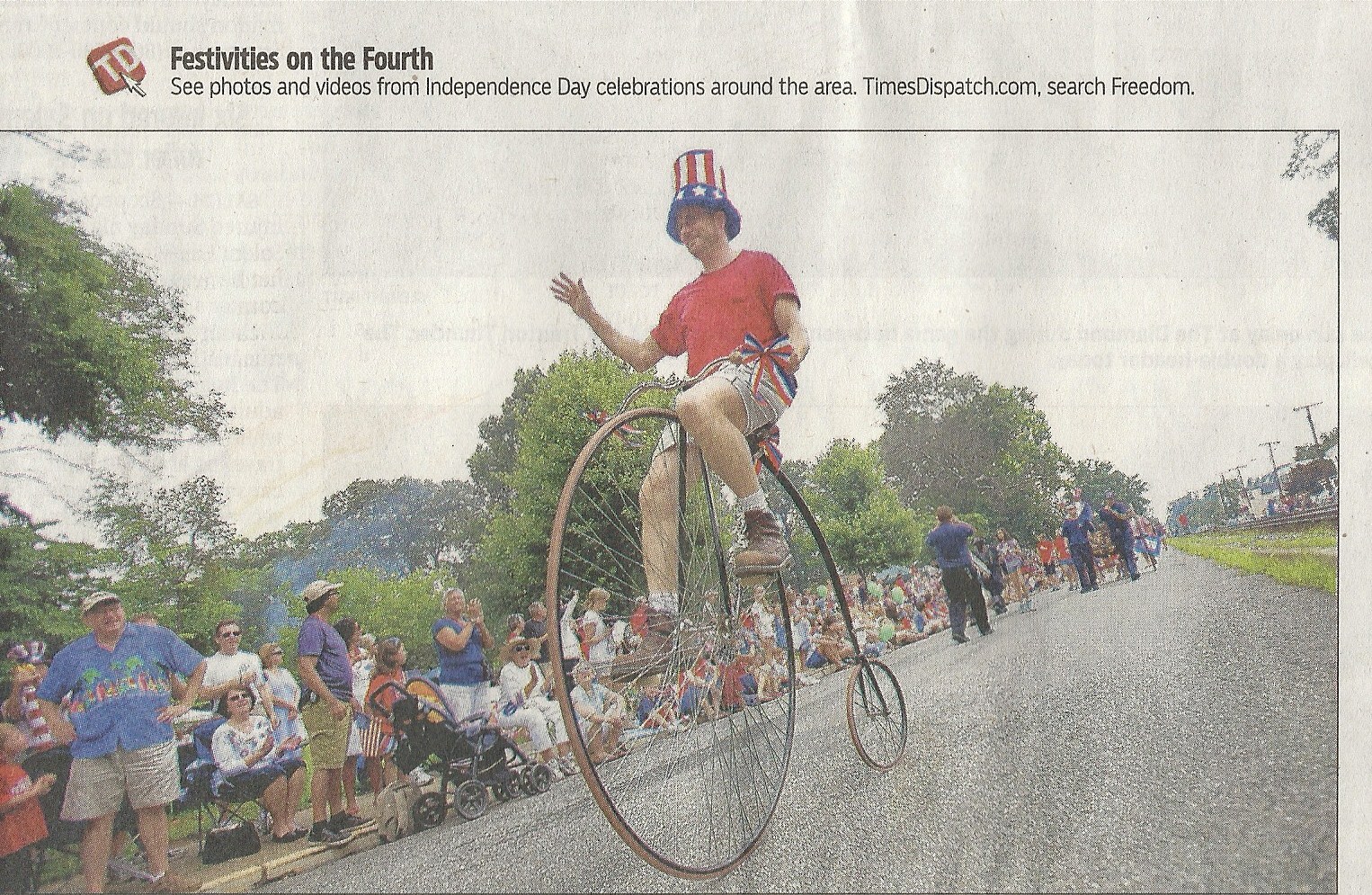
Self-portrait of a homophobic politician

Carlo Giovanardi of Italy’s PDL (that’s Berlusconi’s party) had a few things to say about Lady Gaga’s upcoming appearance at the EuroPride parade in Rome:

“…all the surveys prove scientifically that the majority of Italians are against gay marriage.” 

“It’s wrong to allow the Coliseum, symbol of the death of thousands of Christian martyrs, to be dressed in so-called rainbow colors. The Coliseum is where the pope celebrates the Via Crucis, the place of Christ’s martyrdom.”

“Isn’t it possible to find another monument to light up for the gay cause without offending anyone’s sensibilities?”

“I’ll attend the Gay Pride parade when it’s a civil demonstration and no longer an exuse to jeer at the Holy Father, make fun of the religious and those who dedicate their lives to others, and prance around in fancy costumes – things which have all happened so far. Don’t get me wrong, everyone is free to do what they want, but I won’t go as long as they overdo it.”

I guess that about sums it up, doesn’t it? Everyone is free to do what they want, as long as it doesn’t offend the religious sensibilities of a bigoted clique of fundamentalist Catholic politicians and their overseers in the Vatican. They, of course, may offend whomever they wish and even prevent other people’s happiness by law in the name of their creed.

There’s no better way to drive intelligent people from the faith, guys – keep it up! Your churches are empty, and our numbers are swelling.

Do you not use your brains?

The videos of the World Atheist Convention in Dublin are being uploaded on YouTube. Here’s a gem: P.Z. Myers and Aron Ra debate two Muslim creationists on embryology. Basically, these guys believe:

◊ The Qur’an states things nobody could’ve possibly known in Muhammad’s day – because pre-Muslim Arabs were just too stupid.

◊ There were only seventeen literate people in Muhammad’s hometown (and he clearly wasn’t one of them.) And no scholars.

◊ Pre-Muslim Arabs were desert cave people who knew nothing of the world, conjectured nothing and thought nothing. This view is consonant with the popular Christian propaganda that “pagans” were essentially amoral beasts, and the Jewish view with regard to Canaanites etc…otherwise what they call prophecy would carry no weight, if one could just as easily have plagiarized Aristotle as channel the Word of God.

“Do you not use your brains?” is a key quote from the Qur’an they which keep throwing at P.Z., which is hilarious. It’s an excellent example of how religious faith can distort your perception and turn otherwise intelligent people into blathering zombies. And it’s completely lost on them that they are making the exact same claims as Christian creationists, but coming to a wholly different conclusion.

Google considers me an authority on crackpots

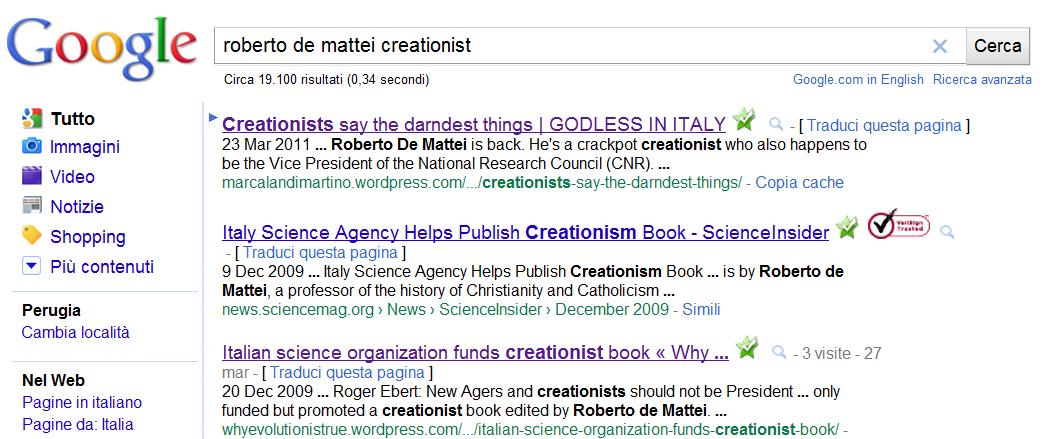
When I google “Roberto De Mattei” and “creationist” this is what I see:

I’m not an authority on many things, but this is kind of cool.

An insult to language

I haven’t read Susan Jacoby’s “Spirited Atheist” column in a month or two, but today I found an absolutely wonderful article on A.C. Grayling’s The Good Book: A Humanist/Secular Bible. Suffice to say the first time I read any of Grayling’s souped-up anthology I thought it sounded awful, like one of the umpteen translations of Genesis that try too hard at saying the same well-worn phrases in novel ways. But how many ways can you find to write, “In the beginning…?” They all just end up sounding vaguely “biblical” no matter how you rearrange the words (which is likely the point.) Here’s Jacoby:

Let me quote from the first chapter of the first “book” (again, modeled after the format of a standard bible), called—what else?—Genesis.“In the garden stands a tree. In springtime it bears flowers; in the autumn, fruit. The fruit is knowledge, teaching the good gardener how to understand the world…When Newton sat in his garden, and saw what no one had ever seen before: that an apple draws the earth to itself, and the earth the apple….”

You can’t satirize this stuff. Forget the vapidity of the language. It’s not even factually accurate, which, at a minimum, a secular bible ought to be. Another chapter (9:18) has arteries carrying “nascent blood,” while “lengthening veins return the crimson flood.” Wrong again. Arteries carry bright red blood, because it is fully oxygenated, away from the heart, while the returning blood in veins is much darker because it is generally deoxygenated.

Apart from my initial sense of enthusiasm on hearing about Grayling’s Good Book, I’ve had some reservations about it (I generally enjoy Grayling’s work). I’m not sure how homogenizing 3000 years of wisdom into an authorless mish-mash of slightly “elevated” (read: biblical) language serves any purpose – especially if one’s purpose is to offer an alternative to the Bible. One thing I love about literature is knowing who wrote what, when. I think that really does matter in the end. And unless the intent is satire, I don’t think many atheists/secularists will be drawn to a book based chapter-and-verse on another book we’ve read – and often trashed – the Bible.

Jacoby sums up:

There has already been a good deal written, particularly in England, about whether Grayling’s bible insults religion. This is utterly beside the point, since the book is an insult to language, to authors who deserve credit for their words, to translators who deserve credit for translating those words, and, above all, to the intelligence of secular readers. We don’t have one Good Book. We have good books, thousands of years of them, and the real Euripides, Shakespeare, Spinoza and Darwin are all available to provide a genuine humanistic education.

Exactly. Who the hell needs a sterilized version of Shakespeare, anyway?

“I crave the stillness of rooms”

Every so often I mention that I write poetry. I used to write a lot of poetry, though lately it’s kind of tapered off due to our recent move, our ten month-old daughter and a hundred other things that eat away at the imaginative mental loitering time so conducive to writing poetry.

This is a poem I wrote a few years ago and posted at my wife’s blog at the time. Probably nobody ever read it but her. I’m posting it again because I like it; it has the scent of Cavafy, Pessoa and the “crepuscolari” poets so dear to me. Enjoy.

I crave the stillness of rooms
full of smoke, after the party,
when all the guests have gone.
That’s when the poem is born.

Late at night, sitting at a desk
in the city, or outside of one,
the poet remembers those rooms
full of smoke. He lives in them,

a world of his own making.
He conjures the odor of ash,
the yellowed lampshade, the stain
of lipstick on a shard of glass.

How Italy’s “8 per mille” religious tax works

I don’t have much time right now to write a lengthy post on the “8 per mille” (that’s “8 per thousand”) religious tax. It’s an obligatory tax, and the taxpayer must choose which religious confession gets the money. If the taxpayer is a Muslim, Buddhist or Hindu he or she is out of luck. Their religions aren’t able to participate. In that case the taxpayer might simply not choose, or choose “State”, in which case the money almost certainly goes directly to the Catholic Church. 

The UAAR has done an excellent job of informing the public on how this all works. Around 60% of Italians don’t choose, perhaps because they’re apathetic or have no idea what’s at stake. Only 37% or so actually choose the Catholic Church, yet the C.C. receives around 87% of the entire tax. Something’s clearly wrong with this picture.

If you understand Italian, this short video explains what’s going on (and how the C.C. spends the €1 billion or so they get as a freebie from the State each year.)

The “8 per mille” Wikipedia page exists in ItalianEnglish and Hebrew.

Low-hanging testicles

Jerry Coyne has a post commenting on a review of his book Why Evolution Is True at the BioLogos site. Jerry is always funny, and not at all deserving of his reputation in some circles as a misanthrope. If you read the WEIT blog regularly, you’ll know that he’s always picking on these folks for mixing up religion and science. Poor folks! Why can’t the biologists just let the BioLogos crowd be so they can go on reconciling God with His creation in peace and quiet?

Well, because He did a pretty bad job of it. And Jerry has a little list:

Organisms are full of flaws.  Considering only humans, we have descending testicles that can cause problems, very difficult childbirth in females, vestigial wisdom teeth (and appendixes) that can become impacted or infected, and our recurrent laryngeal nerve, which, instead of connecting the brain and larynx by the shortest route, loops way down around the heart and comes back up again.  These are not features an intelligent designer would have given us. But those features are completely understandable in light of evolution.  The nerve, for example, was constrained to form a long loop because a blood vessel moved backwards during our evolution from fishy ancestors, forcing the nerve (which once lay next to that vessel) to elongate around it to retain its connection with the larynx.

I’m always wondering how IDers and their ilk can reconcile a benevolent designer with…childbirth. Any man who’s ever seen a woman go through labor knows what I’m talking about. It’s torture. Not to mention the women who’ve actually gone through it. I’m surprised they aren’t all atheists. Maybe there’s a T-shirt in that thought.

Here’s my limerick about it:

If life on this earth was designed
with all of us neatly in mind
why isn’t it clear
just why we are here,
not to mention the crippled and blind?

If there’s an intelligent designer, I want my money back.

The greatest

When I sent a fake Bob Dylan tweet last night before going to bed, I didn’t realize he was turning seventy today. Seventy! I’m not going to go into a long spiel about how Dylan is the greatest songwriter since X or how he revolutionized contemporary music more often than Y, because there’s really no point. But who’s got the consistency of quality we find in Dylan’s work over such a span of time? Lou Reed has always been my rock-n-roll hero, but he’s been constantly checked by Dylan every step of the way. I love Lou for his chutzpah, much of which he likely lifted wholesale from Bob (and both via Warhol). Bob made Lou possible, not the other way around.

Anyway, here’s a brief post I wrote a few years ago under my then-nom-de-plume about the influence Blonde On Blonde had on my youthful self.

I arrived in New York City armed with a roll of twenties, my mother’s suitcase, and a portable tape player. I kissed mom goodbye, paid rent for a week (this was a hotel on the Bowery!) and went back upstairs to contemplate my life. I was barely twenty, freshly dropped out of artschool, and unemployed with few or no prospects. I remember throwing Blonde On Blonde into the tapedeck, lying back on my rented cot, and hearing the words that  illustrated my predicament with what seemed an eerie truthfulness. The organ swerving through trickling guitars. That mercury sound. The nasal voice. “Well, the bricks lay on Grand Street…where the neon madmen climb.” I was two blocks from Grand Street! In the middle of the muddle of Dylan’s masterwork–this was why I had come after all! The Chinese fishmongers were still there, the street was indeed paved with bricks, everything shimmering in the bronze light of an early March sunset in Manhattan. Twenty-nine years after the album was cut. The first day of the rest of my life.

In time I must have memorized every word of this album, the most enchanting and eclectic of Dylan’s long career. It functioned like a treasure map of the city, as I followed its clues from point to point, navigating through the people and the places with unassailable curiosity, searching out the Dylanesque in every bookshop and bar. Years passed, and the traumas of life in the city brought me regularly back to Dylan’s couch in order “to find out what price/ you had to pay to get out of/ going through all these things twice.”

(Note: I looked for a Dylan performance of “Stuck Inside of Mobile with the Memphis Blues Again” on YouTube, but all I could find were covers. So listen to Cat Power, ’cause she rocks, too.)

Belief (almost) made me a complete asshole*

I’ve been having a debate (what else to call it?) on Facebook lately with a couple of friends over whether religion can be held responsible for its homophobic teachings. I say it can and should, whereas my friends disagree. They suggest that prejudice most likely has a different explanation, and religions simply capitalize on pre-existing feelings of hatred and fear. That’s quite true. But religion has crystallized these emotions and normalized them for billions of people, weaving them into the fabric of belief. To be a Roman Catholic who does not think homosexuals are “disordered”, or “unnatural” is to have shed an important part of that belief system, and one that is hammered home at every opportunity by those in charge of Roman Catholic beliefs.

Once, when I was flirting with religious belief, I was on the road to such thinking as well. I remember quite vividly the way in which my perception of sexuality became more prudish. I was reading the Bible and trying hard to put my thinking in line with what I thought was a “Jewish” view of sexuality. While I never became homophobic, I did begin to think differently about two men having sex (but not two women). I began to adopt more “conservative” or “traditional” opinions. And this opinion was rather negative, as I recall it.

It didn’t stick, though. The more I studied and tried hard to ignore the cognitive dissonance of “believing” while going to the movies on Friday evening – which is strictly forbidden by Jewish law – the more I felt like the whole edifice was just that: an artificial construct. Then it fell, just like the cardboard cut-out it was.

The experience was useful, however, for it put me in the mind of a believer for a short time. Some might say this isn’t accurate, as I was never really any such thing. Either way, it felt a lot like what I’ve read over and over again about the tension people feel when they put their religious beliefs to the test and decide they can’t go on lying to themselves.

To get back to homophobia, though. In my admittedly anecdotal experience, I was aware of a change taking place. And that wasn’t because of radical preachers, fundamentalist company or any such thing; it was what I had begun to intuit about the Bible itself and its archaic worldview (I even began to wonder how one might make sacrifices in the 21st century). I only wished to get in line and act, well, religious.

Thankfully, this proved rather difficult. I have a bad habit of analyzing things to death, and for me whatever ad-hoc idea of God I’d begun to formulate in my head vanished under scrutiny. By the time I’d finished reading The End of Faith, I had accepted that the religious life – and accompanying worldview – wasn’t for me.

In fact, more than anything it was the way an even diluted religious belief messed with my mind that turned me off. It was a bit like drugs (I’ve had bad experiences on both). It was the realization that I wasn’t in full control, that I felt puppeted, manipulated by the things I was reading. I even began to entertain creationism, which is a perfect example of the way religion can damage one’s thinking; I can think of no other reason on Earth anyone would question the evidence for evolution if not for a religious (read: Abrahamic) worldview.

As an atheist I’m always discussing religion with people who will discuss it with me. Having briefly tasted belief, I’m curious to know what others experience and how it affects them. Some even quip that I’m more “religious” than the religious because I take belief seriously. Well, I’ve seen what it can do, and it’s heady stuff. Trust me.

* Some people think I’m an asshole now, of course; but they don’t know what was happening inside my head then.