God does not exist!

Every time I go to the supermarket there is a guy selling socks in the parking lot. It’s not always the same guy, but he always says the same thing: “Hello, my friend…” and then elicits handouts with a combination of smiles, hand gestures and appeals to the goodness of god.

Sometimes I give him spare change. Once I gave him a banana, for which he seemed grateful. I’m sorry for his predicament (he’s likely a refugee from a war-torn place), but I try not to let myself become an easy target for people begging for money, either. Maybe this is a holdover from my New York days.

Today we had a brief conversation. It went like this: “Hello, my friend!”

“Hey.”

“Ah, god is good, is he not?”

“No, he’s not. You should thank people who have helped you out, not god.”

“But doesn’t god help you, my friend?”

“He’s never done anything for me.”

“Why don’t you believe in god?” he asked.

“Because he doesn’t exist!” I said gleefully. I made sure to smile, too, so he could be sure that he was speaking to a happy atheist. (Maybe secretly I was hoping he’d take a swipe at me. To his credit, he didn’t.) Then we got in the car and drove off.

Later, I asked my wife if I’d been too hard on the man. She replied that he came from Africa and had seen who knows what horrors before embarking for Europe. He may have lost his family and possessions along the way. He’d probably come from a country where life was hell, and seen things that would make us shudder. My little quip wasn’t going to cause a breakdown in him.

Fair enough. I wasn’t going for that, anyway. I was just expressing mild outrage at the idea of a person who depends upon the kindness of strangers but can’t thank them directly. Instead, he thanks “god” – the same all powerful god, no doubt, who surveys his perpetually war-trashed African homeland with such an approving grin.

You can’t have one without the other, can you?

Italy’s Ugliest Churches

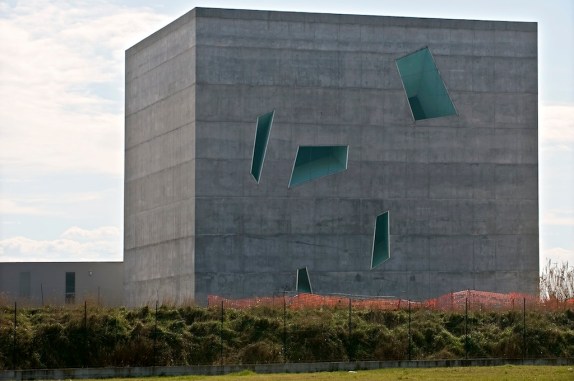
I’m always tired of people yapping about how wonderful Italy is because it’s full of beautiful old churches. Well, it’s just as full of terribly ugly modern churches. The kind which make you shiver, the ecclesiastical equivalent of the Yugo. I posted some photos of one of them here. There is even a blog devoted to them: bruttechiese. Here are some others.

The freedom of unbelief

Liberi di non credere
By Raffaele Carcano
Editori Internazionali Riuniti, 2011. 379 pages (in Italian)

The PD should be advocating a more secular agenda.

Raffaele Carcano, who heads the UAAR, Italy’s association of atheists, has written a vademecum on the current state of secularity in Italy. Here the reader will find no philosophical arguments for atheism, no attacks on religious belief or even a catalogue of indecent behavior by the Catholic Church and its hierarchy. Instead, Carcano guides the reader through the routine abuses of the rights of non-believing citizens: from the suppressed atheist bus campaign in Genoa to the Lautsi vs. Italy ruling that crucifixes in public classrooms are not in violation of freedom of conscience, the hand of the Vatican is never far from the puppet theater of Italian politics.

Secularism is on the rise, however. Non-affiliated Italians, according to a recent study cited, represent nearly 20 percent of the population and the number is growing. Compare that figure with the only two percent belonging to minority (non-Catholic) religions and you realize they represent a fair slice of the citizenry. Yet they have almost no voice or visibility. Moreover, their rights are trampled by such institutional perversions as the “8 per thousand” religious tax (income tax routed to the Church), Catholic religious teaching in public schools, and the ostentatious display of (exclusively) Catholic symbols in public spaces. Add to this the tendency of Italian media to pander to the Catholic Church and report every grunt and groan of its leaders uncritically.

Then comes the political class, to which the author devotes two full chapters, serving up an analysis of the near-total abandonment of secular causes to which few politicians — right or left — give more than lip service. In fact, the Democratic Party takes the brunt of the criticism for being practically the only center-left party in Europe that doesn’t lift a finger to advance a secular agenda. The only parliamentarian noted for her devotion to secular causes is Emma Bonino, who was shot from both sides during her 2010 campaign for the governorship of Lazio.

The Italian situation is contextualized throughout the book with reference to the European Union and the United States, even going back to ancient times (the first recorded book burning, according to Carcano, was of the “impious” Greek author Protagoras). The tone is sober, but not without the appropriate irony. The reader comes away with the impression that Italy is less a modern secular nation than a kind of milquetoast theocracy. Non-believers may no longer be tortured or burned for their impiety, true, but they are consciously marginalized and proselytized to by a cynical political class and their hubristic clerical bedfellows. Which, one might add, is nothing to be proud of in the 21st century.

From The American

UFOs attack Assisi!

image

Here is a suggestive photo I took this morning of the sunrise. I suppose it might look like a nuclear explosion or an alien attack (or the second coming), but it’s just the effect of light and cloud filtered through a not-so-powerful Samsung camera.

Big Brother Jesus

image

image

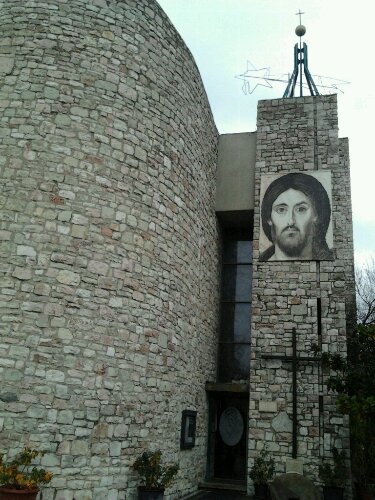
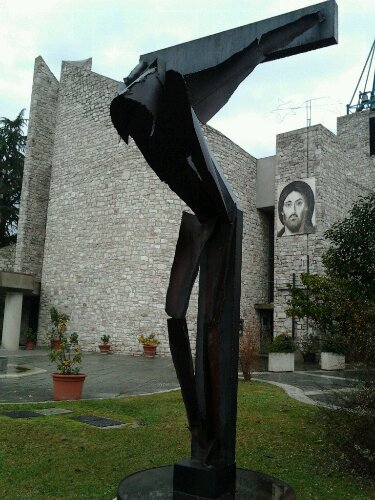
Here’s a positively Orwellian church in Umbria. I’d be totally creeped out if I were a kid growing up here and every day had to pass this staring visage. I suppose that’s the point: good old time thought police. Check out the scrap metal crucifix on the lawn outside.

Italian towns

I wanted to share this wonderful (and disheartening) cartoon. Anyone who has ever been to Italy has noticed that Catholic churches are far grander than any other structures. It’s no mystery that immense amounts of public money are funneled directly to the Vatican through various fiscal mechanisms such as the 8 per mille tax when they aren’t forked over directly for maintenance and the construction of new churches. Churches which are getting emptier every year, one might add. In these hard economic times, the grand old churches which make Italy such a quaint country-sized museum are beginning to look rather suspect.

"Italian towns"

Here’s Mark Twain on the Milan Cathedral (from The Innocents Abroad):

Howsoever you look at the great cathedral, it is noble, it is beautiful! Wherever you stand in Milan or within seven miles of Milan, it is visible and when it is visible, no other object can chain your whole attention. Leave your eyes unfettered by your will but a single instant and they will surely turn to seek it. It is the first thing you look for when you rise in the morning, and the last your lingering gaze rests upon at night. Surely it must be the princeliest creation that ever brain of man conceived.

The building is five hundred feet long by one hundred and eighty wide, and the principal steeple is in the neighborhood of four hundred feet high. It has 7,148 marble statues, and will have upwards of three thousand more when it is finished. In addition it has one thousand five hundred bas-reliefs. It has one hundred and thirty-six spires—twenty-one more are to be added. Each spire is surmounted by a statue six and a half feet high. Every thing about the church is marble, and all from the same quarry; it was bequeathed to the Archbishopric for this purpose centuries ago. So nothing but the mere workmanship costs; still that is expensive—the bill foots up six hundred and eighty-four millions of francs thus far (considerably over a hundred millions of dollars,) and it is estimated that it will take a hundred and twenty years yet to finish the cathedral. It looks complete, but is far from being so. We saw a new statue put in its niche yesterday, alongside of one which had been standing these four hundred years, they said. There are four staircases leading up to the main steeple, each of which cost a hundred thousand dollars, with the four hundred and eight statues which adorn them. Marco Compioni was the architect who designed the wonderful structure more than five hundred years ago, and it took him forty-six years to work out the plan and get it ready to hand over to the builders. He is dead now. The building was begun a little less than five hundred years ago, and the third generation hence will not see it completed.

Now doesn’t that sound like a colossal waste of resources to you?

The cost of the Catholic church

Well, it seems the new government expects everyone to do their part in getting Italy out of its current economic straits – except, you guessed it, the Catholic Church. When asked a direct question on the subject, PM Mario Monti reportedly answerd that “he hadn’t yet considered” making the outlandishly privileged Church pay tax on its commercial assets (an estimated 1 out of 5 properties in Italy are in Church hands). Which is outrageous. Really, the list of offenses just gets longer and longer. Why should anyone be this privileged – above all the richest (and arguably most corrupt and morally bankrupt) country – yes, it’s another fucking country! – on Earth? Can anyone explain to me why those of us who oppose such privileges haven’t yet reached a critical mass?

There’s a new website (icostidellachiesa.it) detailing the actual cost of the Catholic Church. It’s a frightening read. And since most Italians have absolutely no idea how they are financing this freeloading institution, the time has come to educate them. This is the elephant in the room, Italy.

Jobs

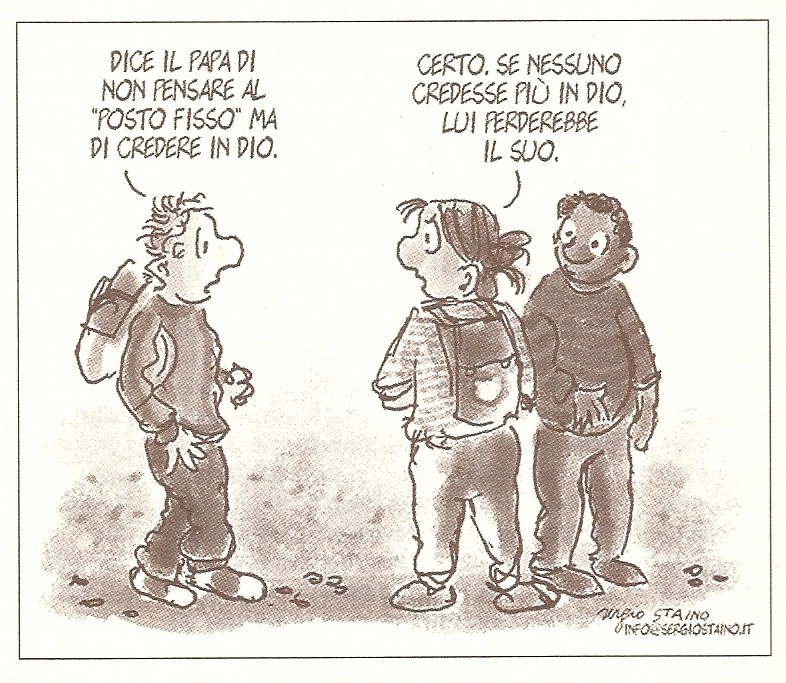
This is a funny cartoon by Sergio Staino. In English it might read something like this:

“The pope says not to worry about getting a permanent job, but rather to believe in god.”

“Sure. If no one believed in god, he’d lose his job.”

Aspiring to a “posto fisso” is one of the hallmarks of Italian society. The pope is always making such idiotic statements.

via L’ATEO.

Abolish the Lateran Treaty!

Sometimes I wonder which is preferable: to live in a place like the US, where religious nuttiness is rampant among the population (and certainly not unknown among politicians), or a place like Italy, where the population is largely complacent and indifferent thanks to an unoffical State religion and politicians submit sheepishly to the whims of the State church.

American separation has led to a lively “cafeteria style” marketplace for all religions to compete for customers. Italy, on the other hand, has the Vatican: it’s a separate country nestled in the city of Rome, an autocracy and a theocracy (the last in Europe, I believe) which has the constitutionally-recognized right to interfere in Italian political life and – and this is the kicker – immunity from interference from the Italian government.

In fact, the Italian constitution is schizophrenic on this issue.

Art. 3

All citizens have equal social dignity and are equal before the law, without
distinction of sex, race, language, religion, political opinion, personal and
social conditions.

Art. 7

The State and the Catholic Church are independent and sovereign, each
within its own sphere.
Their relations are regulated by the Lateran pacts. Amendments to such Pacts
which are accepted by both parties shall not require the procedure of
constitutional amendments.

Art. 8

All religious denominations are equally free before the law.
Denominations other than Catholicism have the right to self-organisation
according to their own statutes, provided these do not conflict with Italian law.
Their relations with the State are regulated by law, based on agreements with
their respective representatives.

And it goes on like this, first establishing perfectly reasonable things like freedom of conscience, and then goes on to contradict itself by stating that the Catholic church has an entirely separate set of rules which govern its relations with the state (rules which highly favor the church and undermine the secular nature of the constitution.)

The Lateran Treaty (“All foreigners in official ecclesiastical employment in Rome shall enjoy the personal guarantees appertaining to Italian citizens, in accordance with the laws of the Kingdom of Italy.”) is the basis for an immense amount of biased and unfair treatment of non-Catholics in Italy as well as enormous and completely unjustified privileges for Catholics and clergy. They need to be abolished if Italy wishes to become a truly European nation based on secularism and rule of law and emerge from its illiberal, fascist-tainted past.

Of course, without Italy’s gentle nursing, the Vatican would probably wither away and disappear from the face of the Earth. Which wouldn’t be a bad thing for anybody.

Making sacrifices

A Catholic government?

“Mario Monti has guaranteed sacrifices for everyone. Now we expect him to trim the more than 5 billion Euro a year in public funds which are diverted to various guises of the Catholic Church.” – Raffaele Carcano, UAAR

It seems almost unbelievable that an Italian government could be even more Catholic than Berlusconi’s banished crusaders, but the Mario Monti’s new technical government didn’t get the Vatican stamp of approval for nothing. So basically everyone is expected to make sacrifices except the clergy and, of course, the politicians who propose making sacrifices. And round and round we go…

Now why does that little word “sacrifice” sound so artificial to my ears?