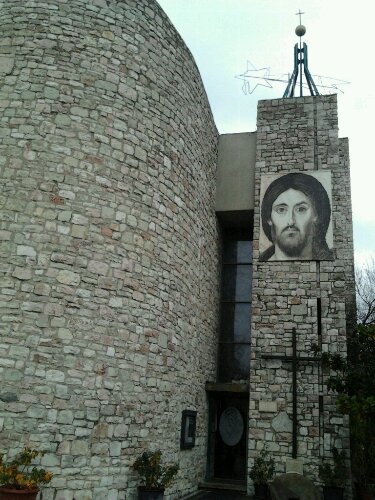
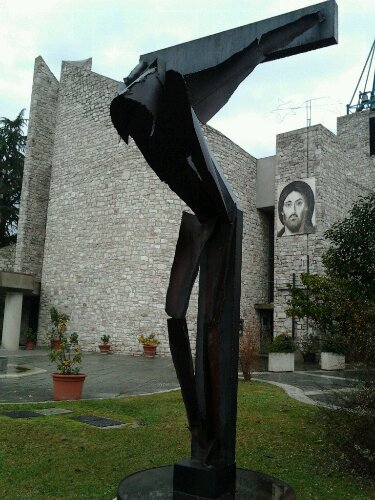
Here’s a positively Orwellian church in Umbria. I’d be totally creeped out if I were a kid growing up here and every day had to pass this staring visage. I suppose that’s the point: good old time thought police. Check out the scrap metal crucifix on the lawn outside.
One thing I love about the Internet is that no matter how much cool stuff you come across there’s always something that makes you think, “How did I never see this before?” Yesterday I was listening to an interview with Phil Hellenes on the Thinking Atheist podcast about his awesome video “Science Saved My Soul.”
Today I went and watched the video, and I’m sharing it here for anyone who may have missed it.
I’m not sure why, but until now I’ve never read Frederick Douglass’ Narrative. I think the impetus was actually from Carl Sagan, who devotes a section of The Demon-Haunted World to Douglass’ life. It’s a remarkable story, not least for the improbability of its ever being written down. His escape from slavery began, however, with his clandestine education by the wife of one of his owners. She taught him to read, but not to write.
Douglass, while invoking a general sort of God throughout, has nothing but the harshest words for the pious Christian slave owners of the American South (mind you he was in Maryland, the state I grew up in 150 years later; the deep South is a whole ‘nother story, as we say.)
“I assert most unhesitatingly, that the religion of the south is a mere covering for the most horrid crimes – a justifier of the most appalling barbarity – a sanctifier of the most hateful frauds, and a dark shelter under which the darkest, foulest, grossest and most infernal slaveholders find the strongest protection. Were I to be again reduced to the chains of slavery, next to that enslavement, I should regard being the slave of a religious master the greatest calamity that could befall me. For of all the slaveholders with whom I have ever met, religious slaveholders are the worst. I have found them the meanest, the basest, the most cruel and cowardly, of all others. It was my unhappy lot not only to belong to a religious slaveholder, but to live in a community of such religionists.”
Bearing this in mind, isn’t it amazing more African-Americans aren’t hostile to religion in general, and Christianity in particular? I think so.
I just wanted to get this down before I forgot it:
• Science is like walking into a pitch-dark room with a small, powerful flashlight. You may not see much at first, but it may stop you from stumbling. Slowly, painstakingly you’ll begin to form a pretty good idea of where you are.
• Religion is like walking into that same room with a glow-in-the-dark Lightsaber. Sure, it feels cool, but you keep swinging away at invisible phantoms. And the light cast is too weak to actually see by. May the force be with you!
Today my wife is attending a funeral for a young man – twenty five! – who recently died of a brain tumor. He was diagnosed only a month before.
My aunt died of cancer a few years ago, after a four year struggle. She was a very religious Catholic, went to church, kept statues of Padre Pio in her home and pictures of the Virgin Mary on the wall of her bedroom. She took trips to sanctuaries. She counted priests among her friends. And yet…she withered away to almost nothing. She lived in tremendous pain. Then she died.
So where is this great God believers speak of? Either he is fucking with us – in which case he is an evil God – or he just plumb don’t exist. Why it would give anyone solace to have faith in such a thing baffles me. Even some atheists I know talk of the “gift of faith” with not a little nostalgia (that they never received it.) All I can think is, What’s wrong with you people? We can do better than this!
We all suffer, atheist and religionist alike. No one is exempt. Life will end in death for all of us, with no regard for our belief systems, education, successes and failures. We all know this. It does no good to pretend that there is a benevolent being who is looking out for us, who is amenable to prayer and flattery, and who will save us when the going gets rough. It does no good because this is quite obviously not true.
Let’s stop pretending it is, and that faith is a gift. It’s a poison apple if it’s anything.
I haven’t read Susan Jacoby’s “Spirited Atheist” column in a month or two, but today I found an absolutely wonderful article on A.C. Grayling’s The Good Book: A Humanist/Secular Bible. Suffice to say the first time I read any of Grayling’s souped-up anthology I thought it sounded awful, like one of the umpteen translations of Genesis that try too hard at saying the same well-worn phrases in novel ways. But how many ways can you find to write, “In the beginning…?” They all just end up sounding vaguely “biblical” no matter how you rearrange the words (which is likely the point.) Here’s Jacoby:
Let me quote from the first chapter of the first “book” (again, modeled after the format of a standard bible), called—what else?—Genesis.“In the garden stands a tree. In springtime it bears flowers; in the autumn, fruit. The fruit is knowledge, teaching the good gardener how to understand the world…When Newton sat in his garden, and saw what no one had ever seen before: that an apple draws the earth to itself, and the earth the apple….”
You can’t satirize this stuff. Forget the vapidity of the language. It’s not even factually accurate, which, at a minimum, a secular bible ought to be. Another chapter (9:18) has arteries carrying “nascent blood,” while “lengthening veins return the crimson flood.” Wrong again. Arteries carry bright red blood, because it is fully oxygenated, away from the heart, while the returning blood in veins is much darker because it is generally deoxygenated.
Apart from my initial sense of enthusiasm on hearing about Grayling’s Good Book, I’ve had some reservations about it (I generally enjoy Grayling’s work). I’m not sure how homogenizing 3000 years of wisdom into an authorless mish-mash of slightly “elevated” (read: biblical) language serves any purpose – especially if one’s purpose is to offer an alternative to the Bible. One thing I love about literature is knowing who wrote what, when. I think that really does matter in the end. And unless the intent is satire, I don’t think many atheists/secularists will be drawn to a book based chapter-and-verse on another book we’ve read – and often trashed – the Bible.
Jacoby sums up:
There has already been a good deal written, particularly in England, about whether Grayling’s bible insults religion. This is utterly beside the point, since the book is an insult to language, to authors who deserve credit for their words, to translators who deserve credit for translating those words, and, above all, to the intelligence of secular readers. We don’t have one Good Book. We have good books, thousands of years of them, and the real Euripides, Shakespeare, Spinoza and Darwin are all available to provide a genuine humanistic education.
Exactly. Who the hell needs a sterilized version of Shakespeare, anyway?
I’ve been having a debate (what else to call it?) on Facebook lately with a couple of friends over whether religion can be held responsible for its homophobic teachings. I say it can and should, whereas my friends disagree. They suggest that prejudice most likely has a different explanation, and religions simply capitalize on pre-existing feelings of hatred and fear. That’s quite true. But religion has crystallized these emotions and normalized them for billions of people, weaving them into the fabric of belief. To be a Roman Catholic who does not think homosexuals are “disordered”, or “unnatural” is to have shed an important part of that belief system, and one that is hammered home at every opportunity by those in charge of Roman Catholic beliefs.
Once, when I was flirting with religious belief, I was on the road to such thinking as well. I remember quite vividly the way in which my perception of sexuality became more prudish. I was reading the Bible and trying hard to put my thinking in line with what I thought was a “Jewish” view of sexuality. While I never became homophobic, I did begin to think differently about two men having sex (but not two women). I began to adopt more “conservative” or “traditional” opinions. And this opinion was rather negative, as I recall it.
It didn’t stick, though. The more I studied and tried hard to ignore the cognitive dissonance of “believing” while going to the movies on Friday evening – which is strictly forbidden by Jewish law – the more I felt like the whole edifice was just that: an artificial construct. Then it fell, just like the cardboard cut-out it was.
The experience was useful, however, for it put me in the mind of a believer for a short time. Some might say this isn’t accurate, as I was never really any such thing. Either way, it felt a lot like what I’ve read over and over again about the tension people feel when they put their religious beliefs to the test and decide they can’t go on lying to themselves.
To get back to homophobia, though. In my admittedly anecdotal experience, I was aware of a change taking place. And that wasn’t because of radical preachers, fundamentalist company or any such thing; it was what I had begun to intuit about the Bible itself and its archaic worldview (I even began to wonder how one might make sacrifices in the 21st century). I only wished to get in line and act, well, religious.
Thankfully, this proved rather difficult. I have a bad habit of analyzing things to death, and for me whatever ad-hoc idea of God I’d begun to formulate in my head vanished under scrutiny. By the time I’d finished reading The End of Faith, I had accepted that the religious life – and accompanying worldview – wasn’t for me.
In fact, more than anything it was the way an even diluted religious belief messed with my mind that turned me off. It was a bit like drugs (I’ve had bad experiences on both). It was the realization that I wasn’t in full control, that I felt puppeted, manipulated by the things I was reading. I even began to entertain creationism, which is a perfect example of the way religion can damage one’s thinking; I can think of no other reason on Earth anyone would question the evidence for evolution if not for a religious (read: Abrahamic) worldview.
As an atheist I’m always discussing religion with people who will discuss it with me. Having briefly tasted belief, I’m curious to know what others experience and how it affects them. Some even quip that I’m more “religious” than the religious because I take belief seriously. Well, I’ve seen what it can do, and it’s heady stuff. Trust me.
* Some people think I’m an asshole now, of course; but they don’t know what was happening inside my head then.
One of the perks of living in Italy is that, no matter where you end up, you are in the realm of miracles. They happen all the time here. But like UFO sightings, hauntings or any other paranormal activity, miracles never seem to happen to me. I wonder why that is.
Not long ago we were having dinner with some friends when one mentioned that the Virgin Mary had appeared in our local church last year. There had been a big brouhaha over it on television, and apparently the Vatican is now doing whatever it is they do to “verify” the supposed breach of all known laws of reality. We might be living in the next Lourdes, or Medjugorje, for all we know.
According to RAI’s Massimo Giletti, who hosted the relevant television special, one of the “seers” of Medjugorje (one of the six people who supposedly saw the Virgin Mary appear the Herzegovina town in 1981) was at the church of our modest hamlet for some commemorative prayers. An elderly woman who was attending took out her cell phone to film the service for her daughter. When she got home and watched the results, there was “a luminous figure” in the foreground. The woman sustained later that there was “no one there” while she was filming.
Miracles often begin their lives this way. Let’s take a closer look, though.
First, Assisi is a place known for one of the best-loved saints in Catholic canon, St. Francis. Everything near Assisi is bathed in the glow of this humble man, and our town is no exception. He was akin to the Italian Jesus (or was until Padre Pio usurped his throne). It’s a very suggestive place, even for a skeptic.
Second, we are in the presence of religious believers. Who else goes to church to see a religious celebrity like the woman of Medjugorje, anyway? So two very essential elements are in place for miracles to happen.
What would be truly astonishing is if the woman had filmed something quite unrelated to the Catholic faith. Joseph Smith maybe, or a Hindu deity. That would’ve at least been worthy of scrutiny. That she filmed the Virgin Mary is prosaic; it’s expected in a place already saturated with Virgin Marys. They are on the walls, in paintings, on street corners, in people’s houses and in their wallets. There should be nothing surprising if she “appears” on someone’s cell phone.
The imageitself is very suggestive — at least to me — of Princess Lea from Star Wars. There is a famous scenein the movie where she appears in a hologram projected by R2-D2. Supplicating, she says, “Help me, Obi-Wan Kenobi. You’re my only hope.” It’s an astonishing resemblance. So how do we know it wasn’t Princess Lea in that church?
We don’t, any more than we know it was or wasn’t the Virgin Mary. Because for a vague white glow to be either of those two presupposes an enormous amount of supporting evidence, which we just don’t have. We’d need to establish their historical existence, first of all. One is a minor character from a book written thousands of years ago and full of all sorts of things we know to be fanciful, falsified and just plain fraudulent. The other is from a movie made comparatively recently, in 1977. The actress Carrie Fisher — who played Princess Lea — is still alive, giving a slight edge of probability to our admittedly absurd hypothesis.
I could go on, but I’m only trying to establish the idea that miracles are in the mind of the credulous. When enough people begin believing these things, the Vatican authorities step in and “verify” them, creating a moneymaking publicity machine in the process.
One could say that not all supposed miracles are accepted by the Vatican, thereby suggesting that there are some criteria by which miracles are tested for veracity. As they are by definition unfalsifiable, though, it really appears to be a matter of shrewdness. The case of Padre Pio is a good example. The Vatican actively opposed his cult for decades, until it grew too large to be ignored. So they incorporated it. Now, as they say, he’s more popular than Jesus and almost every Italian knows someone who has been “miraculously cured” by him. I know I do.
I’m daily amazed that adults are susceptible to such obvious nonsense. What doesn’t amaze me, though, is that Italian state-television cynically plays to this credulity. They know their public, and they will do just about anything to keep them as uninformed and complacent as possible.
 I’m not sure why, but until now I’ve never read Frederick Douglass’
 I just thought I’d share it with anyone
 Today my wife is attending a funeral for a young man – twenty five! – who recently died of a brain tumor. He was diagnosed only a month before.
 Marc Di Martino