This line from Timothy Snyder’s profound reflection on the fourth anniversary of Russia’s awful war in Ukraine struck me: An anniversary is an abstraction that separates us from responsibility. Read his full post here.
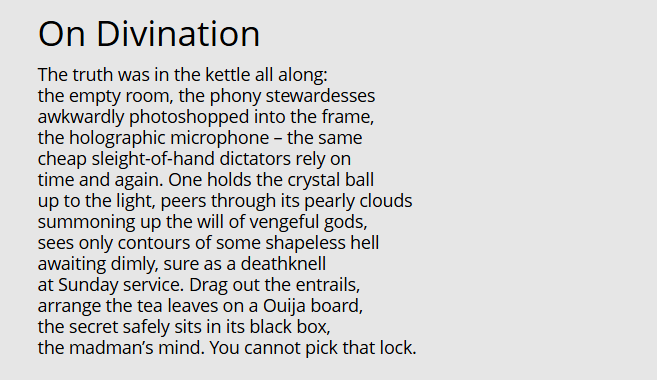
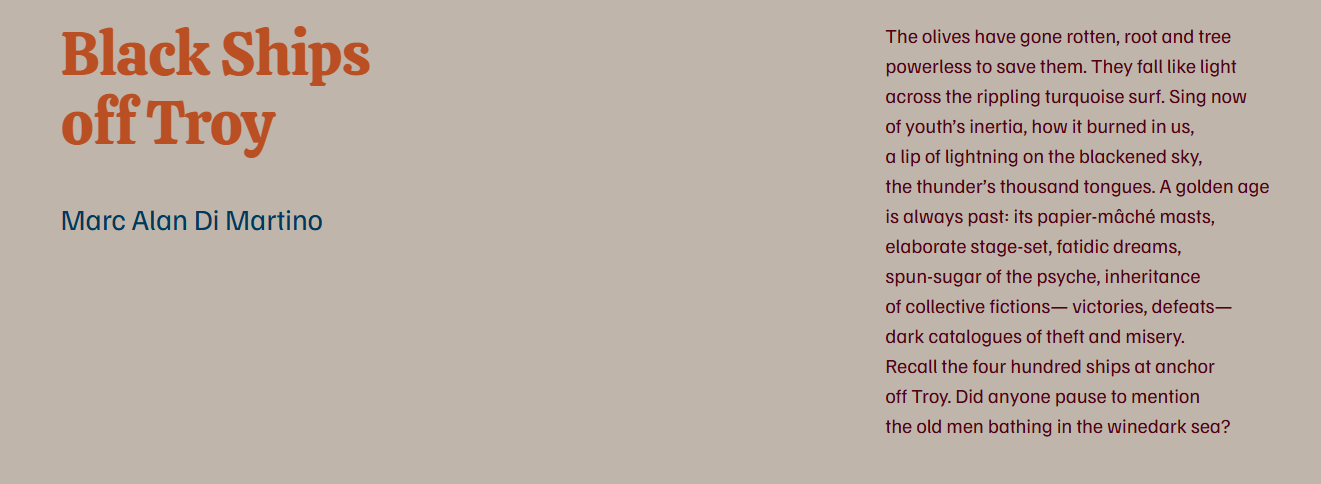
Solidarity comes in many forms. I write and translate poetry, and that is often how I think about what is happening in the world. Here are two poems I wrote about the invasion at the very start of the war. It may not be much but it’s what I have. May this terrible and unjust war end soon. Slava Ukraini!
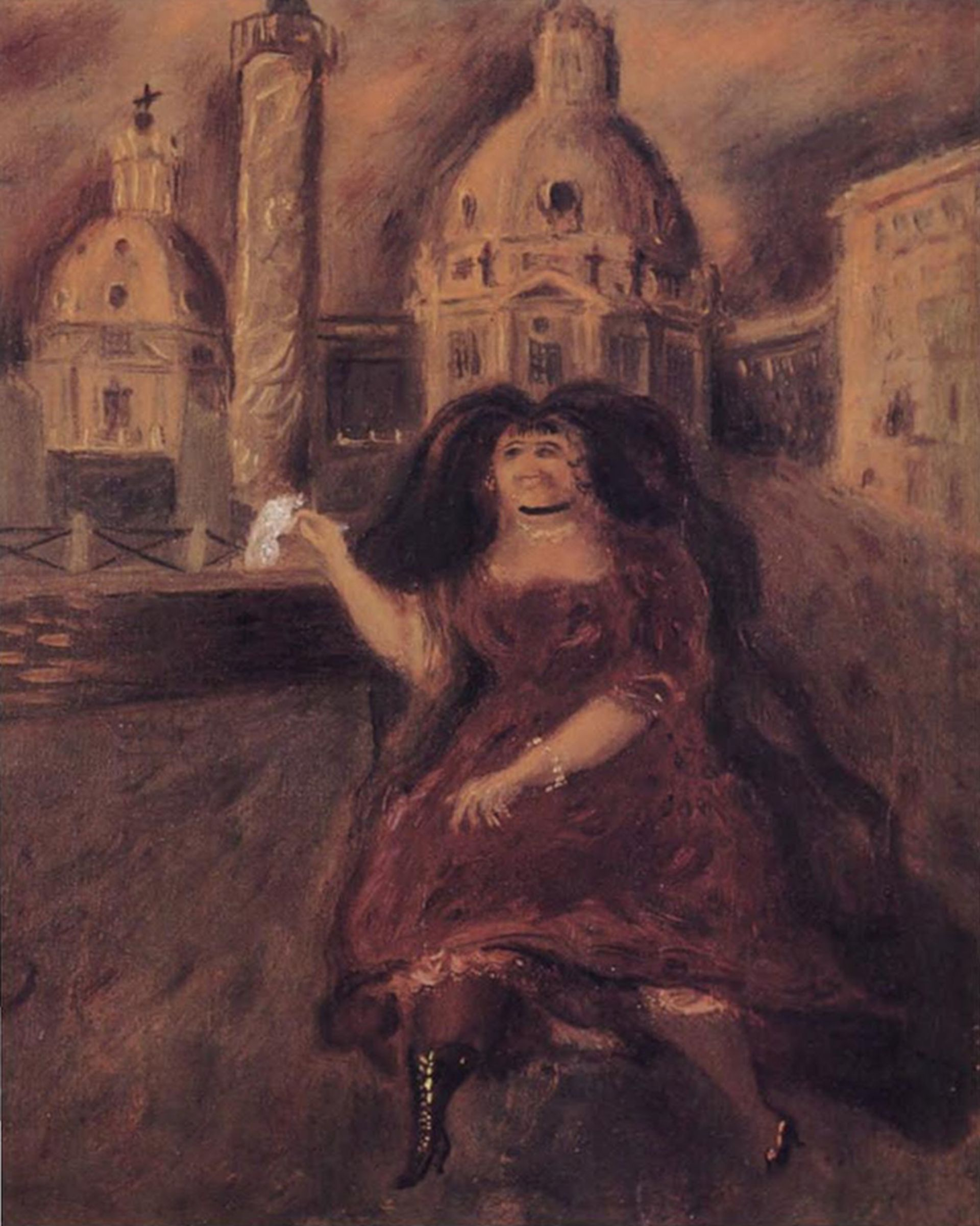
The good folks at One Art have generously published the very first of my translations of Romanesco poet Mauro Marè. I’ve been working diligently on these since late last year, and it has so far been a much different experience than that of translating Mario dell’Arco. With Dell’Arco, each poem is a kind of gemstone and the translation is performed like microscopic cutting, polishing the edges until they gleam. My approach to Marè has so far been the opposite—basically diving into his vision headfirst and learning to swim or perish in the thrashing current of bold juxtapositionings and idiosyncratic neologisms. The above painting by Italian artist Scipione (1904-33) is the subject of one of his early efforts, “Mamma Roma”, an ekphrastic sonnet whose title echoes Pier Paolo Pasolini’s 1962 film of the same name. It hints at a Roman darkness and grotesqueness which Marè puts his finger on, especially in his later work of the ’80s and ’90s.
Marè’s publishing career was brief compared to Dell’Arco’s—a mere 20 years as opposed to the latter’s half century of dominance—but in his final decade he broke exciting new ground. It has been said to me by those in the know that Dell’Arco never once used a cuss word or profanity in his poetry. (If true, I am guilty of misrepresenting him in a single poem in which—inspired by Belli’s more profane moments—I put the ‘c’ word in the mouth of Santaccia, or St. Bad Girl, the infamous prostitute of Belli’s most gloriously dirty sonnets. [I justify my choice in a note on the poem, for those interested.]) In any case, Marè provides a jarring juxtaposition to Dell’Arco’s tame tongue, offering up a literal smorgasbord of romanaccio terms anyone with a passing familiarity with the Urbs will recognize: li mortacci tua, mmavvaffanculo, bbojja de mmerda,zzozzone etc…these are such colorful words, the verbal equivalent of Niki de Saint Phalle’s Shootingpaintings, made by literally pointing a shotgun at her canvasses and blowing away pockets of colored paint. As a kid, I used to listen to my dad on the phone with his brother and sisters in Rome, and immediately grasped the unique lure of these interjections. They were my first words of Italian. Marè at times strings them together in zinging neologisms, the kind of thing one might hear from some drunk meandering though the streets at 2 a.m. cursing the world to the world: the bust driver, the Prime Minister, the Pope, all the way up to the throne of god.
There is a lot more to say about Marè and his poetry, which will surely be the subject of further posts.
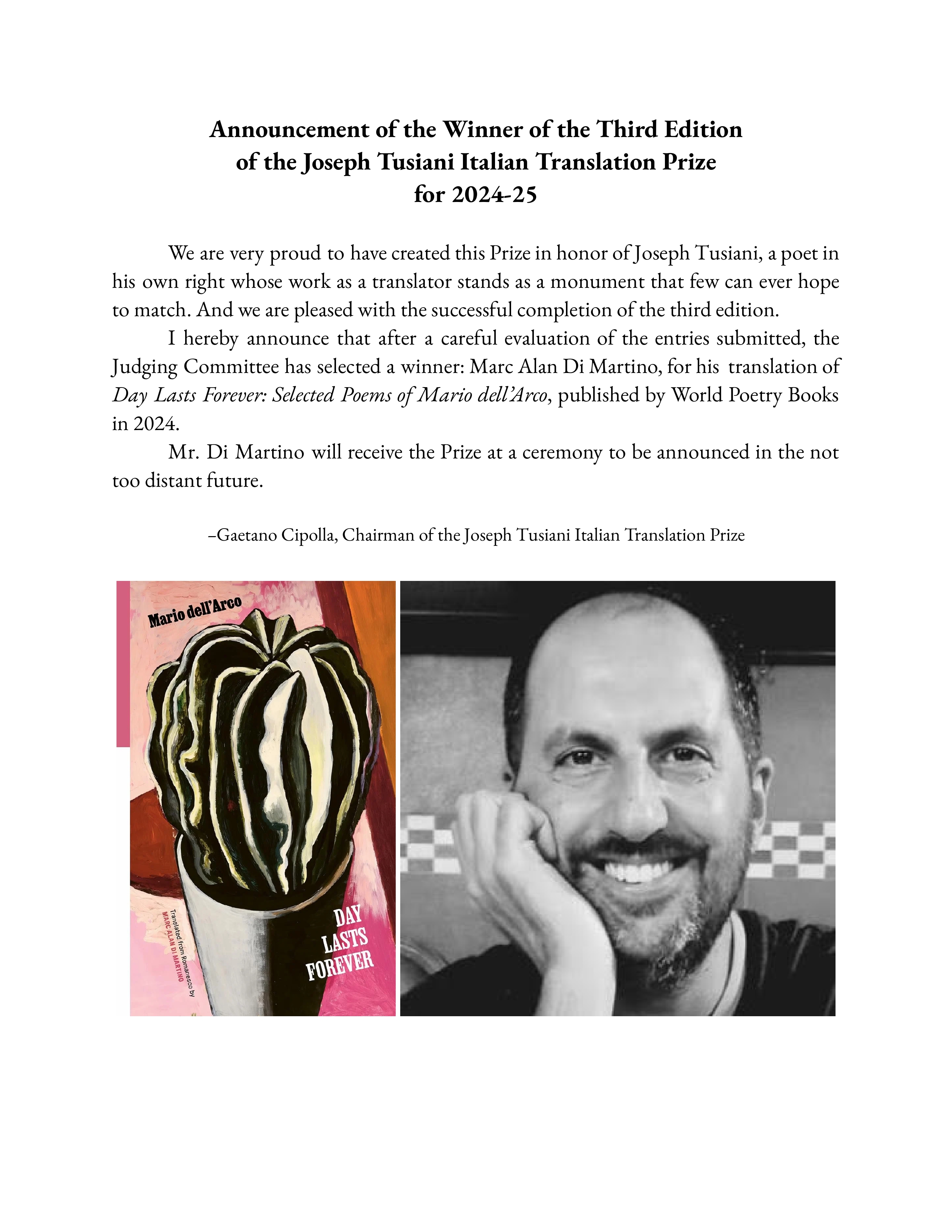
I have an exciting bit of news to share – Day Lasts Forever has won the Joseph Tusiani Italian Translation Prize for 2024-25! Below is the official announcement. The book can be ordered directly from World Poetry Books, from your local, preferably independent, bookseller or from anywhere that sells quality poetry books. An excellent review of the book by Jason Gordy Walker can be found at Asymptote. Another, by Anna Aslanyan, can be found in the Times Literary Supplement. You can read selections of Mario dell’Arco’s poetry at On the Seawall,Bad Lilies,Apple Valley Reviewand One Art. For Mario dell’Arco’s 120th birthday celebration at the National Library in Rome, see this post. Thank you to everyone who has supported this project! More to come!
Bruce naming the names. This is actual patriotism, not the phony kind performed by MAGA. Honor to the heroes and victims of Minneapolis and all Americans standing up to this traitorous, un-American regime.
Here’s a little poetry update, as I have a few new poems up at some fine venues. “End of the World”, a recent translation of Mario dell’Arco’s “Fine der monno” (1947) is now up at Apple Valley Review. This is particularly significant to me, as I’ve been subbing them off and on since perhaps 2007 and this is the first time my work has been accepted.
Another poem, “Holes” – a demi-sonnet – is up at Shot Glass. If you’ve never heard of a demi-sonnet, here is the lowdown. Did I do it right?
“Dear Liz–“, an appreciation of musician Liz Phair’s album Exile in Guyville (1993) is up at The Shore. I was nineteen when that album came out and it’s one of a handful of records from my once-extensive vinyl collection to have followed me in my inter-continental wanderings.
Finally, a little political poem, “An Enemy Within” is up at One Art. One does what one can to resist the horrorshow. In any case, Do something.
*
Day Lasts Forever: Selected poems of Mario dell’Arco is available from World Poetry Books.
I’m extremely pleased to have a poem in the current issue of the Shore. “Dear Liz—” is a little love letter to Liz Phair’s first album, Exile in Guyville (1993). The poem was originally a shape poem, but it didn’t really work and so – after a few years and a few rounds of modifications – it settled into its current mode as a haibun. The allusion in the last lines is to the rock critic Robert Christgau, who must’ve written something memorable about the Rolling Stones that insinuated itself into the fabric of this poem.
Dear Liz—
you had me at‘Fuck and Run’, your parched voice like husks of sweet corn under a dying August sun—Silver Queen, the only kind—all sturm und twang, slight lisp betraying a shyness undercut by your half-exposed nipple on the album jacket. You drove us wild at nineteen, tired of guys like ourselves running everything, screaming their emo angst in our ears.



 Marc Di Martino