David Aaronovitch explains:
The banality of conspiracy theories
David Aaronovitch explains:
David Aaronovitch explains:
I was at the park this morning, which is about the best place to be in Rome this time of year. Typically without camera, I saw all sorts of things worth photographing. One was a cricket match, which was kind of exciting because it was some sort of championship (there were trophies on the table and a sound system blasting Europe’s “Final Countdown”), and the other was a turtle sunning itself on a rock which looked suspiciously like a female turtle. My first thought was, “Turtles having sex!” but then I realized I’d been duped by nature. Just a turtle out getting a tan, I guess.


The genetic evidence is in and we Jews are basically what we’ve been saying we are all along – a people. No, not a “race.” But a people with a long history which goes back to, you guessed it, the Middle East. So say the results of two recent genome studies as reported a few weeks ago in the NY Post.
This already raises spectres. Who wants to have their identity confirmed by genetics? Suppose the results were negative. Then would Jews not be a people? Jewish history is absorbing and complex, brimming with migrations and intermarriage (shhhh!), conversions and just about anything else that can happen to people over a period of thousands of years, and then some. Somehow, we are still here, which is the really interesting part. How did we get to where we are?
The Khazar theory has apparently bitten the dust, and with it will go The Invention of the Jewish People, last year’s shock-schlock bestseller (well, if you count France and Britain). Shlomo Sand’s thesis was essentially that what we call “Jewish history” is little more than a Zionist construct. Cui bono, you ask? Clearly to appropriate Palestine from its rightful occupiers, then swindle the world with tall tales of expulsion and diaspora.
Martin Goodman reviewed it for the TLS, concluding that:
In a self-glorifying preface to this book, Sand describes his role as that of a revealer of inconvenient facts suppressed by a malicious political and academic establishment. Some of those who have expressed approval of his book may believe that, like the Israeli New Historians whose discovery of genuinely new data on the events of 1948 has indeed caused much discomfort to that establishment, Shlomo Sand, too, has faced opposition because he has unearthed something new. Nothing could be further from the truth.
Shall Shlomo Sand now eat humble pie?
* If any of you are seriously interested in critiques of Sand’s book, Anita Shapira reviewed it here; Hillel Halkin’s review is here.
Lately I’ve been perplexed by the seemingly unstoppable popularity of Slavoj Zizek. Not only does his incomprehensible rhetoric annoy me (that would hardly make him special), but his actual positions are puerile when he finally gets around to articulating them. Nonetheless, I actually sort of like him despite his best efforts to be monstrous. He’s said similar things about Jesus – and Stalin, too.
Because that’s what Zizek does. He plays on our preconceptions (Hitler was evil; Jesus was good)) and turns them against us (Hitler was less evil than Stalin; Jesus was a monster), which isn’t always a bad way to make a point. I just wish he could do it without all that Lacanian-Derridean-derived jargon that gets in the way of everything. I found a review of Zizek! by Johann Hari which gets it right:
When you peel back the patina of postmodernism, there is old-fashioned philo-tyrannical nonsense here. At some level, Zizek knows that this is preposterous – he lived under Soviet tyranny, and even joined the opposition. Simply by putting a camera in front of him and leaving it running, Taylor sees his facade and his ideas crumble.
Hari came under fire for this review. Ophelia Benson defended him. There was a massive comment-volley on Butterflies and Wheels (Benson’s site) which is worth reading. Essentially, Hari was attacked for not having read and thoroughly considered the whole of Zizeks’ work (this was back in 2007 by the way), as if that were necessary for a film review. Hari wrote in plain English, and for this he was called a “reactionary anti-intellectual.” He was lambasted for “denouncing” Slavoj Zizek.
Does any of this sound familiar?

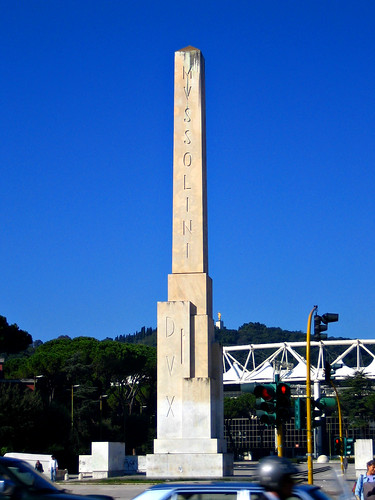
Since I first read about him, I have always been intrigued by the little-known Italian poet Lauro De Bosis. Born in Rome in 1901, he vanished while flying solo over the Mediterranean at the age of 29. Apart from a Rome piazza bearing his name — which, ironically or not, houses an obelisk with the vertical inscription MUSSOLINI DUX down one side — De Bosis is lost to history.
I first came across his name in “The Oxford Book of Italian Poetry,” which I found while scavenging the shelves of the Gotham Book Mart for anything in Italian. He edited the volume before his death.
Though the book was a goldmine, it was his personal story that caught my attention. He was the son of Adolfo De Bosis, an esteemed poet and translator of Whitman, Shelley and Homer, and Lillian Vernon, a New Englander and daughter of a Methodist minister who grew up in Italy. Since I’m the son of Roman and a New Englander, the story was irresistible.
In the years before Mussolini rose to power, De Bosis’s Rome home was a kind of intellectual salon. Like many thinker of his day, De Bosis had flirted briefly with fascism in its early phase, though he grew quickly disillusioned with Mussolini after the murder of the anti-fascist politician Giacomo Matteotti.
His verse drama “Icaro”, written in 1927, was an anti-fascist allegory disguised as a retelling of the Greek myth of Icarus. The poem culminates, as does the legend and De Bosis’ own life, with the hero’s glorious flight and subsequent fall into oblivion.
I kept the New York Public Library’s copy of “Icaro” on loan for months. De Bosis’s companion, the American actress Ruth Draper, had translated it in the early 1930s. By then, my curiosity was obsessive. Had De Bosis really prefigured his own end? The symmetry between his only completed poetic work and his actual death was an eerie footnote to his legend. Or rather, it was his legend. I finally bought my own copy of “Icaro” from an online bookshop.
De Bosis shuttled back and forth between Italy and the United States, where he taught Italian literature at Harvard. While abroad, many of his friends and family were arrested by the regime, including his mother. He crime? She had assisted her son’s dissident political activities by operating his mimeograph machine in his absence.
According to historian Gaetano Salvemini, when the arresting officer courteously asked her, “Why did you do it?”, she fell back on Mussolini’s recent reference to the Italians as “40 million docile Italian sheep” who gave wool to the government. “Because I am not a sheep,” she replied.
De Bosis then devised a plan. He purchased a small plane, filled it with hundreds of thousands of pamphlets denouncing the atrocities of Mussolini’s regime, and dropped them over Rome at the crowded dinner hour.
The pamphlets’ were dated “Rome, year VIII since the murder of Matteotti.” The mockery of the regime was obvious: It’s own dating system had started 1922, a perverse satire of the Christian Anno Domini. The De Bosis pamphlet contained a 10-point message to the Italian people on the need for resistance, accompanied by a letter to King Victor Emmanuel II. It was signed “The Director.” Among the points:
2. Don’t buy newspapers. They are all full of lies.
3. Don’t smoke.
4. Say and do nothing that may be interpreted by the regime as obedient.
The final point was the essential one, and it runs through his poetry and letters: “Have faith in Italy and in Liberty. The defeatism of the Italians is the real basis of the fascist regime. We are in full Risorgimento. Don’t despair.”
After De Bosis completed his run, he and his plane vanished over the sea.
When I left the United States for Italy I was busy working on my own translation of “Icaro.” I was even in touch with author and translator Arturo Vivante, De Bosis’s nephew. Nearing his eighties, he lived in Wellfleet, Massachusetts and ran a small press called Delphinium. I sent him a few verses of “Icaro.” He responded in tiny, almost illegible script: “Lauro, who cared a great deal for his play, would have been very pleased.” Vivante died in 2008.
I had planned to continue working on “Icaro” once in Rome. Maybe I was put off by De Bosis’s seeming anonymity among his countrymen, or maybe I was just too busy perfecting the language and letting the city flow through me to be bothered, but the incomplete translation is now in the dusty bottom drawer in my writing desk. I pick it up from time to time. It is written mostly in pencil on broad-lined yellow stationary and makes me marvel at the ambition of a younger self.
After years of chasing down De Bosis’s shadow, his other surviving nephew, the engineer and author Roberto Vacca eventually contacted me. He’d found me through a piece I’d written for this magazine on the Roman poet G.G. Belli. Generous and encouraging, he has often regaled me with anecdotes about the lively De Bosis household.
But I don’t despair over my half-finished work. A day will come when I’ll feel up to the task of finishing up “Icaro,” and give this literary curio a second life. Circumstances could not be more favorable.
The New Humanist has a bunch of recent posts featuring the cartoons of Martin Rowson. Rowson, whose cartoons I’d never seen until now (well, maybe I had but I just don’t know), takes religion – and atheism – for his subject matter. Here is an apparently controversial cartoon depicting a ginger, prancing Dawkins and a grim, rotund Hitchens at a “coming out” parade. The point, as I take it, is that even atheists can be touchy about how their mascots are treated. Richard Dawkins-as-Muhammad. Though I doubt many death threats or protests will erupt over this one. Because that’s just not what we’re about. But if you happen upon any reports that the New Humanist offices have been bombed by Hitchens’ acolytes, or that the Hitch himself has called for this image’s removal in the name of decency and respect, please forward me the link. In all seriousness.

Last night I sat down to watch a film on contemporary philiosophers called The Examined Life. I got about halfway through before my mother called and I spent the next hour or so hearing about her recent bout of hives (from Chinese food, no less) and how you can eat sour cream up to six months after the expiration date without any risk. She doesn’t believe in expiration dates, you see.
So I never got past Judith Butler, who was kind of boring me with talk of “the role of the body” and all kinds of deconstructionist gibberish. But she was actually fairly coherent after ten minutes of Zizek carrying on about garbage being the real soul of ecology. “To be an ecologist” – I’m quoting from memory – “means you must learn to love trash.” Zizek is hilarious but I cannot bring myself to take anything he says seriously. He’s like the Charles Bukowski of contemporary philosophers.
Here is a clip of Avital Ronell yakking on about “the other.” It’s kind of a minor masterpiece of nonsense. “The minute you think you know the other, you’re ready to kill them.” Oh, shit, really?
I could’ve used another ten minutes of Cornel West, all things considered.
These people aren’t going to take environmental disasters lying down. They’re going to stand up and pray to God to remove the oil, save the fish and the beaches, and return their gulf to them as it once was. They feel impotent. They can’t do anything except watch from their perch on the beach. They are frustrated. I understand them, and I think we all know the frustration of not being able to lift a finger to save the world. But why this leads some people to invoke magic and invisible spirits is beyond me. Do they really think Jesus is going to swoop down out of the sky like Superman and suck up all the contaminated water and take it to some celestial cleansing facility in the sky?
And she likes it!
This idea of intellectual inquiry as a self-evident good died in the West for nearly 1200 years with the ascendancy of Christianity, and it is always–as we see in much of the Islamic world and in the precincts of far-right Christianity today–an object of hatred for those who would still criminalize heresy and blasphemy and, in the case of Islamists, murder those who defy their definitions.
 Marc Di Martino