Further objections to astrology

Do the constellations exist? Well, yes and no. Obviously, to the naked human eye, a few specks of light on a dark screen may suggest a pattern. One sees a lion, a ladle, an archer. These forms are vague at best. At worst, they are the products of our innate ability to find patterns in everything. Here is an outline of Leo.

Now this doesn’t look terribly much like a lion, does it? But we can easily see (as long as the dots are connected for us) how the mind can make out the vague outline of some lazing animal. There are the haunches, there is a neck, and a head is suggested by the final upper curve. But why a lion? It could just as easily be a housecat, or a St. Bernard. Or nothing at all, which is what it is.

Let’s pretend we can travel across the constellation Leo to it’s far side and look at it from there. What would we see? The lion’s left side? Consider that when seen from the perspective of another part of the galaxy, any suggestion of a lion would simply disappear. What we are looking at is not a pattern of white dots on a flat black surface, but stars caught in what is perhaps a kind of four-dimensional space. The science of topology seeks to understand things like the shape of the universe. Here is an example of a topological coffee mug.

Now, I’m no cosmologist, nor am I a topologist, mathematician or even philosopher. I don’t have to be to understand the basic principle that the constellations are mere optical illusions. Consequently, so is astrology. Here is a paragraph from “Obections to Astrology,” published in The Humanist in 1975:

“In ancient times people believed in the predictions and advice of astrologers because astrology was part and parcel of their magical world view. They looked upon celestial objects as abodes or omens of the gods and, thus, intimately connected with events here on earth; they had no concept of the vast distances from the earth to the planets and stars. Now that these distances can and have been calculated, we can see how infinitesimally small are the gravitational and other effects produced by the distant planets and the far more distant stars. It is simply a mistake to imagine that the forces exerted by stars and planets at the moment of birth can in any way shape our futures. Neither is it true that the position of distant heavenly bodies make certain days or periods more favorable to particular kinds of action, or that the sign under which one was born determines one’s compatibility or incompatibility with other people.”

I used to be fixated with astrology. I had a girlfriend who was into it at the time (for all I know she still is), and I came to recognize that Virgins are rather anal retentive, Cancer men are annoyingly self-obsessed, and Leos are natural-born leaders. It even appeared that facial characteristics conformed to a ziodiacal predisposition: Leos had a wide, grinning visage; Arians had a pronounced “t-zone” (resembling a ram’s horns); Sagittarians had a tendency toward red hair and freckles (think “fiery”). All of the above examples were taken from our circle of friends, and I took astrology for a kind of rough social science. I never pursued it further afield, and eventually I lost interest in it.

The zodiac is child’s play when you consider what stars are really out there. Even a weak telescope will convince you of this, but our most powerful telescopes are simply overwhelming. Here is a Hubble image worth scrutinizing.

Suddenly, in this bath of light from a million stars (no, I haven’t counted them), all hints of design simply disappear. There is no archer lost in the woods, no lazing lion, no bears or anything else here but a cluster of stars about 10,400 light years away from Earth. In our galaxy there are billions of stars. Carl Sagan’s voice ricochets down the ages, “Billions and billions.”

Yet many people speak of astrological signs as if they were an accepted barometer of social compatibility. “Oh, you just can’t get along with Libra men. Trust me, my ex-husband was a Libra.” But as the constellation of Libra is an obvious fiction, and as astrology itself has been widely discredited by actual scientific discoveries, then what can it mean to call oneself a Libra, a Capricorn or a Virgo? They are nothing but a kind of folk religion, a link to a more ignorant past when princes summoned the court astrologer for a prediction of famine, or whether or not to invade a neighboring land if Venus is rising. Astrology is on par with crystal balls, tarot cards, fortune telling and all the other types of silliness human beings should be mature enough to laugh at.

“Objections to Astrology” concludes: “It should be apparent that those individuals who continue to have faith in astrology do so in spite of the fact that there is no verified scientific basis for their beliefs, and indeed that there is strong evidence to the contrary.”

Post-prayer reflections

So the National Day of Prayer 2010 has come and gone. President Obama’s proclamation contained the following words,

NOW, THEREFORE, I, BARACK OBAMA, President of the United States of America, by virtue of the authority vested in me by the Constitution and laws of the United States of America, do hereby proclaim May 6, 2010, as a National Day of Prayer. I call upon the citizens of our Nation to pray, or otherwise give thanks, in accordance with their own faiths and consciences, for our many freedoms and blessings, and I invite all people of faith to join me in asking for God’s continued guidance, grace, and protection as we meet the challenges before us.

Apparently, on National Day of Prayer, those “freedoms” do not extend to the freedom from religion. Non-religious Americans have every right to feel abandoned by their government on such a day. In inviting “all people of faith”, President Obama is slicing up the American people into those of faith and the rest of us who, on one day a year, are essentially barred from participation on a nationwide scale. Not only is this idiocratic, but it is unnecessary and counterproductive.

And where in the Constitution is there any mention of it being the President’s responsibility to proclaim such things as national prayer days? I’m not a constitutional scholar, but my understanding is that the government is bound to neutrality on religious matters and those of individual conscience. So it was slightly shocking to read:

IN WITNESS WHEREOF, I have hereunto set my hand this thirtieth day of April, in the year of our Lord two thousand ten, and of the Independence of the United States of America the two hundred and thirty-fourth.

The year of our Lord two thousand ten? Clearly, this was a call to Christian prayer, neatly undermining the much-heralded pan-religious propaganda of the event in question. I, as an American citizen, do not recognize the year 2010 as the year of my Lord, or any Lord whatsoever. That, as we say, is a private matter of conscience. It has no place on White House letterhead.

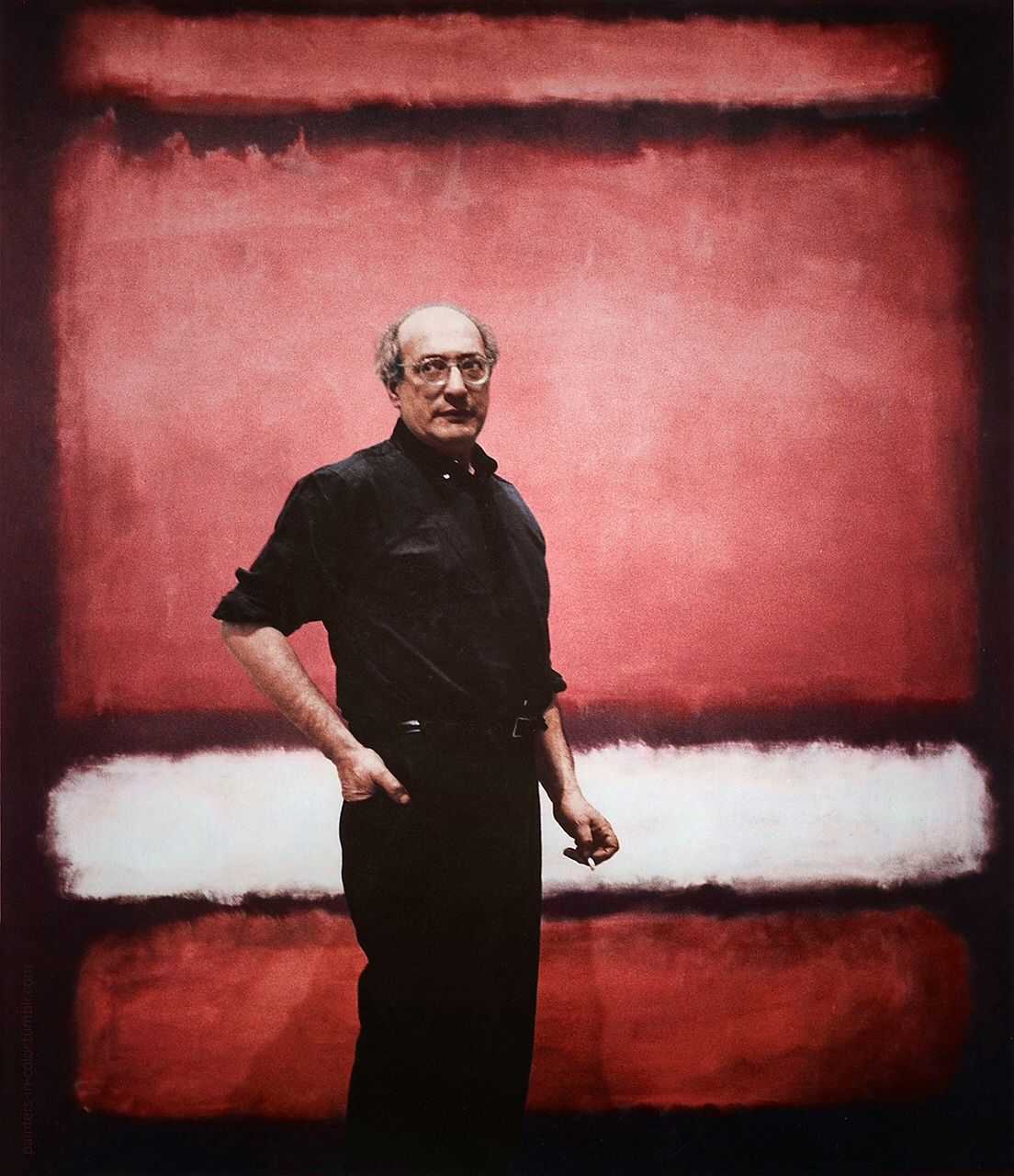
“The Artist” by Stanley Kunitz

This is not a poetry blog [sic], though from time to time I like to post poems or poetry-related matters. In this instance, I’m posting this poem by Stanley Kunitz (1905-2006) because I can’t find it anywhere online. Now, hopefully, if someone is searching for it they will find it. More of his poetry can be read here, or in his Collected Poems.
 
8 things to know about Mark Rothko - Art Shortlist
___________________________________________________________________________
His paintings grew darker every year.
They filled the walls, they filled the room;
eventually they filled his world –
all but the ravishment.
When voices faded, he would rush to hear
the scratched soul of Mozart
endlessly in gyre.
Back and forth, back and forth,
he paced the paint-smeared floor,
diminishing in size each time he turned,
trapped in his monumental void,
raving against his adversaries.
At last he took a knife in his hand
and slashed an exit for himself
between the frames of his tall scenery.
Through the holes of his tattered universe
the first innocence and the light
came pouring in.
 
(from The Collected Poems, Norton 2000)

If you like this poem, you might also like Day Lasts Forever: Selected Poems of Mario dell ‘Arco

The history book of the universe

Pharyngula is always brimming with interesting things. Today PZ posted this video of creationist propaganda in action. Watch it. Squirm while you think, but I don’t believe in Ken Ham’s God! If you have any doubts why atheism just seems to have sprung up out of nowhere while you were sleeping, this video should explain what so many of us have been so nobly speaking out against.

“So here are some more sacrilegious acts you can commit. Learn something new. Teach something new. Question dogma. Challenge tradition. Laugh at the quaint myths religion offers us.” – PZ Meyers (Video removed.)

*Postscript: It’s worth mentioning that the “grandfather” and “grandmother” in Ham’s photoshopped presentation actually look quite a bit like Ham himself. So I suppose he’s a monkey-man after all.

All my friends are Deists

Recently every conversation I have had has devolved into, “I can’t believe you call yourself an atheist!” Then follow accusations of bandwagoning, shallow reasoning and appeals to the Courtier’s Reply or the mystery card. My favorite is the accusation that I, as a non-believer, am somehow limited in my ability to appreciate fine art. Ha, ha Houdini!

The odd thing is that this is all coming not from religious folks, ministers, rabbis or what have you. These have almost exclusively been conversations with secular, avowedly non-religious people like myself who – for whatever reason – don’t like my calling myself an atheist.

“Just don’t proselytize and we’ll be alright.” Somehow we atheists have been confused with religious fanatics, with a church and a creed and a militant lobby of non-believers out to atheize America and the world.

But what arguments have they offered in favor of belief? None, I’m disappointed to say. I kind of look forward to a good, respectful debate, but all I’ve been offered has been the claim that I am presumptuous, materialistic (contrast with “spiritual”) or a preacher in disguise. “I don’t have enough faith to be an atheist,” I am rebuked. What does that statement even mean?

What I’ve learned about my “opponents” is this: they are all Deists. They all believe in some higher power which is ethereal, non-material, invisible, all-encompassing and completely devoid of any of the qualities most people mean when they speak of God. “Oh,” they say, “I don’t believe in that pedestrian, biblical God, or miracles, or any of that stuff. Ha! You atheists are so dumb you’re the only ones left who believe that crap. If that’s your straw man God, I’ll stick with the believers.”

So what do they believe in? “Spirituality,” “love,” and any number of heightened, pseudo-religious states of appreciation are the usual answers. The divine spark that separates us humans from baser forms of life. Intimate conversations with the deity. They believe in the God of Fine Art. A wireless iGod with infinite loving memory.

They can have their Terry Eagleton, though. Because none of these are remotely persuasive arguments for the existence of a god or God Himself. People seem almost embarrassed to have their intimate, personal deity confused with the huffy-puffy swordsman of biblical lore. Don’t they realize that religious folks probably lump them in with the atheists?

So let’s clear something up: atheists are not proposing any counter-cult to the thousands of existing cults out there. We remain unconvinced by them all. We are just like you, only we believe in one less god than you do (if you are Hindu or polytheist of another stripe, rest assured we don’t believe in any of your gods either). End of story. If this is so bothersome, most atheists welcome lively debate or exchange of ideas. We promote discussion and differing points of view. But if all you can muster against us is, “You’ll never understand the spiritual dimension of Mark Rothko’s later paintings unless you admit there is an immaterial plane where altered truths reveal themselves…” then I’ll remind you that that’s exactly the way cults of all types work. The truth can’t be revealed to you unless you give yourself over to faith.

So, if anyone reading this has any novel, powerful arguments for the existence of God (or the god of your choice), I’m listening. Until then, I’m happily godless and enjoying every minute of it.

My unremarkable loss of faith story

I have been unofficially appointed “God columnist” for this magazine. Don’t ask me how that happened, because I don’t even believe in it. God, that is. It’s not quite right for me to use gender-specific pronouns when speaking of what, to my mind, doesn’t even exist.

I think my appointment has to do with the fact that I can’t seem to stay away from the subject of religion. Try as I might, I can’t avoid it. It’s everywhere I look. To tell you the truth, I don’t really mind it unless I’m expected to revere it, pay it “respect,” or financially support it in any way other than voluntarily.

Then there are those other itsy-bitsy issues that keep popping up like the National Day of Prayer. Some of my secular friends are bewildered as to why we atheists are upset at something so benign, so negligibly harmless as a government-sponsored prayer day. It may sound silly, but once God gets its foot in the door, all sorts of unsavory things scamper in with the breeze.

I know this because I live in Italy, where the constitution states that all religions are equal, but that the relationship between the Catholic Church and the state is governed by the eighty-year old Lateran Pacts. Crucifixes are stuck to the walls of public schools, courtrooms and other buildings. There is even a Catholic religion-hour in school, with teachers handpicked by the Vatican and paid for by the state.

In the eyes of a secularist, this is a bad thing. It means that non-Catholics are put on a separate plane in public life. Where are our symbols, we ask? The answer from the religious apologists is telling, though. No longer are they mouthing off about “truth” and “salvation” in defense of their symbols; now they use more acceptable terminology like “The crucifix is an inseparable part of Italian culture,” or “It is a universal symbol of love.” As some skeptics have pointed out, that is also a working definition of pizza.

But now for my unremarkable loss of faith story. Losses of faith stories are fascinating, don’t you think? They exude an air of epiphany similar to that of religious conversion, at least on the surface. The truth is that I, apparently alone among my countrymen and women, came of age in the United States of America — the most devout developed country on earth — without so much as ever having peeked between the pages of a Bible. In fact, and I’m slightly embarrassed to admit this (but isn’t that what personal anecdotes so gingerly proffer?), but I wasn’t even aware that the Bible was about the Jews.

Of course, I knew I was Jewish. I just had no idea what that meant on a historical scale. Religion was perhaps the only subject — right next to politics — that was never addressed in our home. Years later, my sister would come to regret this omission. But it wasn’t deliberate. Our parents were simply not religious people, and the enlightened suburb of Baltimore we lived in was not Bible-drunk. In many ways it was the archetypal American secular experience.

It wasn’t until I came to Italy that I realized what I had missed. When I met my wife, she had just gone through an idol-smashing of her own, in which she had managed to break through the wall of traditionalist religion that society and her family had built around her. She had become infatuated with Judaism. That’s when I began to read the Bible, because being Jewish suddenly seemed electrifying and special. This was no longer midtown Manhattan.

I read the Bible, or “Tanakh,” as I learned to call it. I felt I needed to grasp Jewishness at its core. As I read, I tried hard to believe what I read. I began — for the first time — to employ expressions like “God willing” and “Thank God.” I tried praying, although I knew no Hebrew. I would mouth the words I read in transliterated Roman characters: “Baruch atah adonai, eloheynu melekh ha-olam…” Over time I began to make some sense of all this newness. I began to think deeply about God, observe a very personalized form of kashrut (the Jewish dietary laws), attend synagogue on holy days and fast on Yom Kippur. This lasted for about three years. Then, as quickly as it began, it ended.

Looking back, I realize I censored myself at every pass. I constructed an ad-hoc reality for myself out of holy books. I wouldn’t even read novels on shabbat because I wished to preserve some of its holiness. No matter that I worked on that day. God didn’t want me to be unemployed, did he? Then who would praise him? I’d stroll home from work, basking in the glow of the dying sunlight, then dutifully search out the first three stars which marked the beginning of the profane week ahead. It wasn’t much of a Sabbath, but I managed to make it feel special. I knew I could feel the presence of the shekhinah, the divine essence, descending on the world each week.

Or maybe it was just the smog at Largo Argentina.

– Published in The American

I’m getting my daughter one of these when she’s eight

BlagHag’s Atheist Barbie (ok the no pants thing we can discuss).

Some of the old tricks

I used to play around on ramps like this when I was a tyke. Then gave up skating when I went to college, like so many, and never went back to it. I was even embarrassed by my past as a skater (it was very unintellectual-sounding) for awhile, but I got over that, too. Now I really enjoy checking out what the young’ns are doing these days. They just keep blowing my mind.

Update. Compare with this video, recently salvaged by a friend (and don’t laugh). Play simultaneously for optimum effect:

National Day of Prayer is such a bad idea

I’m not even sure I can find the words – without offending almost everyone I know – to describe why this is such a bad idea. “What is so offensive about God?” It’s this kind of question that creates atheists.

Those, myself included, who do not think God – or any type of “higher power” – exists (except in the minds of the faithful), might answer, “Nothing is offensive about God, as long as you keep Him or It out of public life.”

National Day of Prayer is clearly in violation of this principle. Non-theistic Americans are being told, “Unless you pray, you are excluded. Your government encourages you to pray.” For what, pray tell? Money? Power? To stave off disaster from our shores? To win the lottery?

If you do believe in God, or any of the many gods on offer, that’s your business. I respect you, even if I may not respect your belief. I will not lobby for our government to enforce an National Day of Unbelief. And I will remind you that the only type of society in which both you and I are equals is a society which nurtures each individual’s right to believe, or not believe, in accordance with his or her own conscience.

I don’t especially want to turn you into a non-believer. I don’t care to debaptize you or your children. Calm down. There is no atheist inquisition out to get you. All we want are the equal rights guaranteed to all citizens by the constitution, with no favoritism of the religious over the non-religious.

And I would expect religious people to be a bit more up in arms over this as well. Do you really want your government trampling over your personal relationship with God? Rev. Barry Lynn has a great piece in which he writes,

Government is supposed to be neutral on religion. It has no business telling people how, when or where to pray — or even if they ought to pray. Government does lots of things well, but meddling in our private religious lives is not among them.

I know people who think we atheists are “obsessive” about separation of church and state. But this is a very real, and important, battle none of us can afford to lose.

“Will you ask that ‘under God’ be removed from the Pledge of Allegiance? ‘In God We Trust’ from money? Will you people not stop until you have destroyed God entirely?”

This is typical Fox News talk, and not really worthy of serious discussion. But, for the record, it wouldn’t be a bad start.

Because once you open the door to God, all sorts of opportunistic little critters start scampering in. And, trust me, you don’t want them around.

Mario Dell’Arco

No, I haven’t stopped blogging. But I do have a life. Among the many things I manage to pack into the twenty-four measly hours of a day, I translate poetry. Since I’m working on a manuscript, the blog logically goes on the back burner. And since nobody reading this has probably ever heard of Mario Dell’Arco, here is a sample of his work. This and about ten other lyrics were published in the Autumn 2009 issue of the Journal of Italian Translation. Go buy a copy.

Diffidenza

Giove compie mill’anni, e l’animali
je porteno er cadò.
La serpe striscia co una rosa in bocca
e Giove: – Cocca, accetto li regali;
ma da una serpe, e da la bocca, no.

Diffidence

At Jove’s one-thousandth birthday bash
the animals paid their respects.
The serpent brought him a rose. Jove quipped:
– That I love presents everybody knows;
but from the snake, and from its mouth,
that gift I can’t accept.