
Author: Marc Alan Di Martino
David Cross: “Perfect Ruby Starfruit”
Here is comedian David Cross on sexual abuse in the Catholic Church. The routine is from a few years ago. It’s hilarious and unsparing.
A Special Kind of Sin
Italy’s Il Messaggero has published an interview with Monignor Gianfranco Girotti, who makes some amazing claims. The Church is embroiled in sex scandals up to its ears: Holland, Germany, Ireland and even Vatican City itself are on the block. In a discussion of sin, Monsignor Girotti explains that murder and pedophilia – if accompanied by proper and convincing repentance by the offender – are absolvable. Abortion, he rhapsodizes, is a “special kind of sin.” Not only is it homicide, but it’s a profanation of the Eucarist! Which, if you didn’t get the Monsignor’s point, is much worse than raping children, covering it up and then lying about it to the press. Not to mention making lame and implausible excuses for the rapists themselves and shielding them from a proper prosecution.
Now Reading: The Seduction of Unreason
Read the introduction here.
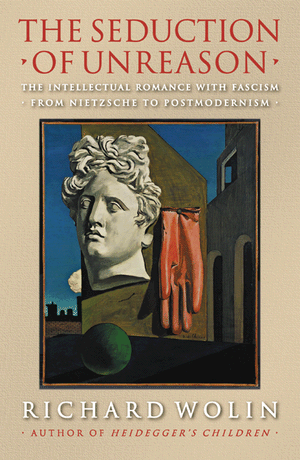
“That postmodernists rely unwittingly on arguments and positions developed by proponents of Counter-Enlightenment does not mean they are conservative, let alone reactionary. The study that follows is not an exercise in guilt-by-association. Nevertheless, such reliance suggests that their standpoint is confused, that the disjunction between their epistemological radicalism and their political preferences (supposedly “progressive,” though often difficult to pinpoint) results in a fundamental incoherence. Nor are postmodernists, as their right-wing detractors maintain, particularly “dangerous.” Despite their antipathy to democracy and their radical political longings, they, too, are the beneficiaries of a modern political culture in which tolerance has been enshrined as a fundamental value.”
Worse than the USSR?
Here in Italy we’re in the middle of a media blackout. That means you can’t mention anyone by name until the regional elections at the end of the month. So what were once lively televised debates have become censored affairs full of, “Don’t say that!” and the bleeping out of certain names. Of course, they get around the censors by calling Berlusconi “The Sultan,” or some such euphemism. Kinoppete suggests things were actually better in the USSR circa 1976:
Review of 36 Arguments for the Existence of God
 Rebecca Newberger Goldstein has written a highly intellectual – and intelligent – book. One might even be tempted to classify it as the first “new atheist” novel. The protagonist of her book is a slightly snuggly version of author Sam Harris — an unknown academic named Cass Seltzer who pens a runaway atheist bestseller. But this doesn’t make “36 Arguments” a polemic on atheism (which may disappoint some readers.) Not to worry, though. The dialogues are playful, the characters vivid, and the overall feel is one of affectionate satire towards the uptight world of academia.
It has been said that the book paints an unflattering picture of the literary critic Harold Bloom, whose alias Goldstein makes the object of a spirited burlesque. This reviewer is of the opinion that no malevolence was intended. Sure, Jonas Elijah Klapper comes off as a gluttonous genius with a penchant for rambling kabbalistic interpretation of poems like “Dover Beach,” but there’s so much verve and enjoyment in the ideas he (she) toys with that a certain admiration shines through nonetheless. Who would argue that the real Bloom — a self-described “Falstaffian” — presents himself in much the same way as Goldstein’s fictional one?
The appendix of the novel consists of 36 (a recurring number in this mathematics-driven book) philosophical arguments for the existence of God and their subsequent refutation. While the narrative itself is full of atheists — a sexy game theorist, a cameo by literary agent John Brockman and the likeable anthropologist-cum-Rastafarian chauffer Roz Marglois, there is no special attention paid to atheism. It’s just part of life at Frankfurter University.
All this intellectual action climaxes in a debate between Seltzer and his fictional theistic antagonist, a Nobel prize-winning economist named Felix Fidley. Unsmiling Fidley comes off a bit unflatteringly, as one might expect. The scene is a page-turner. Fidley’s arguments for God fall predictably flat.
Goldstein has an uncanny grasp on the dynamics of academic rivalry. She is also a pushover for romantic love with a knack for wonderfully constructed English sentences. Best novelty: she coins her own meme, “to fang,” meaning “to pose a question from which the questioned can’t recover.”
– from The American
Get In Line, Boys

An American Radical
I missed American Radical: the Trials of Norman Finkelstein in the theater, but I hope to catch a copy on the black market. It’s even said to be well-balanced and fair, and that’s a real selling-point when talking about Norman Finkelstein. Watch the trailer below. I’ll just point out that F’s initial declaration, “Excuse me, every single member of my family on both sides was exterminated…” (um, playing the Holocaust card again, Norman?) can’t be taken too seriously. A minute later in the same trailer, he’s kvetching about how his mother thought he had taken her too literally and was destroying his life for an ideal. So was she exterminated or not? If not, the author of The Holocaust Industry is fabricating his own personal history around a people’s tragedy in order to win sympathy from his listeners. Sound familiar?
36 Arguments
I just finished reading Rebecca Newberger Goldstein’s 36 Arguments for the Existence of God. Well, I still have to get through the appendix, where the arguments are stated (and refuted) logically, but the meat of the novel is behind me.
Tempted as I was to think of it as the first “new atheist” novel, one whose protagonist is a public atheist a là Sam Harris (though much more cuddly and polite), I’m not so sure if that’s the best way to characterize Goldstein’s book. Which means it’s not fiction-as-propaganda for the new atheism. It’s a pretty sappy modern love story with affectionate portraits of Hasidim reminiscent of Chaim Potok’s The Chosen.
Of course, there’s a lot of what John Brockman dubbed the “third culture,” which means science: game theory, mathematics, anthropology, etc…and a brilliantly over-the-top lampoon of Harold Bloom which is worth the read in itself.
So will this book convince you God does not exist? No. But then again, you don’t need books to help you with that, do you?
Is Suicide Painless?
Yesterday the news reached me that an old friend committed suicide. We grew up together in suburban Maryland. Our families were close. Our mothers and sisters were friends as well. There was a kind of inseparableness that governed our friendship in the golden years before adolescence took its toll and widened the gap between us forever.
He was sent away to a private school, then a military school, ostensibly because he was becoming increasingly uncontrollable and violent. He discovered drugs. When, after a few years, he returned to our public school I didn’t recognize him. He had grown tall and awkward. His skin had taken on a strange shade of purple. His blonde hair was ratty and knotted. His voice had become a bellow and his manners antagonistic. Before the year was out, he disappeared again.
Twenty years have passed since I last saw him. He never kicked his addiction to drugs. Our mothers are still friendly. News of his suicide – despite our unbridgeable distance over the years – is like a small part of my past which has been definitively silenced.
I didn’t think I even cared about him anymore. I was wrong. Alav ha-shalom.

