“During Operation Cast Lead, the IDF did more to safeguard the rights of civilians in a combat zone than any other army in the history of warfare.” Kemp said this at the United Nations. Courtesy of UN Watch.
Author: Marc Alan Di Martino
God Wants You to Be Rich, Fucked Up and Misunderstood
Here’s the weird item of the week: “America’s Rabbi,” Shmuley Boteach, has a new book out: The Michael Jackson Tapes. It turns out–for those of us who weren’t following either of their careers too closely–that Boteach was Michael Jackson’s “close spiritual guide.” I actually held the book in my hands and opened it today. The subject matter varied from Michael’s days as a Jehovah’s Witness to his hopes that children get to play in heaven. We even get Jacko on Hitler and his boundless love for the Jewish people (ok so I didn’t open the book at random, exactly).
Remember, this is a man who surrounded himself with mannequins.
The Muhammad of Midtown
The indefatigable Taxi Gourmet recently reviewed Muhammad Rahman’s Kwik Meal #1, midtown Manhattan’s most viral food cart. I should know, as I used to go there back in the day when it was still an upstart, and before there were even two of them, and word was just beginning to spread across the borough. It still has the best falafel sandwich I’ve ever tasted, bar none. Then again, after six years in Rome, that’s not such a difficult accolade to aquire.
Taxi tells the tale, as it was told by me:
It was actually a poem by Taxi Gourmet reader Marc Alan Di Martino that moved me to consummate my curiosity about Kwik Meal’s food:
“I was a regular at Muhammad Rahman’s Kwik Meal #1 cart, as were we all at the Gotham [Book Mart]…And one day Mr. Rahman — who was aware that I wrote poetry — asked me to write him something that would make people stop and eat. I declined. He insisted. I wrote, and he paid me in falafel sandwiches.”
I wrote about this here. It was Macy Halford at the New Yorker who “discovered” my little couplets and wrote them up in the New Yorker’s Book Bench column. Midtown is a great place to get noticed, even if you’re not a naked cowboy.
Here’s the poem, a stab at heroic light verse:
Of pleasures gastronomical I sing
Incomparable treasures; everything
Cooked to perfection by the expert hands
Striving to meet the customers’ demands.
A sweet aroma scents the afternoon
Air like some harbinger of happy June
When people hunger for the tastiest
Sandwich in Midtown: they have the best.
The really great part of the story, and the reason I had to get in touch with Ms. Halford, was that the poem (admittedly no great shakes) was attributed to a certain Thane Dimatims. Such blunders often inspire innovations, and in this case it became the stuff of poetry,or rather a long narrative poem which will be published to great acclaim a century or so after I am dead. “As it was, so it will be”, said the pope. Or was it Pope?
Next time you’re in midtown, tell Muhammad I sent you.
We Need One of These in Rome
The escalators don’t work anyway.
My Vote Goes to Sarah Silverman
Taxi Gourmet: Staying Thin and not Going Broke
I have yet to meet Layne Mosler, better known as Taxi Gourmet. But I like what she does, which is go around town in a taxi trying to find great places to eat. Of course, you have to be adventurous. Every so often, you even have to squirm before a plate of tripe.
Rome
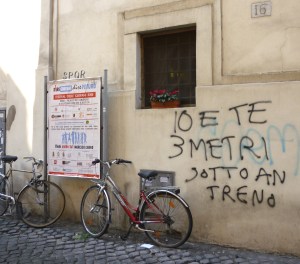
Is Santa Claus Really the Pope All Dressed Up in Red?
Madeleine Johnson, my colleague at The American, has a brilliant satire on the Italian citizenship quiz. Of course, I challenge anyone to guess whether she made this up or not. That’s what’s brilliant–it just might be true.
— Which of the following is known to cause cancer among Italians?
•a. Drafts;
•b. Indigestion;
•c. Not wearing a woolen undershirt;
•d. Smoking.
— Padre Pio is:
•a. The center of a lucrative cult that aims to defraud and delude the credulous;
•b. The priest who administered the last rites to Elvis Presley;
•c. A saint whose good works and popularity has attracted envy and hostility from the Roman Catholic Church hierarchy;
•d. The patron saint of taxi drivers.
T.S. Eliot and his Enemies
T.S. Eliot’s reputation has undergone a thorough reassessment over the last sixty years or so. He was, at mid-century, the prevailing protagonist of orthodox English literature. As both poet and critic, he was worshipped in the academies and by struggling young poets alike. Hart Crane’s admiration from Eliot was so extreme that his long epic The Bridge was conceived as an answer to The Wasteland.
In 1951 the Anglo-Jewish poet Emanuel Litvinoff read a poem that he had written, “To T.S. Eliot.” It was something of a game-changer, as it brought into the open the most uncomfortable aspect of Eliot’s poetry–his anti-Semitism. Amazingly, Eliot was in the audience that evening and is quoted as saying, “It is a good poem, it is a very good poem.”
None of this is news, however. In 1995 Cambridge University Press published a book-length study of Eliot’s controversial poetry, “T.S. Eliot, anti-Semitism and Literary Form” by Anthony Julius. A few years later, Julius would represent Deborah Lipstadt in court against David Irving. Lipstadt was defending herself against a charge of libel. She had written that Irving was a Holocaust-denier. He pressed charges, and the court found him giuilty. Lipstadt’s account can be read in History on Trial: My Day in Court with a Holocaust Denier.”
But what is so extraordinary about T.S. Eliot, you ask? Everyone, arguably, was anti-Semitic in those days. Except, of course, those who weren’t. And Jews themselves, who paid a hefty price for this durable brand of bigotry. Litvinoff was horrified not only that Eliot had written these poems in the first place as far back as the 1920s, or even earlier. Litvinoff was horrified by the fact that Eliot had them reprinted in his 1948 Selected Poems. Considering that Eliot had barred his embarrassing early book, After Strange Gods, from ever being reprinted, one must ask the question: Why did he allow his Der Sturmeresque characterizations of Jews (or “jews” as Eliot himself wrote it) to be reprinted immediately following the Nazi carnage? Could this have been an oversight on the part of the great poet? If so, then why was After Strange Gods, with its ranting on about perilious “freethinking Jews” (p.20) and the utopian dream of a “Christian society” (p.21), not similarly overlooked?
These are just some of the questions readers must ask themselves when they open Eliot and begin reading, “The rats are underneath the piles/ the jew is underneath the lot.”
Carl Bernstein: Berlusconi Bordering on Stalinism
Carl Bernstein was invited on the controversial Italain political show Annozero last night. He spoke twice (from New York), and it appeared that there were indeed two separate Carl Bernsteins: one who chose journalistic prudence: “We have to be very careful of generalizations. I think many of the restrictions of good journalism are self-imposed.” He won a Pulitzer Prize, so he should know. Below is the clip, around 4:30. (Video blocked.)
Which brings us to the second Carl Bernstein. About half an hour later, the previously prudent Bernstein–who had admitted he wasn’t in any position to judge Italian politics because he didn’t really follow them–lashed out against the Berlusconi government as “a kind of Soviet Stalinism.” You can hear this at around 3:20 in the clip below. (Same story.)
What was responsible for the sudden change of heart? Even Michele Santoro, who earlier had introduced Bernstein as “played by Robert Redford in the movie”, commented: “Bernstein must have had an espresso.”
 Marc Di Martino