Here’s the latest video from the Thinking Atheist. I almost take it for granted that Christmas is – like the Bible and most everything else in Christianity – a mishmash of earlier, mostly forgotten (and suppressed) traditions.
Happy holidays!
Here’s the latest video from the Thinking Atheist. I almost take it for granted that Christmas is – like the Bible and most everything else in Christianity – a mishmash of earlier, mostly forgotten (and suppressed) traditions.
Happy holidays!
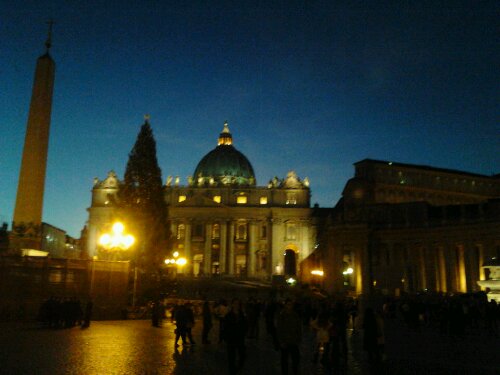
The Vatican isn’t an actual country. It just plays one on television. Here you can see about 60% of it. The rest is the garden in the back. Average annual earnings of its citizens circa 400.000 euro. Enjoy your day.
We watched “Barney’s Version” last night. It didn’t really render the uproarious nature of Richler’s novel and it was a bit sentimental. Much sadder than the book. And where in the novel Barney married his first wife in Paris, in the movie it happened in Rome. Here’s the scene, which is hilarious for Clara’s shiksa spiel.
(Two generations of my family were married in that same red room on the Campidoglio!)
Well, it seems the new government expects everyone to do their part in getting Italy out of its current economic straits – except, you guessed it, the Catholic Church. When asked a direct question on the subject, PM Mario Monti reportedly answerd that “he hadn’t yet considered” making the outlandishly privileged Church pay tax on its commercial assets (an estimated 1 out of 5 properties in Italy are in Church hands). Which is outrageous. Really, the list of offenses just gets longer and longer. Why should anyone be this privileged – above all the richest (and arguably most corrupt and morally bankrupt) country – yes, it’s another fucking country! – on Earth? Can anyone explain to me why those of us who oppose such privileges haven’t yet reached a critical mass?
There’s a new website (icostidellachiesa.it) detailing the actual cost of the Catholic Church. It’s a frightening read. And since most Italians have absolutely no idea how they are financing this freeloading institution, the time has come to educate them. This is the elephant in the room, Italy.

The Freedom From Religion Foundation has a number of their billboards available on their website. Now that the holiday season has begun, I thought I’d post one of my favorites here.

I’ve never really been a huge fan of December and the competing religious holidays. Personally, I’d just assume let them pass unnoticed. But when children are involved there’s just no way to do that. As a parent, I want our daughter to enjoy this time of year without her feeling out of place because her parents aren’t religious. The best solution is not to forcibly shield her from images of Santa or fir trees (what’s religious about them?) but to celebrate in a secular fashion. This holds true throughout the year, of course.
In a few years I’ll be able to explain the above message to her. For now, though, the important thing is to help her to enjoy her life and grow up without dogma. This will be increasingly hard as she gets older and enters the Italian public school system, which is distinguished by its institutionalization of Catholic religious proselytizing. Why should it be so difficult to be free from religion?
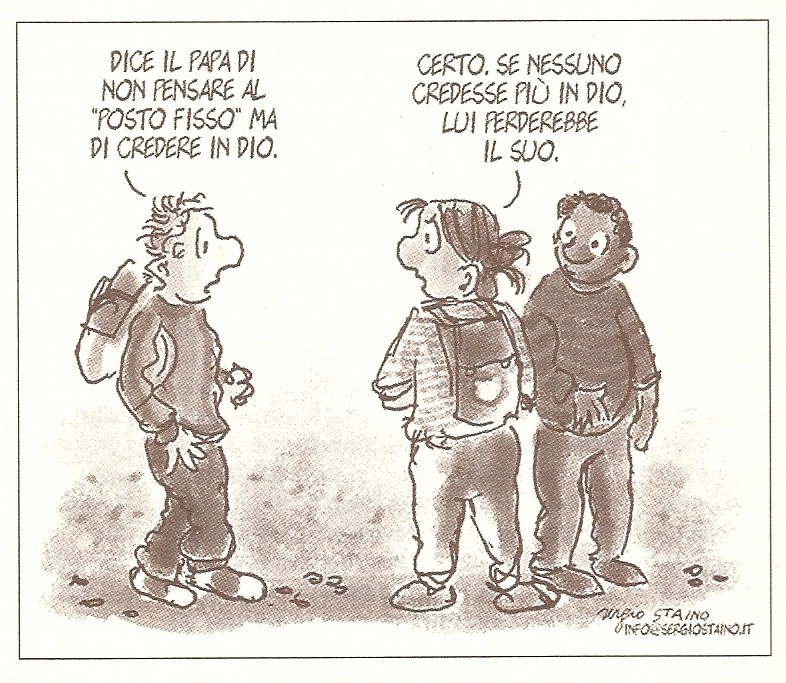
This is a funny cartoon by Sergio Staino. In English it might read something like this:
“The pope says not to worry about getting a permanent job, but rather to believe in god.”
“Sure. If no one believed in god, he’d lose his job.”
Aspiring to a “posto fisso” is one of the hallmarks of Italian society. The pope is always making such idiotic statements.
via L’ATEO.
Sometimes I wonder which is preferable: to live in a place like the US, where religious nuttiness is rampant among the population (and certainly not unknown among politicians), or a place like Italy, where the population is largely complacent and indifferent thanks to an unoffical State religion and politicians submit sheepishly to the whims of the State church.
American separation has led to a lively “cafeteria style” marketplace for all religions to compete for customers. Italy, on the other hand, has the Vatican: it’s a separate country nestled in the city of Rome, an autocracy and a theocracy (the last in Europe, I believe) which has the constitutionally-recognized right to interfere in Italian political life and – and this is the kicker – immunity from interference from the Italian government.
In fact, the Italian constitution is schizophrenic on this issue.
Art. 3
All citizens have equal social dignity and are equal before the law, without
distinction of sex, race, language, religion, political opinion, personal and
social conditions.
—
Art. 7
The State and the Catholic Church are independent and sovereign, each
within its own sphere.
Their relations are regulated by the Lateran pacts. Amendments to such Pacts
which are accepted by both parties shall not require the procedure of
constitutional amendments.
—
Art. 8
All religious denominations are equally free before the law.
Denominations other than Catholicism have the right to self-organisation
according to their own statutes, provided these do not conflict with Italian law.
Their relations with the State are regulated by law, based on agreements with
their respective representatives.
And it goes on like this, first establishing perfectly reasonable things like freedom of conscience, and then goes on to contradict itself by stating that the Catholic church has an entirely separate set of rules which govern its relations with the state (rules which highly favor the church and undermine the secular nature of the constitution.)
The Lateran Treaty (“All foreigners in official ecclesiastical employment in Rome shall enjoy the personal guarantees appertaining to Italian citizens, in accordance with the laws of the Kingdom of Italy.”) is the basis for an immense amount of biased and unfair treatment of non-Catholics in Italy as well as enormous and completely unjustified privileges for Catholics and clergy. They need to be abolished if Italy wishes to become a truly European nation based on secularism and rule of law and emerge from its illiberal, fascist-tainted past.
Of course, without Italy’s gentle nursing, the Vatican would probably wither away and disappear from the face of the Earth. Which wouldn’t be a bad thing for anybody.
I’ve recently been digging into Twain’s Innocents Abroad. I carry it around on my phone’s Kindle app, so usually I read a few “locations” at a time while waiting in line in the supermarket or killing time somewhere. Today I came across a marvelous passage about the shiftless population of the Azores. It sums up what is the matter with so much “traditional” culture:
The good Catholic Portuguese crossed himself and prayed God to shield him from all blasphemous desire to know more than his father did before him. The climate is mild; they never have snow or ice, and I saw no chimneys in the town. The donkeys and the men, women, and children of a family all eat and sleep in the same room, and are unclean, are ravaged by vermin, and are truly happy. The people lie, and cheat the stranger, and are desperately ignorant, and have hardly any reverence for their dead. The latter trait shows how little better they are than the donkeys they eat and sleep with.
The only well-dressed Portuguese in the camp are the half a dozen well-to-do families, the Jesuit priests, and the soldiers of the little garrison. The wages of a laborer are twenty to twenty-four cents a day, and those of a good mechanic about twice as much. They count it in reis at a thousand to the dollar, and this makes them rich and contented. Fine grapes used to grow in the islands, and an excellent wine was made and exported. But a disease killed all the vines fifteen years ago, and since that time no wine has been made. The islands being wholly of volcanic origin, the soil is necessarily very rich. Nearly every foot of ground is under cultivation, and two or three crops a year of each article are produced, but nothing is exported except a few oranges—chiefly to England. Nobody comes here, and nobody goes away. News is a thing unknown in Fayal. A thirst for it is a passion equally unknown.
You know and I know that there are still many places like this in the world today (more or less). Now every time someone makes an argumentum ad antiquitatem I’m going to envision this desolate scene and humans sleeping in the same room as donkeys.

I’m reminded, now more than ever, of something Arthur Miller (yes, that Arthur Miller) told me as we sat together in his kitchen on 68th St. in Manhattan. “One day in the future” — this was around 1999 or 2000 — “someone will have an idea of genius. They’ll decide to put books in a store and allow people to come in and browse them. It’ll be called a ‘bookstore.'”
You’re probably asking yourself what I was doing in Arthur Miller’s kitchen. My then-employer, Gotham Book Mart, had sent me to get five or six large boxes of rare and not-so-rare books signed by the renowned playwright. One of the ways the sinking bookshop stayed afloat was by milking its proximity to famous authors. Signed books sold like hotcakes. They were a boon in a dying market, and if they couldn’t come in to sign and schmooze, we went to them.
The most remarkable such trip was to Provincetown, Massachusetts. We drove up from New York to spend the weekend with the famously hermetic illustrator Edward Gorey at his mansion on Cape Cod. Overgrown weeds had ambushed the house on all sides. Thorn bushes crowded the walkway up to the front door. Inside, the house reeked of cat urine.
Everywhere there were books: on sagging shelves, piled on top of tables, in stacks on the floor, cluttering up every conceivable surface. Any square inch not occupied by books was occupied by an equally endless collection of trinkets: I recall a rich assortment of colored glass bottles of every size along the many windowsills of Gorey’s great home. From the stairwell the theme song of “Cheers” resounded down through the sitting room. In contrast to the spooky, ethereal persona he projected through his books, the man was a television junkie.
Both Miller and Gorey have since died, and everywhere there are signs that bookstores are about to follow them to the grave. Of course, people have been talking about the death of God for a very long time, and the old bugger is still with us. So I’m not going to get all sentimental just yet. Bookstores — and, let’s just say it, books — may yet survive the online onslaught.
There was a time when I proudly stated I’d never buy a book from Amazon. A vacuous statement, and easy to say by someone who at the time lived in the vicinity of countless English-language bookstores. This was the same mouth that had proclaimed at various points in its history that it would never a) eat onions; b) kiss girls; c) speak a language other than English. The contradictory adage “Never say never” never seemed more appropriate.
Now that I’m living in a place with no access to anything in English but bestsellers — and even those must be hunted down — Amazon has begun to makes sense. It’s all so perfect. You go online (if you’re like me, you’re there already), find the book you want, click and wait for it to arrive at your door. All you need is an Internet connection and a mailing address. So why does clicking “Add to cart” make me feel so unethical?
I’ll chalk it up to having spent most of my working life in bookstores. I’ve breathed in so much of their dust that they’re part of me. The weirdo who comes wandering in off the street with Ziploc Baggies full of pennies and complaining about his rabbi will never infiltrate the virtual walls of online commerce (which is probably a good thing.) But neither will the Arthur Millers and Edward Goreys. And neither will all those odd and interesting people I’ve met over the years who simply happened to ask the right question to the right clerk at the right moment. Some of them are — yes, thanks to the Internet — still my friends.
Sure, you can have fun writing reviews and posting them to Amazon. There are all kinds of interactive ways of sharing your passion for books online, too. For me, however, they don’t quite measure up to the serendipitous experience of stumbling upon a book that changes you forever.
My personal library is like a large-scale model of the mental world I’ve inhabited for the past 20 or so years. I pride myself on being able to remember where and when I got just about every book in my collection. Downloading an e-book to my Kindle app is exhilarating for it’s speed and simplicity, but I doubt it will leave me with much after I’ve read and digested the text. Books have always been about more than just content, haven’t they?
Maybe I lack the visionary imagination of a Steve Jobs, but books are simple things in the end. They come in all shapes and sizes and they can take abuse. I’ll never forget the first time I actually saw a Kindle. A woman came into the bookshop, pulled the broken device from her purse and explained that she needed to buy back the books she’d lost when it slipped out of her hand onto the pavement. She was crestfallen.
As I muse on the demise of bookstores and the much-prophesied disappearance of the “dead-tree book” I watch my daughter flip the pages of “The Very Hungry Caterpillar.” She’s enjoying the colorful pictures of fruit and the feel of the cardboard in her hands. She pokes her fingers through the tiny holes. She’s just as taken in by the physical properties of this book as she is by the content — more, actually, as she can’t yet read.
What, I wonder, would her first experience with books be if she were to fondle a Kindle “Baby” reading device?
Mona Eltahawy was beaten and sexually assaulted yesterday by Egyptian police. They broke her left arm, her right hand and “surrounded me, groped and prodded my breasts, grabbed my genital area and I lost count how many hands tried to get into my trousers.”
These women out there on the front lines deserve our support. Let Mona explain what happened, though:
 Marc Di Martino