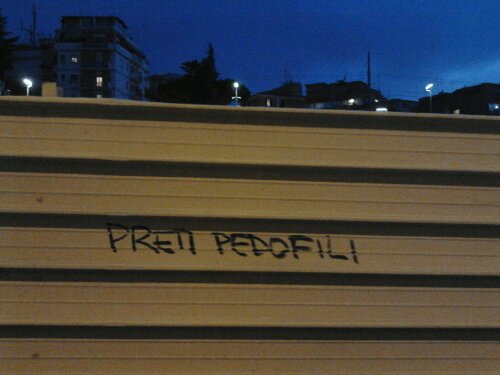
Rome burns – get used to it

Here’s a video of today’s “protests” in Rome. There’s a pattern to these protests, which basically boils down to a group of masked marauders getting in the middle of things and burning shit, throwing rocks through storefront windows and antagonizing the police. This typically destroys whatever force or function the protest might have had to begin with. The result is that everyone blames everyone else for the riots for days and weeks afterwards. Nothing is ever resolved. They never make a point. It’s just photos and videos of idiots with scarves over their faces throwing Molotov cocktails at the cops while those who came to actually demonstrate are sent hightailing it over the nearest fence. So much for the constitutional right to a peaceful protest. Enjoy your gelato.

Frederick Douglass on religious slaveholders

I’m not sure why, but until now I’ve never read Frederick Douglass’ Narrative. I think the impetus was actually from Carl Sagan, who devotes a section of The Demon-Haunted World to Douglass’ life.  It’s a remarkable story, not least for the improbability of its ever being written down. His escape from slavery began, however, with his clandestine education by the wife of one of his owners. She taught him to read, but not to write.

Douglass, while invoking a general sort of God throughout, has nothing but the harshest words for the pious Christian slave owners of the American South (mind you he was in Maryland, the state I grew up in 150 years later; the deep South is a whole ‘nother story, as we say.)

“I assert most unhesitatingly, that the religion of the south is a mere covering for the most horrid crimes – a justifier of the most appalling barbarity – a sanctifier of the most hateful frauds, and a dark shelter under which the darkest, foulest, grossest and most infernal slaveholders find the strongest protection. Were I to be again reduced to the chains of slavery, next to that enslavement, I should regard being the slave of a religious master the greatest calamity that could befall me. For of all the slaveholders with whom I have ever met, religious slaveholders are the worst. I have found them the meanest, the basest, the most cruel and cowardly, of all others. It was my unhappy lot not only to belong to a religious slaveholder, but to live in a community of such religionists.”

Bearing this in mind, isn’t it amazing more African-Americans aren’t hostile to religion in general, and Christianity in particular? I think so.

Jewishness without “God”

This goes back almost a month, but In the Moment excerpted my essay for Moment Magazine’s “Elephant in the Room” contest. The question was, “What does being Jewish mean without belief in God?” Entries are now closed. If I win, I get an iPad – so pray for me!

“In my Jewish excursions, one thing I never felt comfortable with was God. I disliked newly-learned expressions like ‘Baruch Hashem’ and the socially-driven piety I saw around me every day. (The Jews were behaving just like the Catholics, I thought.) The end came when, at Yom Kippur services one year, they brought out the Torah scrolls and the congregants began kissing them. ‘Idolaters!’ I wanted to scream. I left and never went back.

“Not long after this – and likely as a product of my voracious studying – I concluded I was an atheist. I spent some time thinking about how to reconcile my sense of Jewishness with my rejection of the Jewish God and, eventually, Judaism itself.

“I sometimes hear that a Jewish atheist is an oxymoron. In such cases I like to tell my one of my favorite jokes. A young student reveals to an elderly rabbi that he is an unbeliever. ‘And how long have you been studying Talmud?’ the rabbi asks. ‘Five years.’ ‘Only five years, and you have the nerve to call yourself apikoros!?’ (Apikoros is a rabbinical term for ‘atheist’, from the Greek philosopher Epicurus.)’ 

“As an atheist, my Jewishness is rooted in a shared historical identity and not belief in a popular idea called ‘God.’ If I thought for a moment that lacking this belief disqualified me as a Jew, I’d have no trouble saying goodbye to Jewishness forever. But I feel no pressure to make this choice. Jews have always been heterodox in their beliefs, despite attempts by zealots to unite them under one banner or another. It’s a bit like herding cats, or atheists.”

(There is) life after CELTA

“My blog is dead. My social life has disappeared. I’m living with my aunt, taking cold showers and eating one square meal a day.

No, I haven’t gotten divorced – I’m doing CELTA.

CELTA, for those who don’t know, means Certificate for English Language Teaching to Adults. And it’s a lot of work.

Let me rephrase that. I’d been told it was a lot of work by friends who’d done it. I was told the same thing during my screening for the course. Work, shmork was my response. I’m not some bedwetter just out of college who wants to pay for a trip to Thailand with sporadic teaching jobs. I’m an adult; I know from work.

I must concede, however, that they were right. It is a lot of work. It’s so much work that I almost decided to skip this month’s column. Work’s been coming out of my ears for two weeks now. And I’m loving every minute of it.”

The above paragraphs were written nearly halfway through the CELTA course. I’ve now “graduated.” I hit a point during the third week when I thought I was going to jump out of a top-floor window (in Rome that’s about the fifth floor). Nothing seemed to be going right. I wasn’t sleeping, and no matter how much studying I did it just wasn’t enough. Now that moment seems a thousand years ago.

Reading over what I’d written – the only thing I’d managed to write besides lesson plans and assignments all month – it almost seems I was exaggerating. I wasn’t. CELTA really is a kind of black hole. You can’t do anything else while you’re doing it: no work, no love-life, no entertainment. I’d compare it to the first month with a newborn: it sucks you in totally.

Thankfully, I have a daughter. On weekends, the only time I was able to think of anything but Monday’s lesson plan or some knotty grammar problem was when I was with her. She, alas, was more demanding than the Cambridge curriculum. Thank evolution!

Now my last lesson is behind me and I’m back home in Umbria with my family. Our daughter has begun walking and I’ve turned a year older. Summer is over and we’re putting blankets on our bed at night. The same wars that were going on in August continue into October. The world hasn’t stopped turning, not even for a second.

As the spumante goes flat in the fridge, though, a friend’s balmy sagacity zips by like an advertisement on a fast-moving bus: “That wasn’t your last lesson, dear; it was your first.”

A skeptic’s eye view of Rome

image

I found this right near the Vatican. Where else?

Just a reminder

This comes via Michelle at Bleeding Espresso:

I just thought I’d share it with anyone who still needs to hear it.
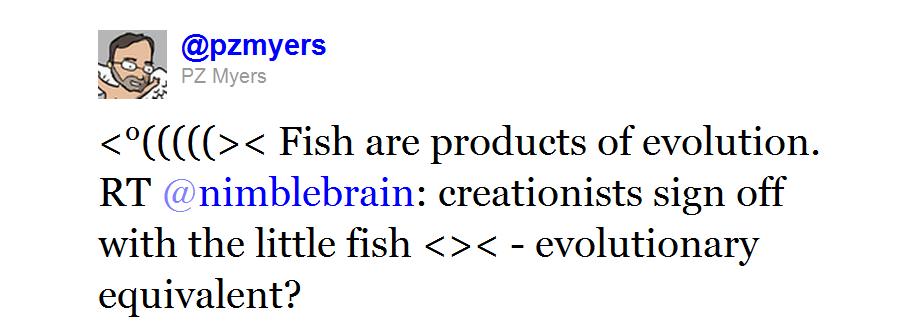
It’s not us, it’s them

I was having a conversation with a tweep this morning about a religious friend we have in common. Our friend is a rabbi. We both made sure to mention what a wonderful person she is, and then my tweep commented that she’s glad the rabbi accepts her, godlessness and all.

Then it dawned on me: Why is it the job of the religious to accept/not accept the non-religious? Who gave them such authority? (Nobody – they just claimed it for themselves without asking us.) My tweep and I were in agreement: it’s not us, it’s them. They’re the ones who believe weird things without evidence, not us. We’re normal.

Sometimes people who believe in weird things like gods happen to be exquisite human beings, too. Who woulda thunk it?


September 1, 1939

It’s September, which would not be complete without a re-reading of Auden’s great poem, “September 1, 1939“. That was the date of the Nazi invasion of Poland and the beginning of WWII. I’ve never understood why this poem didn’t make the cut in the Collected Poems (apparently Auden, in retrospect, didn’t think much of it – or perhaps he was concerned with false sentiment and “German usage,” as he put it); however, it’s available in the Vintage Selected Poems. And, of course, online. If you’re not familiar with it, read it – then go read Joseph Brodsky’s fine essay on it (it’s in one of his major essay collections). The poem begins:

I sit in one of the dives
On Fifty-second Street
Uncertain and afraid
As the clever hopes expire
Of a low dishonest decade:
Waves of anger and fear
Circulate over the bright
And darkened lands of the earth,
Obsessing our private lives;
The unmentionable odour of death
Offends the September night.

(keep reading…)

An embarrassment

I still haven’t seen the controversial statue of Pope John Paul II at Rome’s Termini Station. Next week I’m taking a train in and hope to gawk at it as it deserves.

Openly criticized across the political spectrum, on social networks and by commuters, the statue has also brought dim views from the Vatican’s daily newspaper itself. L’Osservatore Romano said it ”resembles a sentry box” and that its head is ”excessively spherical”. The city commission has listed several points it sees in need of intervention. Among them are the statue’s face, the head’s welding and inclination, the arm, the cloak, and the shoulder.

And that it reminds not a few of a very famous Italian dictator:

Some Romans and tourists think the giant artwork looks more like Fascist dictator Benito Mussolini.

”That bullet-like head on top, it reminds me of Mussolini,” said Enrico, a 42-year-old computer programmer who commutes from Latina south of Rome.

American tourist Sandra Hillhouse, 24, from Arizona, said: ”I don’t understand it at all. He looks more like one of those weird creatures from Star Trek”.

Well, anyone but the conservative religious leader Karol Wojtyla. But here’s the surprise:

Rome Mayor Gianni Alemanno has since been facing calls from political and cultural figures to ”do something” about a statue some think gives visitors an embarrassing impression of Rome’s contemporary cultural scene.

He said he would bow to popular opinion.

”If public opinion coalesces around a negative view, we’ll have to take that into consideration”.

So, presumably, if popular opinion were to express a largely negative view of the Vatican, Mayor Alemanno would have it renovated. It seems a negative view has been steadily coalescing for a few centuries around the papal palace, and has taken a turn for the worse in recent years.

But who ever took a politician at his or her word?