On March 12 – Mario dell’Arco‘s 120th birthday – I will take part in a presentation at the National Library of Rome with Marcello Fagiolo dell’Arco, Franco Onorati, Carolina Marconi, Riccardo Duranti& Gemma Costaon the topic of poetic translations from Romanesco. Below is the flyer for the event (in Italian). It is a great honor to be invited to speak about my experience translating the poems of Mario dell’Arco. If you’re in Rome or environs, feel free to drop in!
One of my favorite photos of him, doing what he loved. Sometime in the 1970s.
Roughly five years ago, then-editor of the journal Verse-VirtualFirestone Feinberg invited me to collect some of the poems I had been writing about my father and add some biographical notes in order to create a ‘portrait’ of him for publication. The ensuing piece, which I called “Starman” after one of the poems I had written (and ripped from the Bowie song of the same title) developed into my first book of poems, Unburial. “Starman” collects poems, biographical sketches and photos of the man who was my father, and whose sudden and premature passing left its mark on me in ways I am – now older than he ever was – perhaps still unable to fully understand.
February 11, 2025 marks thirty-five years without him.
I’ve made an Unburial playlist for anyone who wants to read the book in a different way, in which each poem is paired to a song that is meant to extend it or comment on it. It’s a pretty good playlist, I think!
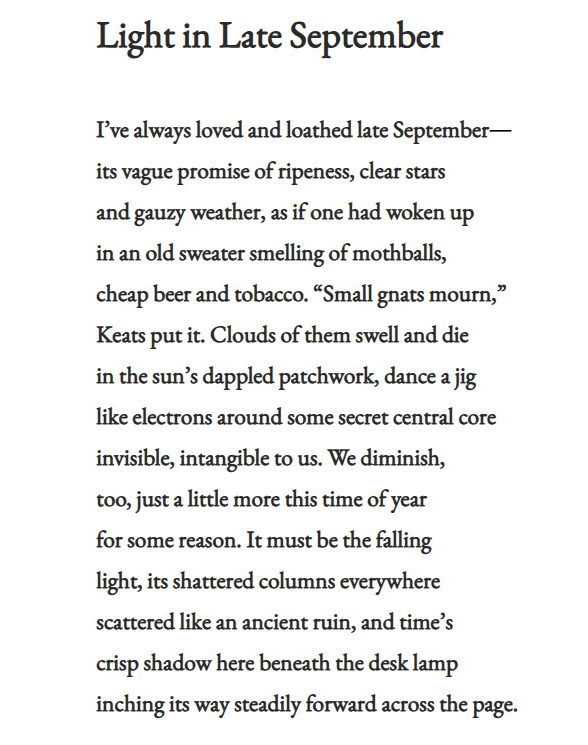
I have a new poem at SOFLOPOJO– or South Florida Poetry Journal* – called “Light in Late September”. It’s a bit of a companion piece to a poem I wrote a few years ago called “Sestina for the Falling Autumn Light“, a variation on the theme of the changing of the seasons, the waning of the light and the gradual entry into the dark half of the year. My birthday falls in late September, so I guess it’s a time of introspection for me. At that time last year I had just returned from a trip to the United States and was feeling hopful about the future of America and the world. The Harris campaign was in full swing, and it really looked like she had a strong chance at not only winning the election but winning decisively. So it goes.
The poem took its initial inspiration from a walk near my house, in Umbria. The sky was doing its usual late summer light show, full of pinks and deep yellows, streaked with the white of clouds like an artist’s brushstrokes. Swarms of gnats gathered in the dusk. Birds cut across the sky in formation. Later I found that Keats mentioned the gnats in his “Ode to Autumn“, and that image made its way into my poem. (In practice, whatever I’m reading worms its way into whatever I’m writing in one fashion or another.) Fiat lux!
*For future reference, the poem is in the February 2025 Issue, #36, which can be found in their Archives.
I have a think-piece – I love that expression – at Mark Danowsky’s newsletter Stay Curious this week. The piece is about submission fees, as the title hints at. I don’t love them, as the title also hints at. Here is a taste:
As a poet with a personal policy of not paying submission fees – except for a good cause or the rare contest fee – the number of journals open to me steadily grows fewer and fewer, not to mention those which have gone defunct. Of course, there are always new journals cropping up to replace them, and while many of them are promising, there is nothing quite like a long-serving journal, one that has survived the storms of time like an old ship, weathered and battle-scarred.
We have a convicted criminal in the Oval Office, surrounded by a cabal of oligarchs and sycophants making up a kakistocracy – government by the worst people. Not a day goes by when I don’t ask myself how we got here a second time, and if we will collectively make it to the other side of whatever this is. It’s in such times that the power of art and literature reveals itself more fully, becoming a way to cope with the encroaching darkeness and find a way through the muck.
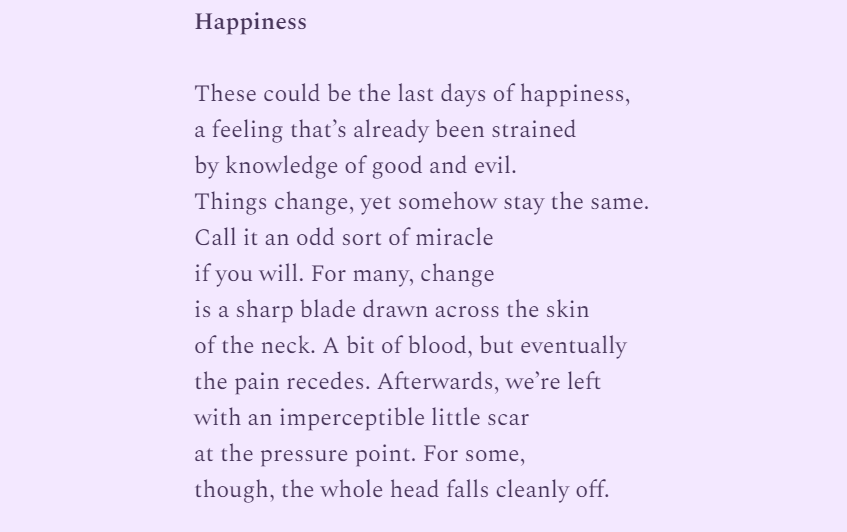
I have a sheaf of new poems at Judith Magazine, titled “A Failed Synonym for Love”, with a heartfelt introduction by editor Rachel Neve-Midbar, poet and translator of the poems of Vilna ghetto partisan and Israeli poet Abba Kovner. “Happiness”, was written just after the 2024 election. As an added bonus you get to read about how much I love bagels and lox!
No one can predict how bad things will get before they begin to get better again. Everyone must find their own way to resist evil: taking to the streets, calling their congresspeople, practicing everyday human decency – all of these counter the effects of malaise and disempowerment they’d like us to feel. “An artist is an artist”, as the recent song by Skunk Anansie goes, “and they don’t stop being an artist ‘cos of you, you know.” Rise up. Shteyt af!
Well, it’s been a week with all the mishaguss in the US, the horrible tragedy on the Potomac and so much other madness around the world. I think when something nice happens it’s a good idea to share it. This really surprised me – I wasn’t expecting to Day Lasts Forever to get reviewed in the Times Literary Supplement! The review is quite enthusiastic, almost as if Mario dell’Arco is a super fun poet to discover. (Which he definitely is!) In fact, the reason I committed to translating his poetry was so that other readers could discover him the way I did so many years ago in a secondhand bookshop in Rome. He put a smile on my face, and got me thinking – an irresistible combination in a poet. Here is a taste of the review:
Dell’Arco’s work has been almost unknown to anglophone readers until now. This book-length selection, translated by Marc Alan Di Martino, is a bilingual edition featuring several dozen poems, often just a few lines long, their themes ranging from Rome to love, from solitude to cats. The names of the author and the translator, arranged alongside each other, themselves read like poetry. Di Martino’s imaginative translations refract the light of the originals at unexpected angles, now preserving things (for example, the letters of the alphabet used as hooks in “The Illiterate Fish”), now playing them up, rendering “bruciato” as “burnt to a crisp” or transforming “un peso morto” into “a ball and chain at my feet”.
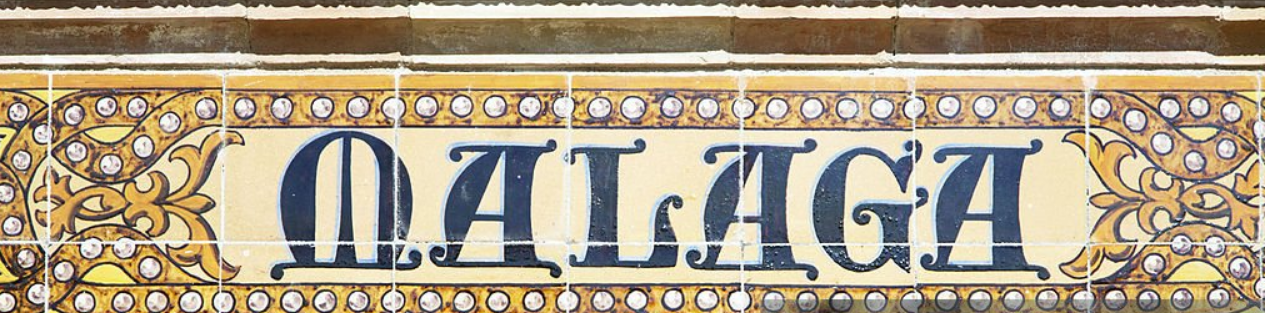
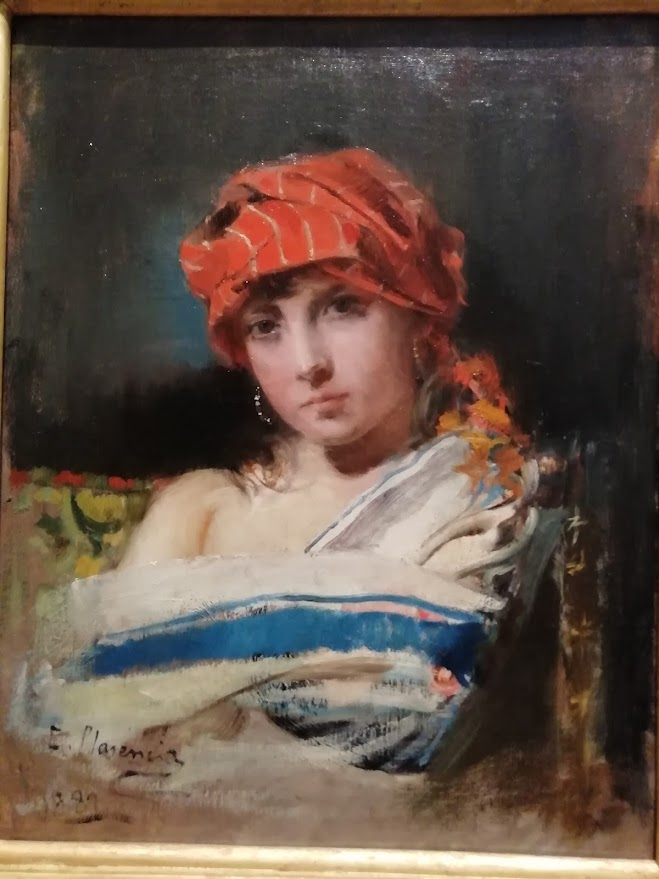
Last spring I took a trip to Málaga, Spain with my daughter and some friends to visit a cousin who has lived there for many years. The weather had been beautiful the week before our arrival, but turned cold and rainy and stayed that way the entire week we were there. Consequently, we saw quite a few museums and indoor spaces, including the Picasso Museum, the Museo Carmen Thyssen and the Málaga Museum.
I hadn’t been to Spain for many years, and it was great to be back despite the weather. After the trip I wrote a poem about Spain, attempting to get my art around some of the complexities of the place, its culture and its history. The poem is titled ‘Azulejos’, and takes its name from the brightly colored ceramic tiles one often sees in Spain and Portugal. It was recently published in Pulsebeat, a wonderful online journal from Detroit. Many thanks to editor David Stephenson for curating it. 🐂
(Portrait of a girl in a headscarf, Museo de Málaga)
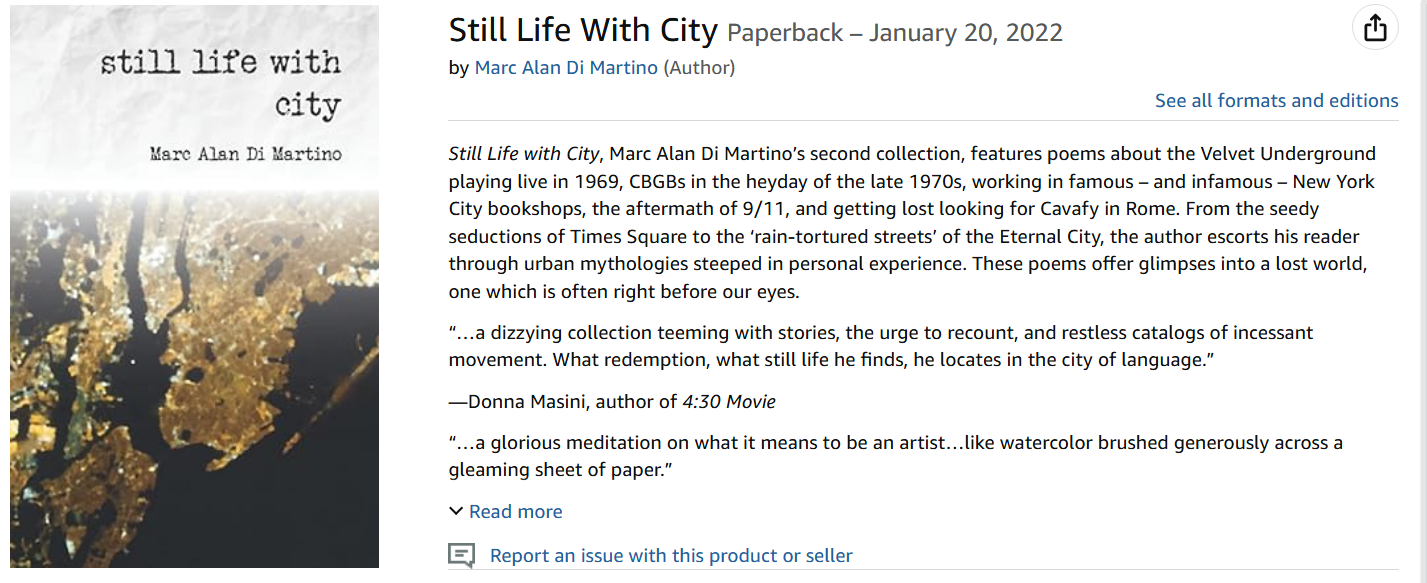
January 20, 2025 will be remembered for many reasons, and most of them bad. As we brace for whatever’s coming, I’m celebrating Still Life with City‘s third birthday! In summer 2022, my sister and I organized a book drive to send aid to Ukraine. Somehow we were able to drum up a few hundred dollars with this book, which we sent to beleaguered writers in Odesa. It may not be much, but one does what one can. It’s pretty affordable for a poetry book, so why not take a chance on it? Слава Україні!
Anglo American Book, Rome’s oldest English-language bookshop – founded in 1953 by Dino Donati and run by the Donati family for 70 years – is shuttering for good this week. This is a profoundly sad piece of news, though not unexpected. Skyrocketing rents have buried yet another temple of culture.
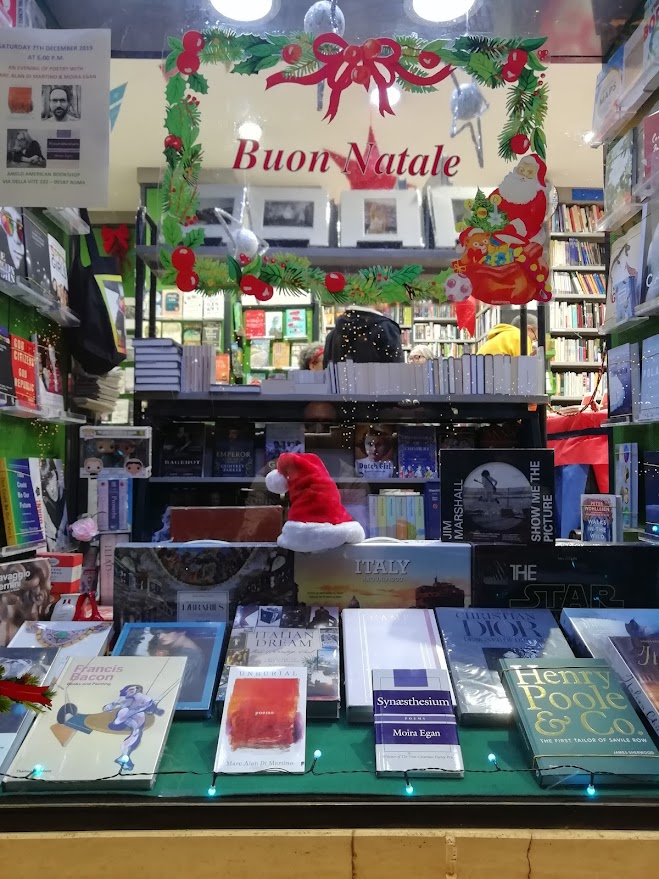
I worked at the AAB for five years, from 2005 to 2011. Like the Gotham Book Mart before it, it was a unique place where I met many unforgettable people. One friendship I struck up at the AAB was with Alexander Booth. He would come in often, and we always got to talking about literature, music and Richmond, Virginia in the 1990s. (We had both gone to VCU, a year or so apart, and ended up expats in Rome.) Alex and I were (and very much still are) both poets and translators, and remain close friends to this day despite living in different countries. Alexander published a lively translation of the poetry of Sandro Penna a couple of years ago. I remember seeing it in the storefront window at AAB, not long before they moved to the windowless upstairs location removed from street traffic. Without the Anglo American, would we ever have met?
I remember the evening when we had just closed up and were turning off the lights, and two ghostly faces appeared at the door. It was poet Moira Egan and her husband, the translator Damiano Abeni. I had to tell them to come back during opening hours. We became friends over time, though, and I interviewed them for The American in 2009. When my first collection Unburial came out, Moira was gracious enough to partner with me for the book launch at AAB (photo above).
AAB storefront window – December 7, 2019
Here are the recordings of Moira and me reading on 12/7/2019 at the AAB:
Moira:
Marc:
___
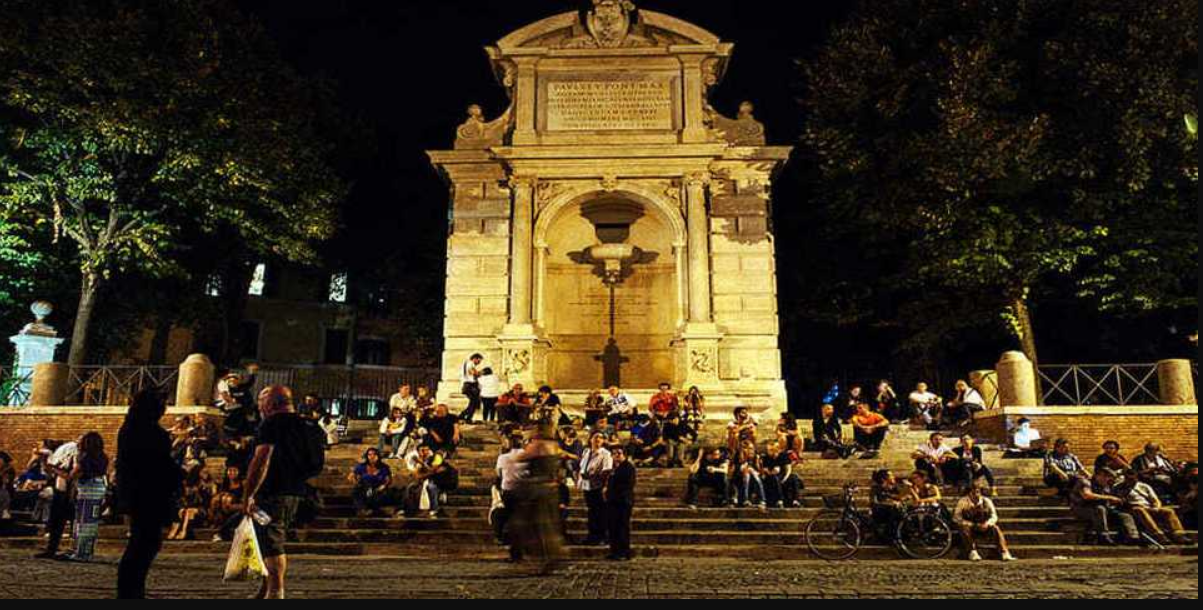
It was also there that I met Mike Stocks, poet and translator of Giuseppe Gioacchino Belli. Mike walked in one day with a handful of copies of his newly published translation. Of course, I had to interview him. We went out for pints near Piazza Trilussa while I recorded our conversation on my wife’s handheld recording device. (This was pre-smartphone.) Mike revealed to me his secrets for approaching the great Romanesco poet, notoriously forbidding both for his 19th century Roman dialect and for the volume of his output: over 2000 sonnets (the critical edition of his poems runs over 5000 pages.) That meeting with Mike influenced my approach to translating Mario dell’Arco, convincing me that one didn’t need to have academic chops in order to get the job done. It was an important lesson, and if he hadn’t fallen off the grid I’d buy him a beer and thank him.
Piazza Trilussa, Trastevere (Rome)
The list could go on, as lists do. Bookstores have played an outsized role in my adult life. It has been dawning on me for some time that I have lived at the edge of a disappearing era, a time when independent bookshops were places people went in their free time to meet other people, not unlike a neighborhood pub. They were like secular houses of worship. Relationships could be forged there. Lives could be altered. You were in the realm of curiosity, always bracing for the unexpected thrill of discovering a new book. Those born too late may never know this way of being in the world.
I spent many years working in bookshops on two continents: Strand, Gotham Book Mart, Anglo American Book. It was never a swank job with a good paycheck, but the summation of that experience was for me the equivalent of a university degree. I’ll always remember the names of people who worked at those NY bookshops before me: Tennessee Williams, Allen Ginsberg, Patti Smith, Tom Verlaine, Richard Hell. It seemed like it might almost be preparation for a future in the arts. Maybe it was.
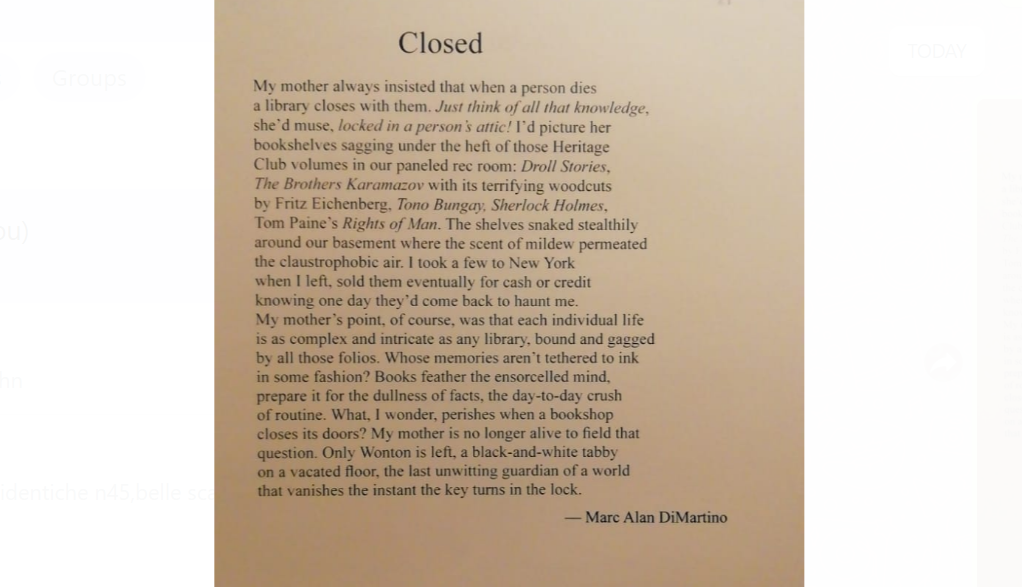
It seems apropos to round out this reminiscence with a poem about another of my favorite gone bookstores, Chop Suey Books in Richmond. It was my go-to bookshop whenever I was in town visiting the old haunts in Careytown. The poem was published in the Hollins Critic, a quirky little literary journal from Virginia which – but of course – ceased publication last year. It seems like our losses are neverending. All we have is art to push back against the rising tides of oblivion.
I have never been to Los Angeles, but it has always been a city I felt I knew through art, literature, music and cinema. This poem by Dana Gioia is one of the most magnificent poetic visions of the City of Angels I’ve ever read. If you’ve never read it, maybe now is the time. Read the full poem at Rattle. Here is a review of Gioia’s Meet Me at the Lighthouse I wrote for Italian Americana.







 Marc Di Martino
