A poison apple

Today my wife is attending a funeral for a young man – twenty five! – who recently died of a brain tumor. He was diagnosed only a month before.

My aunt died of cancer a few years ago, after a four year struggle. She was a very religious Catholic, went to church, kept statues of Padre Pio in her home and pictures of the Virgin Mary on the wall of her bedroom. She took trips to sanctuaries. She counted priests among her friends. And yet…she withered away to almost nothing. She lived in tremendous pain. Then she died.

So where is this great God believers speak of? Either he is fucking with us – in which case he is an evil God – or he just plumb don’t exist. Why it would give anyone solace to have faith in  such a thing baffles me. Even some atheists I know talk of the “gift of faith” with not a little nostalgia (that they never received it.) All I can think is, What’s wrong with you people? We can do better than this!

We all suffer, atheist and religionist alike. No one is exempt. Life will end in death for all of us, with no regard for our belief systems, education, successes and failures. We all know this. It does no good to pretend that there is a benevolent being who is looking out for us, who is amenable to prayer and flattery, and who will save us when the going gets rough. It does no good because this is quite obviously not true.

Let’s stop pretending it is, and that faith is a gift. It’s a poison apple if it’s anything.

An insult to language

I haven’t read Susan Jacoby’s “Spirited Atheist” column in a month or two, but today I found an absolutely wonderful article on A.C. Grayling’s The Good Book: A Humanist/Secular Bible. Suffice to say the first time I read any of Grayling’s souped-up anthology I thought it sounded awful, like one of the umpteen translations of Genesis that try too hard at saying the same well-worn phrases in novel ways. But how many ways can you find to write, “In the beginning…?” They all just end up sounding vaguely “biblical” no matter how you rearrange the words (which is likely the point.) Here’s Jacoby:

Let me quote from the first chapter of the first “book” (again, modeled after the format of a standard bible), called—what else?—Genesis.“In the garden stands a tree. In springtime it bears flowers; in the autumn, fruit. The fruit is knowledge, teaching the good gardener how to understand the world…When Newton sat in his garden, and saw what no one had ever seen before: that an apple draws the earth to itself, and the earth the apple….”

You can’t satirize this stuff. Forget the vapidity of the language. It’s not even factually accurate, which, at a minimum, a secular bible ought to be. Another chapter (9:18) has arteries carrying “nascent blood,” while “lengthening veins return the crimson flood.” Wrong again. Arteries carry bright red blood, because it is fully oxygenated, away from the heart, while the returning blood in veins is much darker because it is generally deoxygenated.

Apart from my initial sense of enthusiasm on hearing about Grayling’s Good Book, I’ve had some reservations about it (I generally enjoy Grayling’s work). I’m not sure how homogenizing 3000 years of wisdom into an authorless mish-mash of slightly “elevated” (read: biblical) language serves any purpose – especially if one’s purpose is to offer an alternative to the Bible. One thing I love about literature is knowing who wrote what, when. I think that really does matter in the end. And unless the intent is satire, I don’t think many atheists/secularists will be drawn to a book based chapter-and-verse on another book we’ve read – and often trashed – the Bible.

Jacoby sums up:

There has already been a good deal written, particularly in England, about whether Grayling’s bible insults religion. This is utterly beside the point, since the book is an insult to language, to authors who deserve credit for their words, to translators who deserve credit for translating those words, and, above all, to the intelligence of secular readers. We don’t have one Good Book. We have good books, thousands of years of them, and the real Euripides, Shakespeare, Spinoza and Darwin are all available to provide a genuine humanistic education.

Exactly. Who the hell needs a sterilized version of Shakespeare, anyway?

Belief (almost) made me a complete asshole*

I’ve been having a debate (what else to call it?) on Facebook lately with a couple of friends over whether religion can be held responsible for its homophobic teachings. I say it can and should, whereas my friends disagree. They suggest that prejudice most likely has a different explanation, and religions simply capitalize on pre-existing feelings of hatred and fear. That’s quite true. But religion has crystallized these emotions and normalized them for billions of people, weaving them into the fabric of belief. To be a Roman Catholic who does not think homosexuals are “disordered”, or “unnatural” is to have shed an important part of that belief system, and one that is hammered home at every opportunity by those in charge of Roman Catholic beliefs.

Once, when I was flirting with religious belief, I was on the road to such thinking as well. I remember quite vividly the way in which my perception of sexuality became more prudish. I was reading the Bible and trying hard to put my thinking in line with what I thought was a “Jewish” view of sexuality. While I never became homophobic, I did begin to think differently about two men having sex (but not two women). I began to adopt more “conservative” or “traditional” opinions. And this opinion was rather negative, as I recall it.

It didn’t stick, though. The more I studied and tried hard to ignore the cognitive dissonance of “believing” while going to the movies on Friday evening – which is strictly forbidden by Jewish law – the more I felt like the whole edifice was just that: an artificial construct. Then it fell, just like the cardboard cut-out it was.

The experience was useful, however, for it put me in the mind of a believer for a short time. Some might say this isn’t accurate, as I was never really any such thing. Either way, it felt a lot like what I’ve read over and over again about the tension people feel when they put their religious beliefs to the test and decide they can’t go on lying to themselves.

To get back to homophobia, though. In my admittedly anecdotal experience, I was aware of a change taking place. And that wasn’t because of radical preachers, fundamentalist company or any such thing; it was what I had begun to intuit about the Bible itself and its archaic worldview (I even began to wonder how one might make sacrifices in the 21st century). I only wished to get in line and act, well, religious.

Thankfully, this proved rather difficult. I have a bad habit of analyzing things to death, and for me whatever ad-hoc idea of God I’d begun to formulate in my head vanished under scrutiny. By the time I’d finished reading The End of Faith, I had accepted that the religious life – and accompanying worldview – wasn’t for me.

In fact, more than anything it was the way an even diluted religious belief messed with my mind that turned me off. It was a bit like drugs (I’ve had bad experiences on both). It was the realization that I wasn’t in full control, that I felt puppeted, manipulated by the things I was reading. I even began to entertain creationism, which is a perfect example of the way religion can damage one’s thinking; I can think of no other reason on Earth anyone would question the evidence for evolution if not for a religious (read: Abrahamic) worldview.

As an atheist I’m always discussing religion with people who will discuss it with me. Having briefly tasted belief, I’m curious to know what others experience and how it affects them. Some even quip that I’m more “religious” than the religious because I take belief seriously. Well, I’ve seen what it can do, and it’s heady stuff. Trust me.

* Some people think I’m an asshole now, of course; but they don’t know what was happening inside my head then.
Ann Widdecombe on the Ten Commandments

This woman is a masochist. Via @GodlessAtheist.

Nostalgia for the “old atheism”

Hemant Mehta has an interesting find today: it’s more proof that the atheists of old were no friendlier than the gnus of today to the religious establishments of their time. In fact, it’s the kind of refrain one hears a lot these days. The “new atheists” are in-your-face, rude, militant, nasty, overreacting…you get the picture. You might even begin to think that atheists weren’t ever like that before (assuming this is even true), that they were mild-mannered, accomodating and – yes – perhaps even a bit melancholy that they lacked the “gift of faith.” The Italian film director Nanni Moretti said that very thing just last night on television while promoting his new film, Habemus Papam. There went my dinner, all over the screen.

Anyone who knows anything about the history of unbelief knows that our predecessors in atheism were rarely such a sad-faced bunch. Names like Robert G. Ingersoll, Bertrand Russell, Baron d’Holbach and many more were completely fine with their atheism. And they were pretty much as outspoken as Richard Dawkins or P.Z. Myers is today, only they lacked the immediacy of Twitter to broadcast their message. Technology may be the only difference worth noting between then and now.

So the next time you hear nostalgia for the “old atheism”, inquire what is meant. You’ll likely find that your interlocutor is: a) unaware of the history of atheism; or, b) just spouting nonsense. Or both.

Debating other atheists

This post was first published at Monicks Unleashed on April 8, 2011. It unleashed a heated debate on Facebook. Happily, no one was hurt. Atheists aren’t into stabbing themselves or others with sharp objects.

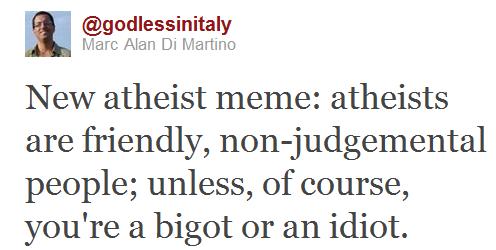
This may surprise some of you, but I’ve probably debated more with other atheists than with believers. It usually becomes clear rather quickly that the main gripe leveled at me is that I’m basically wasting my time – and theirs – with this militant atheism business.

My debate partners normally fall into three categories:

♦ Type I debater begins amicably, “Listen, I’m an atheist, too. I agree with you about most things.” Then a swift condescension: “But I don’t go around waving flags and proselytizing to others. You’re acting just like they do.” Yes, proselytizing. That’s the word they use. If you point out that, no, you’re doing nothing of the sort, then you might hear an annoyed, “Yes you are. But you’re preaching to the converted. You’d do better writing poetry (I also write poetry). Nothing will change because of that red “A” in the corner of your blog.”

♦ Type II debater is the de facto atheist who clings to the word “God” as if it were a life raft. This person has no definable religious adherence, doesn’t believe in holy books and is quite embarrassed by the idea of a white-bearded autocrat in the sky. He or she accepts science as the best explanation of phenomena and has little or no patience for the supernatural (e.g. UFOs, ghosts, etc…) – except where “God” makes an appearance in the ultra-rarified guise of the voice-in-the-head. But when you ask for clarification, don’t hold your breath. You might receive an answer like, “God is what makes us who we are.” Or a sleight-of-hand like, “Do you believe in love?” The difficulty in debatingthis person is that, no matter what points you feel you score, they just smile politely and take credit for the hit. They’ll even quote Einstein at you. Ugh.

(Don’t call Type II an atheist. Oh, no. Type II is a true believer. But if you hint that his or her belief doesn’t remotely correspond to that of 99% of religious believers, you’ll see a wounded look. “Why are you confusing my super-sophisticated conception of the divine quintessence with that bearded fellow on the Christmas cards?” it seems to say. Why, indeed?)

♦ Type III debater tends toward the postmodern. Type III will throw everything at you, confound you with a Žižekian cornucopia of pop culture and deep philosophical concerns, then abruptly proclaim the impossibility of all knowledge. You’ll wonder what that debate was about for days.

It’s really a matter of method, in the end. Many non-believers (yes, Type II, you are a non-believer) feel they’re supposed to suck it up, stick it out and patiently wait for the paradigm shift as if it were the messiah. They don’t like being lumped in with those of us who engage the world directly as atheists. For them, being an atheist is nothing more than having dark hair or wearing glasses.

“You can’t force people to stop believing in God,” they’ll observe. But who’s forcing anyone to do anything? Is arguing a philosophical point all of a sudden holding a pistol to granny’s temple and hollering, “Admit it you old bag, there is no God!”? That’s misrepresenting what’s really going on, which is that many atheists want in on the action. We’re tired of sitting on the sidelines watching the game.

But no matter how much atheists may squabble over the rules of engagement, we’ll still be more consistent than religious believers who can’t agree on anything – except that we are the common enemy.

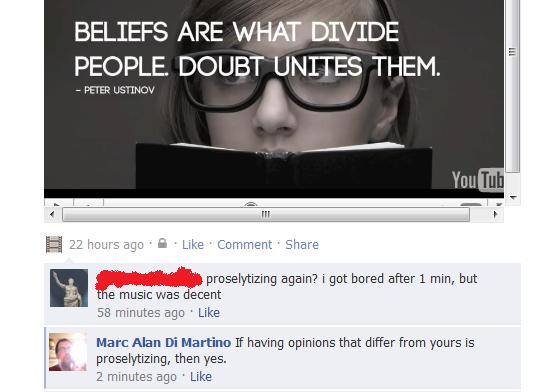
Proselytizing, again

The meme is gaining ground. How does one combat the accusation that expressing one’s views is a form of proselytizing? Funny word, that; it’s clearly picked to draw a parallel between the ways of religious missionaries and the ways of outspoken non-theists. (We’re apparently unable to remember the Golden Rule: If you don’t believe in god, shut up and keep it to yourself. Doh!)

Here’s one answer I came up with, though:

Yep.

Good Times

Remember this show? Who knew there were sophisticated debates about atheism? It was just after school television. But, beyond the canned laughter, they were dealing with “serious” issues. I wonder if the same can be said for today’s shows.

Via Freethought Kampala.

Come out, come out wherever you are!

Hemant Mehta has an interesting post on a study suggesting that the greater the presence of atheists – or even the perceived presence – the less prejudice there is in their regard. It’s counterintuitive, which is cool; apparently it goes the other way for most minority groups. It’s a good reason – if you still needed one – to come out as an atheist (if you are one, that is).

This paper confirms what many of us have known for a long time: If people know an atheist personally — or realize there are more of us out there than churches or popular culture would have them believe — the distrust, unelectability, and don’t-you-dare-marry-into-my-family mentality decreases.

So what are you waiting for?

Tell the people in your life that you don’t believe in a god.

Start the conversation.

Destroy their negative stereotypes about us.

There’s no better time to do it.


Two rabbis walk into a dialogue

I’m delighted to see that two rabbis have entered into a dialogue on religion. One is Jeffrey Falick, the Atheist Rabbi, whose blog is hosting the debate; the other is Frederick Klein, an Orthodox rabbi who took up Falick’s challenge.

Lately HuffPo, or PuffHo, or whatever it’s called, has been hosting various rabbinical voices attempting to talk sense to us new atheists. There’s David Wolpe and Adam Jacobs, and there was that debate where Hitchens and Harris were terribly rude and gnuish to Wolpe and his colleague Bradley Artson Shavit.

I’m thrilled about all this. As a Jewish atheist I’ve had endless discussions with Jewish friends about atheism, faith, God, morality and tradition. It’s been tough to find many other Jews who will stand up and say, “I’m an atheist.” My guess is that they would somehow feel un-Jewish, and that for them Jewishness is at some level sustainable only through passive acceptance of rabbinical tradition. Even if they don’t believe a word of it.

I remember once asking a Lubavitch rabbi what his position on evolution was. He sent me a link to another Lubavitch rabbi rambling on for an hour before a room full of Lubavitchers. His point was that anything that conflicted with the Torah was, well, unacceptable. End of discussion.

Let the Lubavitchers wall themselves off from reality until moshiach arrives. In the real world, the dicussion continues unabated.