One of my favorite photos of him, doing what he loved. Sometime in the 1970s.
Roughly five years ago, then-editor of the journal Verse-VirtualFirestone Feinberg invited me to collect some of the poems I had been writing about my father and add some biographical notes in order to create a ‘portrait’ of him for publication. The ensuing piece, which I called “Starman” after one of the poems I had written (and ripped from the Bowie song of the same title) developed into my first book of poems, Unburial. “Starman” collects poems, biographical sketches and photos of the man who was my father, and whose sudden and premature passing left its mark on me in ways I am – now older than he ever was – perhaps still unable to fully understand.
February 11, 2025 marks thirty-five years without him.
I’ve made an Unburial playlist for anyone who wants to read the book in a different way, in which each poem is paired to a song that is meant to extend it or comment on it. It’s a pretty good playlist, I think!
Anglo American Book, Rome’s oldest English-language bookshop – founded in 1953 by Dino Donati and run by the Donati family for 70 years – is shuttering for good this week. This is a profoundly sad piece of news, though not unexpected. Skyrocketing rents have buried yet another temple of culture.
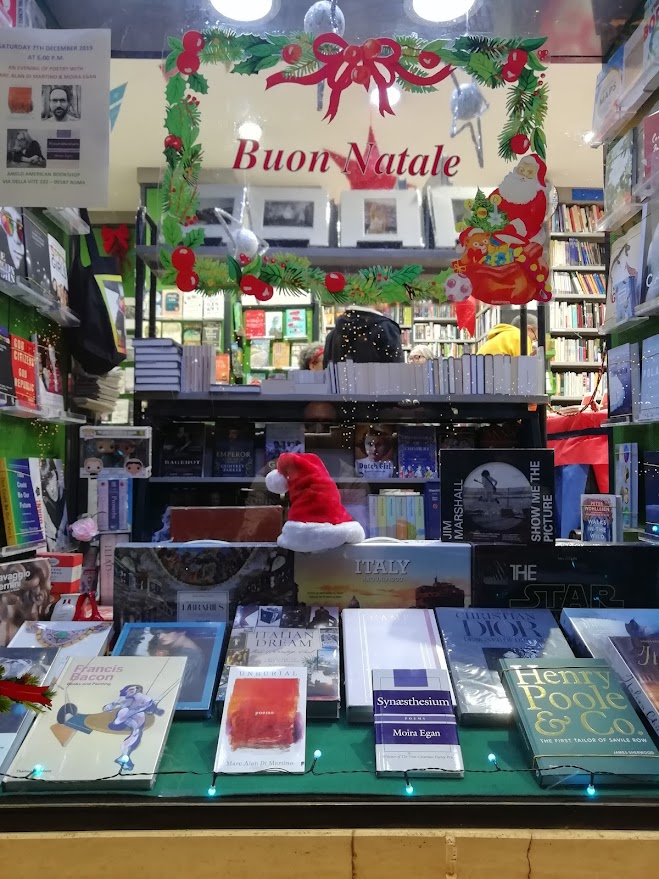
I worked at the AAB for five years, from 2005 to 2011. Like the Gotham Book Mart before it, it was a unique place where I met many unforgettable people. One friendship I struck up at the AAB was with Alexander Booth. He would come in often, and we always got to talking about literature, music and Richmond, Virginia in the 1990s. (We had both gone to VCU, a year or so apart, and ended up expats in Rome.) Alex and I were (and very much still are) both poets and translators, and remain close friends to this day despite living in different countries. Alexander published a lively translation of the poetry of Sandro Penna a couple of years ago. I remember seeing it in the storefront window at AAB, not long before they moved to the windowless upstairs location removed from street traffic. Without the Anglo American, would we ever have met?
I remember the evening when we had just closed up and were turning off the lights, and two ghostly faces appeared at the door. It was poet Moira Egan and her husband, the translator Damiano Abeni. I had to tell them to come back during opening hours. We became friends over time, though, and I interviewed them for The American in 2009. When my first collection Unburial came out, Moira was gracious enough to partner with me for the book launch at AAB (photo above).
AAB storefront window – December 7, 2019
Here are the recordings of Moira and me reading on 12/7/2019 at the AAB:
Moira:
Marc:
___
It was also there that I met Mike Stocks, poet and translator of Giuseppe Gioacchino Belli. Mike walked in one day with a handful of copies of his newly published translation. Of course, I had to interview him. We went out for pints near Piazza Trilussa while I recorded our conversation on my wife’s handheld recording device. (This was pre-smartphone.) Mike revealed to me his secrets for approaching the great Romanesco poet, notoriously forbidding both for his 19th century Roman dialect and for the volume of his output: over 2000 sonnets (the critical edition of his poems runs over 5000 pages.) That meeting with Mike influenced my approach to translating Mario dell’Arco, convincing me that one didn’t need to have academic chops in order to get the job done. It was an important lesson, and if he hadn’t fallen off the grid I’d buy him a beer and thank him.
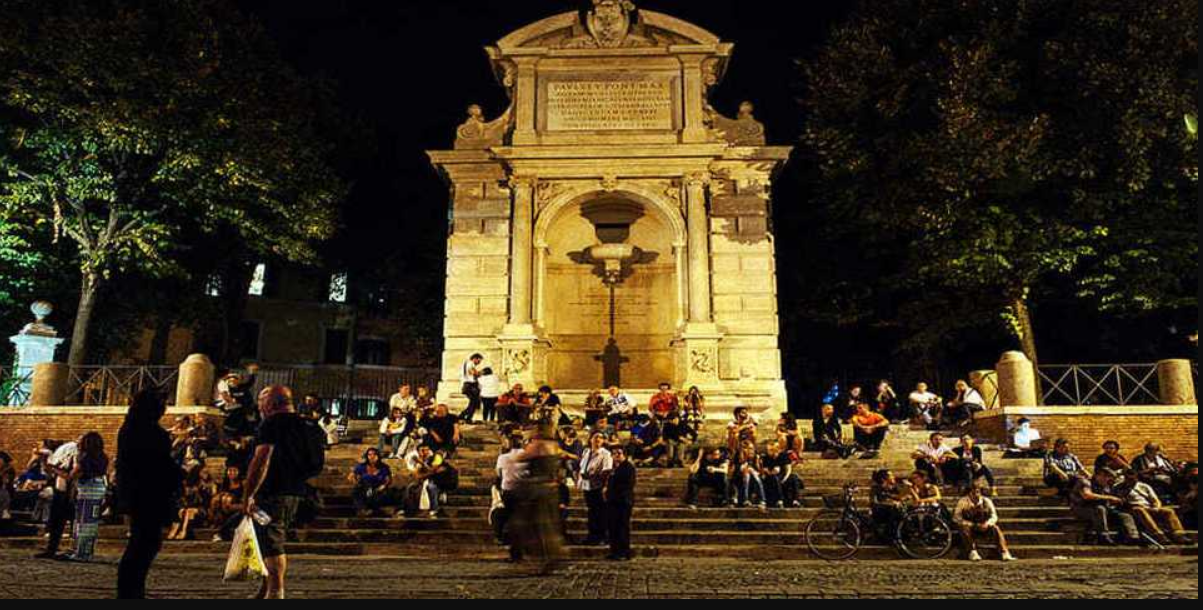
Piazza Trilussa, Trastevere (Rome)
The list could go on, as lists do. Bookstores have played an outsized role in my adult life. It has been dawning on me for some time that I have lived at the edge of a disappearing era, a time when independent bookshops were places people went in their free time to meet other people, not unlike a neighborhood pub. They were like secular houses of worship. Relationships could be forged there. Lives could be altered. You were in the realm of curiosity, always bracing for the unexpected thrill of discovering a new book. Those born too late may never know this way of being in the world.
I spent many years working in bookshops on two continents: Strand, Gotham Book Mart, Anglo American Book. It was never a swank job with a good paycheck, but the summation of that experience was for me the equivalent of a university degree. I’ll always remember the names of people who worked at those NY bookshops before me: Tennessee Williams, Allen Ginsberg, Patti Smith, Tom Verlaine, Richard Hell. It seemed like it might almost be preparation for a future in the arts. Maybe it was.
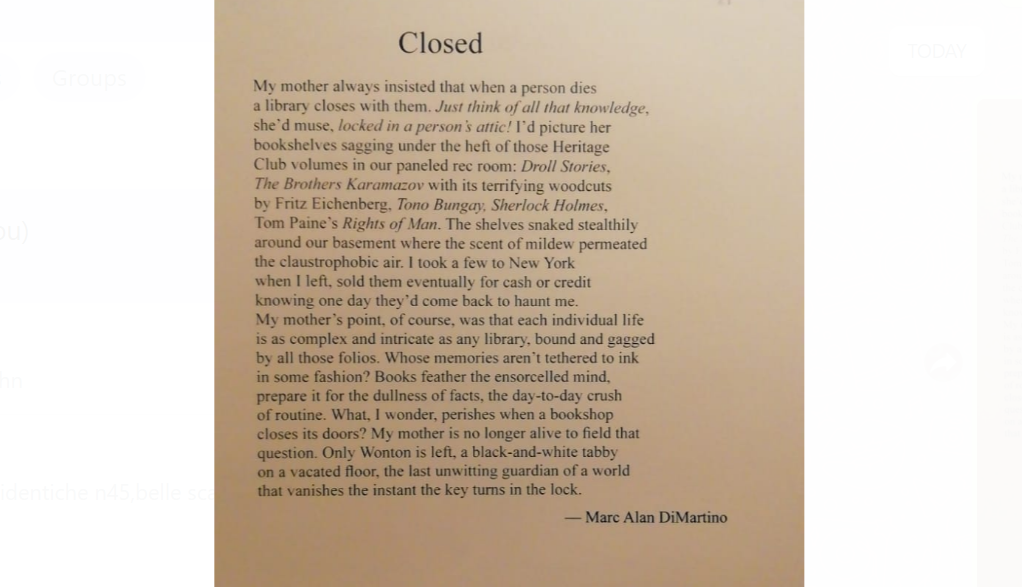
It seems apropos to round out this reminiscence with a poem about another of my favorite gone bookstores, Chop Suey Books in Richmond. It was my go-to bookshop whenever I was in town visiting the old haunts in Careytown. The poem was published in the Hollins Critic, a quirky little literary journal from Virginia which – but of course – ceased publication last year. It seems like our losses are neverending. All we have is art to push back against the rising tides of oblivion.
I’m reminded, now more than ever, of something Arthur Miller (yes, that Arthur Miller) told me as we sat together in his kitchen on 68th St. in Manhattan. “One day in the future” — this was around 1999 or 2000 — “someone will have an idea of genius. They’ll decide to put books in a store and allow people to come in and browse them. It’ll be called a ‘bookstore.'”
You’re probably asking yourself what I was doing in Arthur Miller’s kitchen. My then-employer, Gotham Book Mart, had sent me to get five or six large boxes of rare and not-so-rare books signed by the renowned playwright. One of the ways the sinking bookshop stayed afloat was by milking its proximity to famous authors. Signed books sold like hotcakes. They were a boon in a dying market, and if they couldn’t come in to sign and schmooze, we went to them.
The most remarkable such trip was to Provincetown, Massachusetts. We drove up from New York to spend the weekend with the famously hermetic illustrator Edward Gorey at his mansion on Cape Cod. Overgrown weeds had ambushed the house on all sides. Thorn bushes crowded the walkway up to the front door. Inside, the house reeked of cat urine.
Everywhere there were books: on sagging shelves, piled on top of tables, in stacks on the floor, cluttering up every conceivable surface. Any square inch not occupied by books was occupied by an equally endless collection of trinkets: I recall a rich assortment of colored glass bottles of every size along the many windowsills of Gorey’s great home. From the stairwell the theme song of “Cheers” resounded down through the sitting room. In contrast to the spooky, ethereal persona he projected through his books, the man was a television junkie.
Both Miller and Gorey have since died, and everywhere there are signs that bookstores are about to follow them to the grave. Of course, people have been talking about the death of God for a very long time, and the old bugger is still with us. So I’m not going to get all sentimental just yet. Bookstores — and, let’s just say it, books — may yet survive the online onslaught.
There was a time when I proudly stated I’d never buy a book from Amazon. A vacuous statement, and easy to say by someone who at the time lived in the vicinity of countless English-language bookstores. This was the same mouth that had proclaimed at various points in its history that it would never a) eat onions; b) kiss girls; c) speak a language other than English. The contradictory adage “Never say never” never seemed more appropriate.
Now that I’m living in a place with no access to anything in English but bestsellers — and even those must be hunted down — Amazon has begun to makes sense. It’s all so perfect. You go online (if you’re like me, you’re there already), find the book you want, click and wait for it to arrive at your door. All you need is an Internet connection and a mailing address. So why does clicking “Add to cart” make me feel so unethical?
I’ll chalk it up to having spent most of my working life in bookstores. I’ve breathed in so much of their dust that they’re part of me. The weirdo who comes wandering in off the street with Ziploc Baggies full of pennies and complaining about his rabbi will never infiltrate the virtual walls of online commerce (which is probably a good thing.) But neither will the Arthur Millers and Edward Goreys. And neither will all those odd and interesting people I’ve met over the years who simply happened to ask the right question to the right clerk at the right moment. Some of them are — yes, thanks to the Internet — still my friends.
Sure, you can have fun writing reviews and posting them to Amazon. There are all kinds of interactive ways of sharing your passion for books online, too. For me, however, they don’t quite measure up to the serendipitous experience of stumbling upon a book that changes you forever.
My personal library is like a large-scale model of the mental world I’ve inhabited for the past 20 or so years. I pride myself on being able to remember where and when I got just about every book in my collection. Downloading an e-book to my Kindle app is exhilarating for it’s speed and simplicity, but I doubt it will leave me with much after I’ve read and digested the text. Books have always been about more than just content, haven’t they?
Maybe I lack the visionary imagination of a Steve Jobs, but books are simple things in the end. They come in all shapes and sizes and they can take abuse. I’ll never forget the first time I actually saw a Kindle. A woman came into the bookshop, pulled the broken device from her purse and explained that she needed to buy back the books she’d lost when it slipped out of her hand onto the pavement. She was crestfallen.
As I muse on the demise of bookstores and the much-prophesied disappearance of the “dead-tree book” I watch my daughter flip the pages of “The Very Hungry Caterpillar.” She’s enjoying the colorful pictures of fruit and the feel of the cardboard in her hands. She pokes her fingers through the tiny holes. She’s just as taken in by the physical properties of this book as she is by the content — more, actually, as she can’t yet read.
What, I wonder, would her first experience with books be if she were to fondle a Kindle “Baby” reading device?
We’re moving, and each time I move I end up reflecting on all the moving I’ve done over the course of my life. I’ve tallied up a total of 22 separate abodes in 36 years. I count as an “abode” any place I’ve lived for at least a month with no more permanent address to call home. To be clear, I’ve included places my father lived after our parents’ divorce, really just a succession of cheap apartments in which I was guaranteed a bed. A third of my “abodes” were in New York City, where I racked up a frightening four in one solar year.
Throughout it all I’ve managed to hang on to a few things — mostly books and records — thanks both to my mother’s basement and her goodwill. Now those things are in jeopardy; she’s moving to a small apartment and my ad hoc collection will have to find another home. The alternative is the dump.
Since I bought most of this stuff used, it would be perfectly natural to bid it all adieu in a similar fashion. I could sell the records and donate the books to a local library, in the spirit of the Greek adage panta rei (“everything flows”). What matters most to me is that they find owners who appreciate them. I know this sounds weird for a bunch of plastic and paper — and it’s purely sentimental — but it matters to me.
My collection isn’t worth much even by the standards of an armchair collector. Sure, I have a few choice albums: an original mono version of Blonde on Blonde, an unpeeled Velvet Underground and Nico, a vinyl copy of Metal Machine Music. It’s nothing any Dylan or Lou Reed fan wouldn’t have, and the records themselves aren’t in excellent shape. As for the books, I shipped a lot of them to Italy on my last visit. But what to do about my four-volume calfskin-bound set of Montaigne’s “Essays”? Throw it in my carry-on bag on my next trip? That’s a tough one.
“Forget about them,” my mother said. “Be glad you have your health. You have a family now. Stop obsessing.”
I know she’s right, but I can’t help obsessing. I’ve read the Stoic philosophers, but I’m not able to entirely repudiate material things. “Don’t preach,” I told her. It didn’t come out well, and I regretted having said it.
What she meant was this: “You’ve done perfectly well without these things for eight years. You’ve made a life for yourself in another country. Let them go. You’ll be happy when you don’t have to worry about them anymore.”
I’m not really attached to things in general; in fact, I don’t own much of anything worth keeping. Once you subtract my ballooning personal library, there’s not much left except furniture and underwear. So I think I should be permitted an occasional excess.
Happily, we’re moving to a place with more space than I’ve ever had in any previous arrangement, so there will actually be room for my things. It would cost an arm and a leg to ship them all here, and that’s a nagging detail, but wouldn’t it be worth it in order to restore the harmony of my collection?
That’s the meat hook beneath my skin right now. Should I heed the noble, philosophical angel on my left shoulder and separate past from future? Or should I listen to the neurotic bibliophile devil on my right shoulder and follow my impulses? The deadline is only a few weeks away and I can’t decide what to do.
Like all parents I entertain a fantasy of sharing my passions with my children. I want our daughter to grow up in a home swarming with books, records and cultural artifacts. Now that personal libraries tend evermore toward the electronic (hypothetically I could stuff every book I own into one wafer-thin Kindle) this seems particularly urgent. I dream of the day when Melissa pulls my copy of, say, “American Yiddish Poetry” off the bookshelf and I get to explain it to her.
Not long ago a columnist in The Guardian wrote ecstatically of getting rid of his “dead tree books.” I was mildly shocked reading what appeared to be a manifesto urging all decent people to toss out their weighty stockpiles in favor of a pared down selection of truly essential volumes. The author was positively gleeful, embracing the changing times. By contrast I am a melancholy, deeply torn 20th Century Man.
Which isn’t to say I’m not going to get an e-book reader someday. The problem is simply which one. Because, despite my 20th-centuriness, I recognize a Catch-22 when I’m in one. It’s simply impractical to keep accumulating books unless I develop a system of filtration. The records are a different matter. I would be happy with just a few of the really meaningful ones, and the bulk on CD or iTunes or whatever nascent technology is in store for us. I’ll miss the cover art, the skipping needle, and actually listening to sides of an album. But I’ll still be able to broadcast music through the house, prompting my daughter’s curiosity.
“Daddy,” I can hear her saying, “what’s a Ramone?”
I think it was Saul Bellow who said that we spend our time reading thinking about the next book to read. Or something like that, anyway. And so it is. I’m halfway through Alone in Berlin, which is excellent, and already I have a mental pile of books to plow through as soon as I’m finished with this. So allow me to make a few notes, with the intention of suggesting these books to you as well.
Say Everything by Scott Rosenberg – The past, present and future of the most maddening and addictive pastime…blogging. Can blogs survive the Age of Twitter?
Virgins? What Virgins? by Ibn Warraq – I’ve been curious to read Warraq at some length without diving head first into hardcore Qur’anic exegesis. I still haven’t finished the Qur’an! So this is a collection of his shorter pieces for amateurs like me.
I’m always open to suggestions, so feel free to post them in the comments if you have any.





 Marc Di Martino