Bringing up baby

When my mother in law decides it’s time to let us know her opinion, I try to restrain myself. Her latest op-ed began with the time-honored incipit, “Feel free to ignore me, but…” She then swiftly descended into a tirade about how we’re damaging our daughter by speaking to her in two languages.

I replied, “So you think it’s better if we wait 10 years, then pay for expensive private lessons with an English tutor? What planet are you living on?” I might have expected some opprobrium of the traditionalist variety (“What do you mean you’re raising her without any religion?”), but I hadn’t anticipated this kind of nitpicking. Since when is a learning second language considered hazardous to cognitive development?

I didn’t grow up bilingual. My parents spoke three languages between them, but I was raised speaking — and understanding — only American English. There was a half-hearted attempt to offer some Italian, but it mostly boiled down to the kind of language one uses in conjunction with a stubbed toe. I got pretty good at the bad words, at the expense of all the rest.

In my twenties I began to bemoan my status as a monolingual American. I’d taken four years of Spanish in high school, but had just gotten by with a C average. I wondered what had happened to that other language I’d almost learned, and which was closer to home — Italian. I might still learn it, I thought.

So I found an Italian language school a few blocks from my Manhattan apartment, dropped the cash and began studying. Immediately I decided to memorize the first canto of the Divina Commedia — in Italian. Without really knowing what I was saying, I recited the first 20 or so lines before my class one evening. “Nel mezzo del cammin di nostra vita…” The teacher — a bold Florentine beauty — listened, stunned. (Now that I understand the words, however, I can no longer recall the verses.)

After a year or so I stopped going to classes. I desperately needed to save money. My then-girlfriend and I were breaking up after a quarrelsome four-year relationship, and I was set on living alone (for the first and last time in my life). Not long after, I left for Italy; my Italian has improved dramatically ever since.

I’ve now taken four years of Hebrew, and studied Yiddish independently. I speak neither language well, but I do have a general grasp of both, which is more than I’d have thought possible a decade ago.

When my wife and I decided we were ready to have a child, we had varying opinions on all aspects of child-rearing — all, that is, except the desire to raise our daughter as bilingual. And that’s a point on which we won’t cede ground to anyone: not family, friends or the public opinion that governs so much parental decision-making in Italy.

It’s taken some discipline, but I’ve gotten in the habit of speaking to our daughter Melissa primarily in English. When we’re alone, that’s all she hears from me. And, after three weeks in the United States, she’s begun approximating the English names for preferred objects: duck is “duh”; water is “wawa”; cantaloupe is “catabu.” She’s now added “nonno” and “nonna” to her repertoire, in perfectly pronounced Italian. That’s bilingualism in action.

I remain perplexed by my mother-in-law’s cavalier attitude. When I asked her to explain her resistance, she went on about confusing messages. “It’s like one of you is saying ‘yes’ and the other ‘no.'” When I asked her about the sources of this insight they turned out to be predictably nonexistent.

Maybe she should meet some of the people we know who were raised bilingually, and who are raising bilingual kids. When I sent out my feelers on Facebook, I got a bunch of very enthusiastic responses — not one of which expressed the least bit of concern that we were “confusing” Melissa.

One friend even told me about her son, who was born deaf. Her Italian doctors — who had cured her son’s deafness through an implant — instructed my friend to speak only Italian to her son, saying two languages would only confuse him. She’s convinced the advice was a needless setback. Now her son is learning English, slowly but surely, with the help of his younger brother.

On a different note, another friend observed that her daughter not only started speaking later than other kids her age, but understands less. She attributes this to her bilingualism. I’ve heard from others along similar lines.

A quick Google search yielded a treasury of articles with a recurring theme: “People used to think bilingual children were slow/confused/challenged, but new research shows…” Basically, it seems to show that some children are slower than others in certain things, but likely not for reasons related to their bi- or multilingualism.

That sounds like good news to me.

From The American

All are not equal before the law

The Italian Chamber of Deputies decided it didn’t want to dignify homosexuality by approving a law that would make hate crimes against gays punishable. On. Fabrizio Cicchitto of the PDL explains:

We’re not homophobic. Our position is basically this: we consider gays citizens equal to everyone else. For precisely this reason we contest every legal attempt at differential treatment which would thereby admit and accentuate diversity, which is in substance unconstitutional.

Which isn’t true at all. They don’t consider gay citizens “equal to everyone else.” It’s for this reason that gay marriage is still illegal here (among other forms of discrimination). They’re taking cues from the Vatican, of course, which has perfected the art of discriminating while playing the victim. They cry out about the tyranny of minorities, about how if you give them an inch they take a mile, that the majority (read, “Catholic heterosexual majority”) are somehow in danger of a rabble that wants wants wants…equality.

It’s always the same story: Italian politicians will not risk going against “Catholic values” for fear the Vatican will…what, exactly? What are they afraid of? That they’ll ask a nuncio to come home from his plush quarters down the street? That they’ll get “serious” – always a sign that someone has managed to piss off the Privileged Few? That the Catholic masses will be mobilized to take action against them? And when has that ever happened?

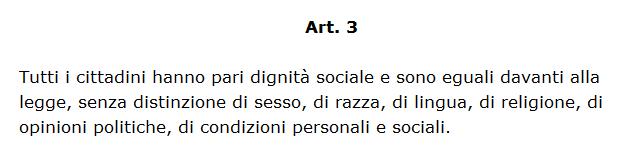
The Italian Constitution has this to say:

(“All citizens have equal rights and are equal before the law, without distinction by sex, race, language, religion, political opinion, or personal or social condition.”)

All of which sounds great, but isn’t true, either. (Notice, for instance, it doesn’t mention “sexual orientation.” Maybe that’s grouped under “personal/social condition.”) That’s why in every courtroom in Italy there is a huge wooden crucifix above the words, “The law is equal for everyone.”

But we know this is a lie, too. Just ask Judge Luigi Tosti.

The Italian Parliament is not secular

Italy’s Northern League wants a crucifix in Montecitorio, the Italian Parliament. They’re taking the Lautsi vs. Italy decision as carte blanche to impose their religious views in every angle of Italian life. The problem is, according to Cronache Laiche, they’re right:

Hanging a crucifix in Parliament is an act of coherence. The opposition, istead of lashing out, should have approved – even raised the bid – asking to hang a crucifix, a huge crucifix, in every angle of the Chamber and Senate as a warning to anyone who still thinks that the secular State functions independently of religion. A provocation? No, just the unavoidable truth. So that Europe and the entire world can see who we are, not that which we pretend to be.

Seriously, I thought they already had crucifixes in Parliament. How did they not get them on the walls before now?

Europe, less secular than you think

It sometimes surprises Americans to learn that “secular” Europe isn’t as secular as it might seem. It has less to do with Italians attending church on Sunday (which they do in ever-fewer numbers) than just how pervasively the state ensures Europe’s religious infrastructure. Europe has no American-style church-state separation. Even two of the world’s most secular nations — Denmark and Sweden — have state-funded churches.

Italy gave up Roman Catholicism as its official state religion in 1984. In its place came the obligatory “8 per mille” (eight one-thousandths) religious tax, which permits the state to apply .8 percent of all taxable earnings to charitable religious works.

But the “8 per mille” concept so bewilders taxpayers that most don’t even bother choosing who gets their “donations.” In a recent poll conducted byOcchiopermille, a website created by the Italian Union of Rationalist Atheists and Agnostics (UAAR), 60.4 percent of a sample of 2,000 people said they simply ignored the question of where the money should go. Another 4.07 percent choose the state, while 34.56 percent indicated the Catholic Church. This in a country that’s often labeled “95 percent Catholic.”

At first glance the “8 per mille” sounds reasonable, even fair. Eight one-thousands of what you earn is a pretty small amount of money, right? And you get to choose your confession (if you have one), right?

Well, yes and no.

The form is friendly if you’re Jewish, Waldensian, Adventist, Catholic, Lutheran or a member of the Assemblies of God. But what if you’re Muslim, Hindu, Buddhist, Methodist, Wiccan or one of thousands of other religious confessions? None of these religions are represented on tax forms. They can’t receive your money (at least not your tax money.)

What if you happen to be an atheist, agnostic, or simply don’t want to participate in tax structure dedicated to supporting religion? You can give your money to the state. But based on UAAR polling figures only about four percent of Italians actually choose that option (just as well, since the state turns funnels a part these earnings to none other than the Catholic Church). The 60 percent who stand pat probably do so because they have no idea what they’re expected to do or why it matters. The Italian state is notoriously corrupt, which doesn’t make contributing to it particularly appealing.

So what happens if you don’t choose? The state distributes the income in proportion to the percentage of people who actively choose a specific confession. That works out to roughly 87 percent for the Catholic Church, 10 percent for the state, and about three percent split by the other five confessions allowed to partake. In essence, the Catholic Church ends up with the lion’s share of the money, about €1 billion a year — even when most people don’t explicitly want them to have it.

It’s an elegant system, at least in the way viruses may be said to be “elegant.”

But how does the Catholic Church spend the money? On the poor and needy, surely? As Raffaele Carcano writes, in the magazine L’Ateo:

“The billion euro that the Church obtains thanks to the 8 per mille is destined for things like the salaries of priests, the building of new churches, etc. for which the state already provides financial help. Nonetheless, the annual report of the CEI (Italian Episcopal Conference) is succinct, opaque and doesn’t mention the enormous amount spent on the relentless ad campaigns… misleading ads, focused as they are exclusively on charity and relief in developing countries, on which only a fifth of the received funds is spent.”

Carcano concludes:

“The picture is so negative that the UAAR has no choice but to intensify its information campaign… the 8 per mille is an authentic calamity for non-believers…who have to pay to explain a mechanism that discriminates against them in every way.”

For the skeptical UAAR, the discrimination consists in citizens being forced to finance a religion that is not theirs, which they do not want, and which discriminates against them at every opportunity.

As bleak as this reality may be, the website Concordat Watch suggests that the situation in Germany isn’t much better:

“In Germany church and state are interwoven such that the sacrament of baptism automatically places you in a tax category. That ceremony can oblige you later on to pay taxes to the church and force your employer to withhold church tax prepayments from your income. In 2010 this brought the German churches €4.794 billion. The only way to end this is to formally leave the church.”

In Switzerland “church tax is levied by each canton for the religious groups it recognizes. And it’s not just people who have to pay. In 18 of the 26 cantons firms must also subsidize the churches, even though they’ve never been baptized and they can’t leave the church. This is now being challenged by a computer specialist who belongs to no church himself, but must still pay church tax for his one-man company. In September 2010 the Swiss Supreme Court ruled that [the law] was constitutional and now he is taking his complaint before the European Court of Human Rights.”

Given the European court’s March ruling that the presence of crucifixes in Italian schools was perfectly consonant with secular principles and didn’t violate the European Convention on Human Rights, I wouldn’t get my hopes up that legal challenges are going to get very far any time soon.

Published in The American

Self-portrait of a homophobic politician

Carlo Giovanardi of Italy’s PDL (that’s Berlusconi’s party) had a few things to say about Lady Gaga’s upcoming appearance at the EuroPride parade in Rome:

“…all the surveys prove scientifically that the majority of Italians are against gay marriage.” 

“It’s wrong to allow the Coliseum, symbol of the death of thousands of Christian martyrs, to be dressed in so-called rainbow colors. The Coliseum is where the pope celebrates the Via Crucis, the place of Christ’s martyrdom.”

“Isn’t it possible to find another monument to light up for the gay cause without offending anyone’s sensibilities?”

“I’ll attend the Gay Pride parade when it’s a civil demonstration and no longer an exuse to jeer at the Holy Father, make fun of the religious and those who dedicate their lives to others, and prance around in fancy costumes – things which have all happened so far. Don’t get me wrong, everyone is free to do what they want, but I won’t go as long as they overdo it.”

I guess that about sums it up, doesn’t it? Everyone is free to do what they want, as long as it doesn’t offend the religious sensibilities of a bigoted clique of fundamentalist Catholic politicians and their overseers in the Vatican. They, of course, may offend whomever they wish and even prevent other people’s happiness by law in the name of their creed.

There’s no better way to drive intelligent people from the faith, guys – keep it up! Your churches are empty, and our numbers are swelling.

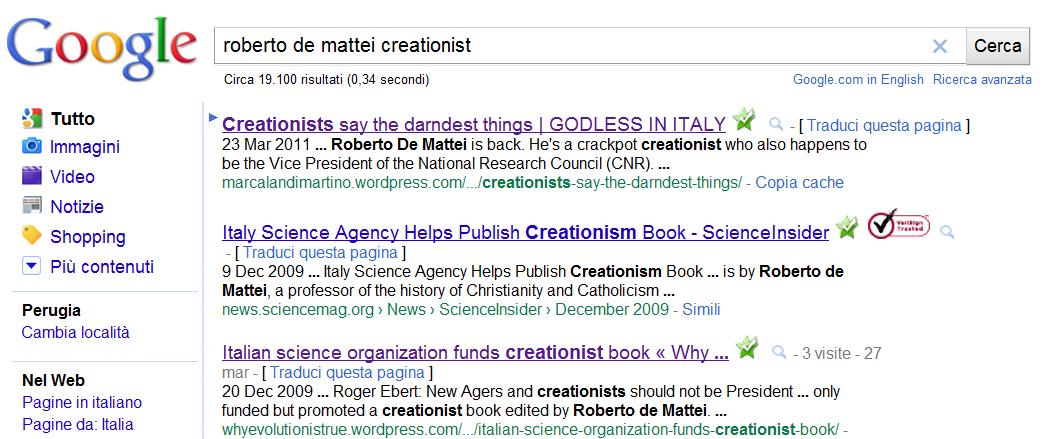
Google considers me an authority on crackpots

When I google “Roberto De Mattei” and “creationist” this is what I see:

I’m not an authority on many things, but this is kind of cool.

How Italy’s “8 per mille” religious tax works

I don’t have much time right now to write a lengthy post on the “8 per mille” (that’s “8 per thousand”) religious tax. It’s an obligatory tax, and the taxpayer must choose which religious confession gets the money. If the taxpayer is a Muslim, Buddhist or Hindu he or she is out of luck. Their religions aren’t able to participate. In that case the taxpayer might simply not choose, or choose “State”, in which case the money almost certainly goes directly to the Catholic Church. 

The UAAR has done an excellent job of informing the public on how this all works. Around 60% of Italians don’t choose, perhaps because they’re apathetic or have no idea what’s at stake. Only 37% or so actually choose the Catholic Church, yet the C.C. receives around 87% of the entire tax. Something’s clearly wrong with this picture.

If you understand Italian, this short video explains what’s going on (and how the C.C. spends the €1 billion or so they get as a freebie from the State each year.)

The “8 per mille” Wikipedia page exists in ItalianEnglish and Hebrew.

Miracle in Petrignano

Our Lady of Alderaan

One of the perks of living in Italy is that, no matter where you end up, you are in the realm of miracles. They happen all the time here. But like UFO sightings, hauntings or any other paranormal activity, miracles never seem to happen to me. I wonder why that is.

Not long ago we were having dinner with some friends when one mentioned that the Virgin Mary had appeared in our local church last year. There had been a big brouhaha over it on television, and apparently the Vatican is now doing whatever it is they do to “verify” the supposed breach of all known laws of reality. We might be living in the next Lourdes, or Medjugorje, for all we know.

According to RAI’s Massimo Giletti, who hosted the relevant television special, one of the “seers” of Medjugorje (one of the six people who supposedly saw the Virgin Mary appear the Herzegovina town in 1981) was at the church of our modest hamlet for some commemorative prayers. An elderly woman who was attending took out her cell phone to film the service for her daughter. When she got home and watched the results, there was “a luminous figure” in the foreground. The woman sustained later that there was “no one there” while she was filming.

Miracles often begin their lives this way. Let’s take a closer look, though.

First, Assisi is a place known for one of the best-loved saints in Catholic canon, St. Francis. Everything near Assisi is bathed in the glow of this humble man, and our town is no exception. He was akin to the Italian Jesus (or was until Padre Pio usurped his throne). It’s a very suggestive place, even for a skeptic.

Second, we are in the presence of religious believers. Who else goes to church to see a religious celebrity like the woman of Medjugorje, anyway? So two very essential elements are in place for miracles to happen.

What would be truly astonishing is if the woman had filmed something quite unrelated to the Catholic faith. Joseph Smith maybe, or a Hindu deity. That would’ve at least been worthy of scrutiny. That she filmed the Virgin Mary is prosaic; it’s expected in a place already saturated with Virgin Marys. They are on the walls, in paintings, on street corners, in people’s houses and in their wallets. There should be nothing surprising if she “appears” on someone’s cell phone.

The image itself is very suggestive — at least to me — of Princess Lea from Star Wars. There is a famous scene in the movie where she appears in a hologram projected by R2-D2. Supplicating, she says, “Help me, Obi-Wan Kenobi. You’re my only hope.” It’s an astonishing resemblance. So how do we know it wasn’t Princess Lea in that church?

We don’t, any more than we know it was or wasn’t the Virgin Mary. Because for a vague white glow to be either of those two presupposes an enormous amount of supporting evidence, which we just don’t have. We’d need to establish their historical existence, first of all. One is a minor character from a book written thousands of years ago and full of all sorts of things we know to be fanciful, falsified and just plain fraudulent. The other is from a movie made comparatively recently, in 1977. The actress Carrie Fisher — who played Princess Lea — is still alive, giving a slight edge of probability to our admittedly absurd hypothesis.

I could go on, but I’m only trying to establish the idea that miracles are in the mind of the credulous. When enough people begin believing these things, the Vatican authorities step in and “verify” them, creating a moneymaking publicity machine in the process.

One could say that not all supposed miracles are accepted by the Vatican, thereby suggesting that there are some criteria by which miracles are tested for veracity. As they are by definition unfalsifiable, though, it really appears to be a matter of shrewdness. The case of Padre Pio is a good example. The Vatican actively opposed his cult for decades, until it grew too large to be ignored. So they incorporated it. Now, as they say, he’s more popular than Jesus and almost every Italian knows someone who has been “miraculously cured” by him. I know I do.

I’m daily amazed that adults are susceptible to such obvious nonsense. What doesn’t amaze me, though, is that Italian state-television cynically plays to this credulity. They know their public, and they will do just about anything to keep them as uninformed and complacent as possible.

From The American

Italian politicians playing on their iPads in Parliament

Here are some photos of Italian politicians using their time wisely. In these photos only right-wing parties are represented, but you can be sure that center and left parties are doing the same. If you’re on a Northern League mailing list, I’m sure you’re getting them (I’m not so I don’t). And they wonder why nobody trusts them?

(Italy Chronicles has done a more in-depth post on these same photos.)

Rita Levi-Montalcini turns 102

The oldest living Nobel laureate.

From Jewdayo:

The oldest living Nobel laureate, Rita Levi-Montalcini, was born in Turin, Italy on this date in 1909. She did her award-winning work at Washington University in St. Louis, MO in the late 1940s, isolating the nerve growth factor, which plays a key role in the growth and homeostasis of nerve cells. The discovery earned the 1986 Nobel Award in physiology/medicine for her and Dr. Stanley Cohen. Levi-Montalcini had become a doctor in the 1930s after witnessing the death from cancer of a close friend, but the rise of Italian fascism forced her to conduct her research in a home laboratory (in both Italy and France) until the end of World War II. She was appointed Senator for Life in Italy’s senate in 2001, and periodically takes part in the chamber’s deliberations expressing progressive views, which has fetched many attacks on her as both a leftist and a Jew from right-wing bloggers and politicians. Her autobiography, In Praise of Imperfection, was published in 1988.

“I tell young people: Do not think of yourself, think of others. Think of the future that awaits you, think about what you can do and do not fear anything.” -Rita Levi-Montalcini