Mario Fagiolo – later Mario dell’Arco – was an architect by profession in the 1930s. This week I was lucky enough to be able to visit his two main contributions to 20th century architecture, both done with his colleague Mario Ridolfi. (The two would have a falling out after the war. Fagiolo would subsequently abandon architecture for literature and change his name to Dell’Arco.)
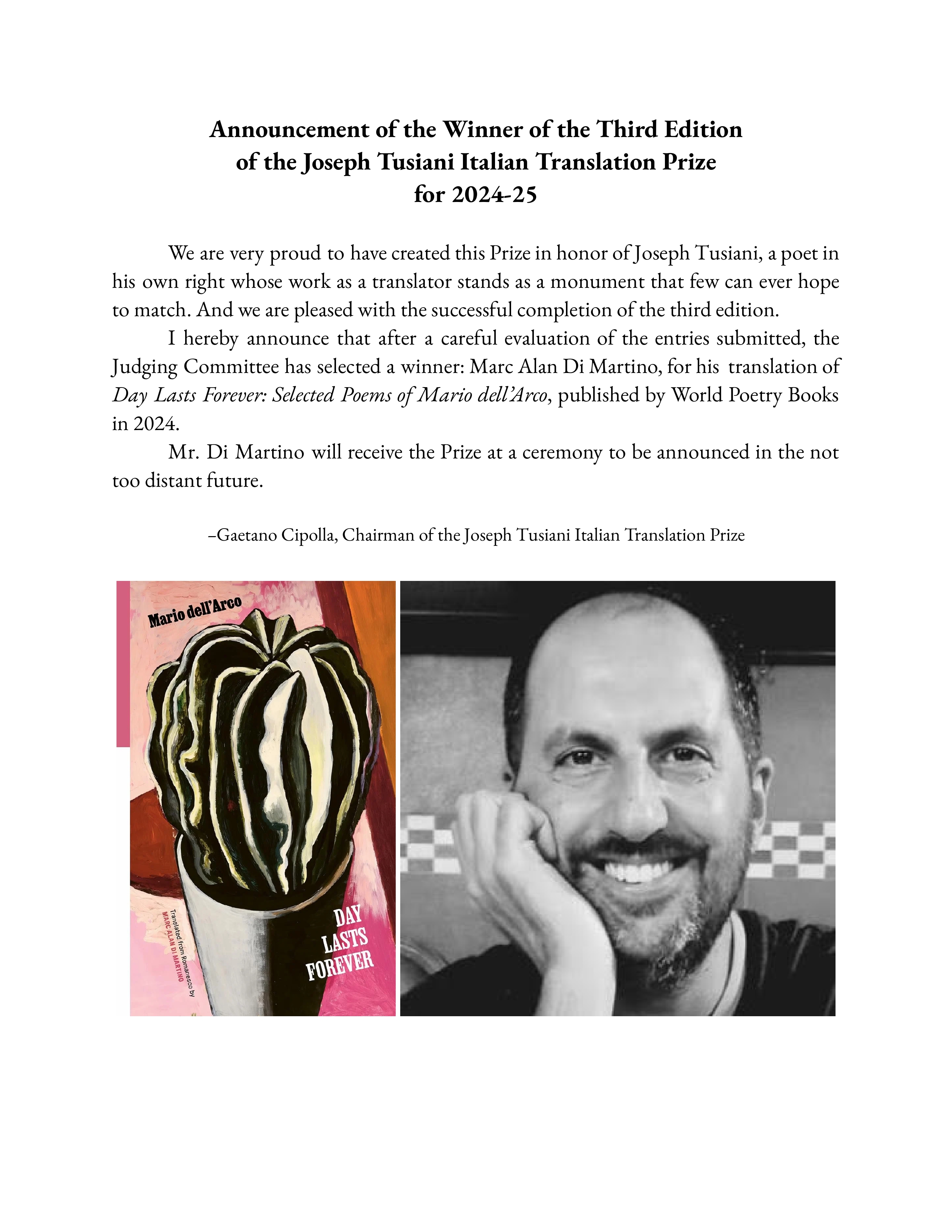
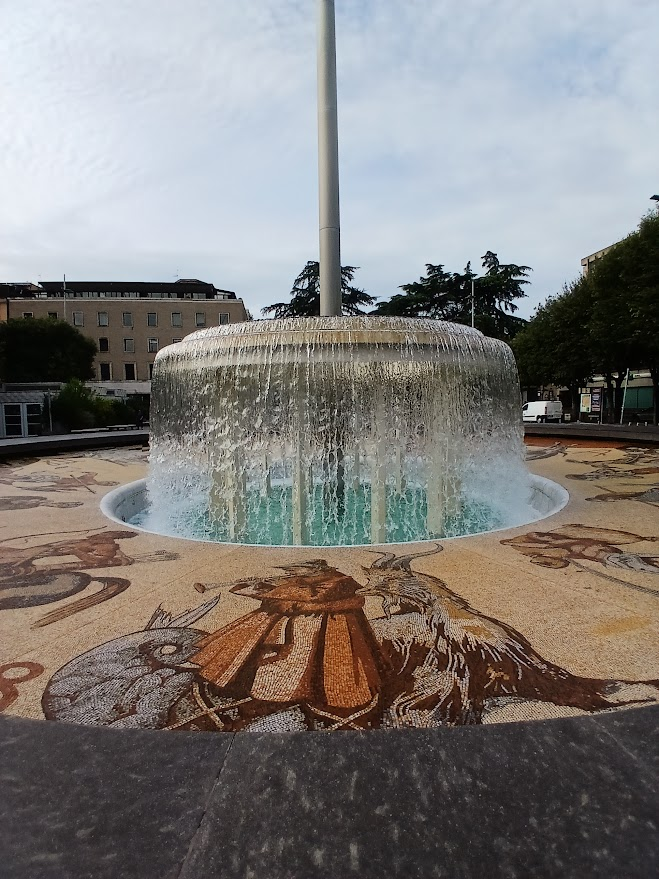
The first, below, is the Fontana dello Zodiaco (Zodiac Fountain) in Terni, which is essentially a ‘space needle’ surrounded by mosaics of the zodiac. Terni isn’t a terrible enchanting city, as far as Italy goes; it was bombed heavily during WWII as it was a major site of arms manufacturing, and the fountain was damaged as a result. After the war, it was reconstructed. The fountain dates from 1932-36, a full decade before Taja ch’รจ rosso! – his first collection – was published.
photos by the author
The second is the Post Office in Piazza Bologna(1935) in Rome. It was night when I visited, so the photo isn’t great, but you can get some idea of its modernist lines.
photo by the author
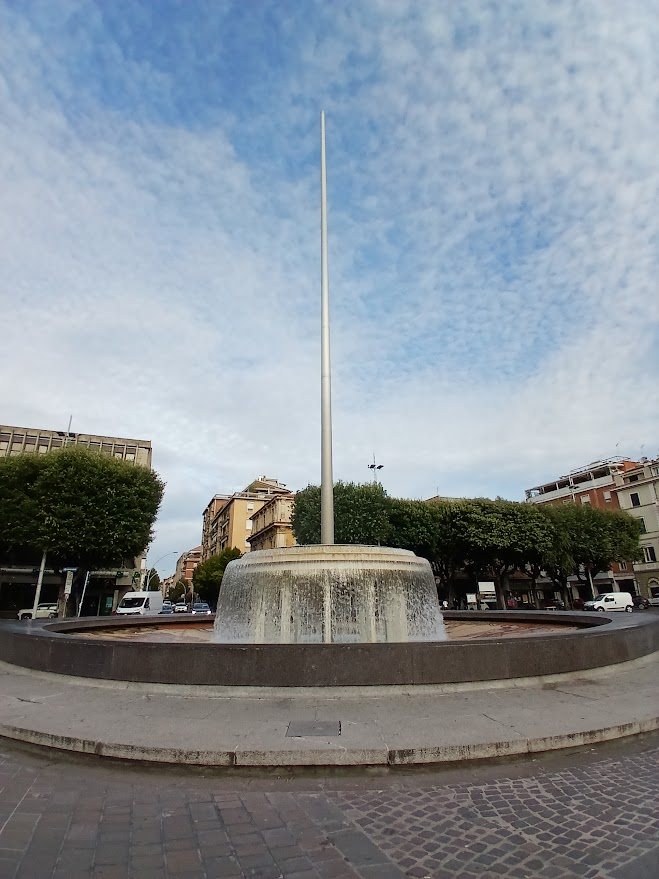
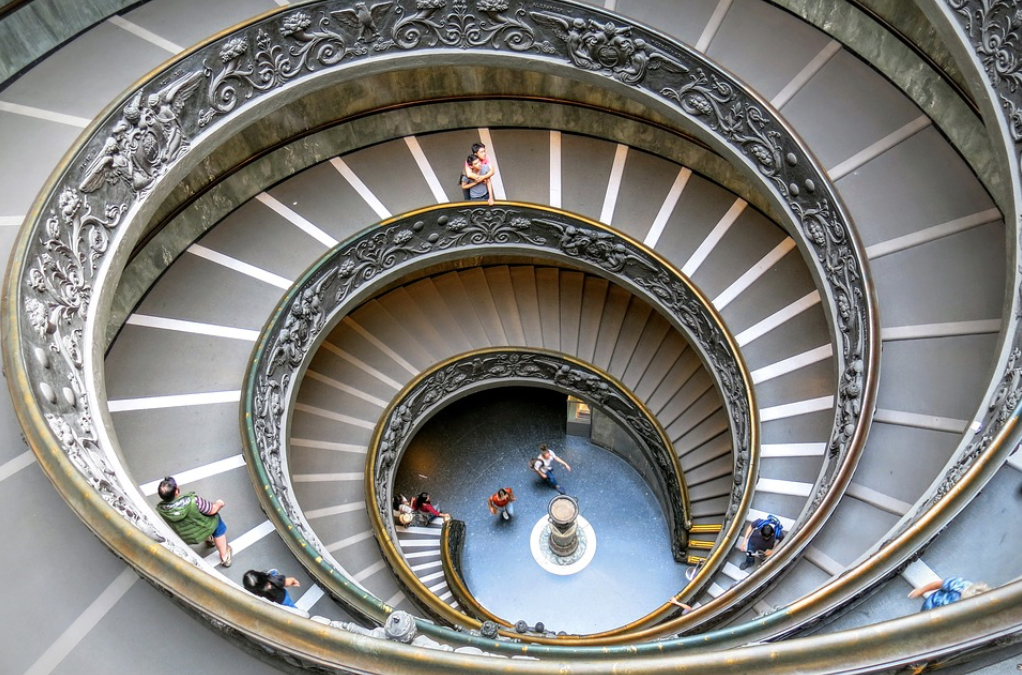
Architecture makes frequent appearances in Dell’Arco’s poetry, as one might expect. Even his nom de plume is a play on architecture: Dell’Arco, ‘of the Arch‘(itect). Here is one of my favorites, “Spiral Staircase”. The poem alludes to what in all probability is the spiral staircase of Bramante in St. Peter’s Basilica (below).
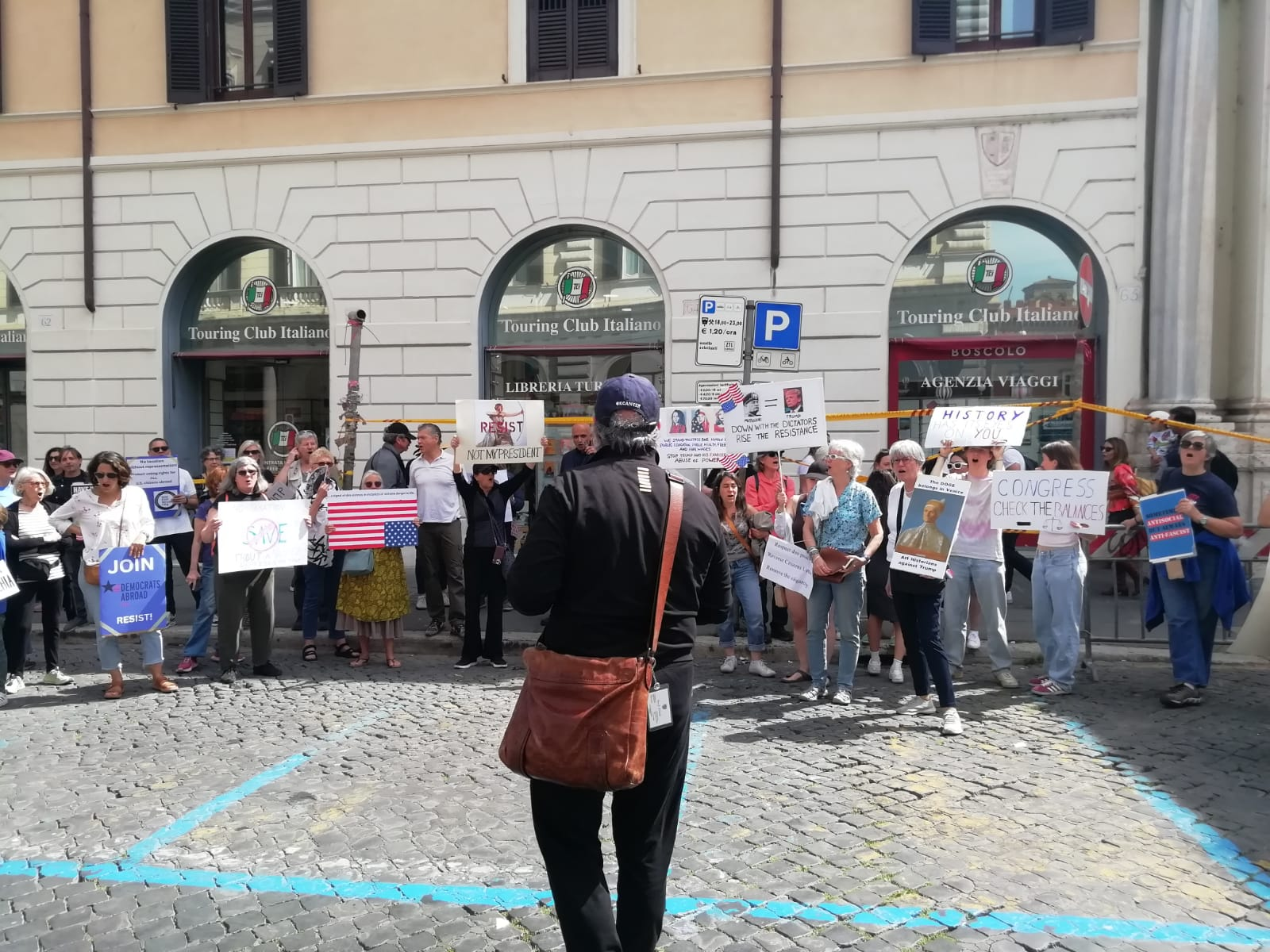
Democrats Abroad protesting in Piazza S.S. Apostoli, Rome – May 3, 2025
On May 3 we protested the rising tide of American fascism in Rome, right near Piazza Venezia. The sign I’m holding reads: “Accept nothing from fascism. Non accettare nulla dal fascismo.” It’s a quote from Italian poet, scholar and anti-fascist Lauro De Bosis, whose final act of resistance against Mussolini’s regime was to fly a small plane over Piazza Venezia and central Rome, disseminating hundreds of thousands of anti-fascist pamphlets overhead. He was never heard from again. His body was never found.
I wrote about Lauro some years ago, recounting my discovery of him at the Gotham Book Mart and subsequent obsession with his life and work. I even attempted a verse translation of Icaro, his 1927 verse drama about the myth of Icarus, which eerily foreshadows his own demise. I realized it was beyond my powers of translation at the time, but I may one day come back to it if I ever take up residence on the Isle of Innisfree.
There is a lot to say about Lauro De Bosis, and to this day I am stupefied by the fact that almost no one I talk to has ever heard of him. In any case, his memory was alive and well last Saturday among a scrappy gathering of Americans abroad protesting the excesses and obscenities of one of Mussolini’s most shameless admirers, one who at present occupies – somehow – the Oval Office. We will keep resisting until this sham administration crumbles under the weight of its own corruption and incompetence. They all do, eventually.
Below is a photo of Piazza Lauro De Bosis, in Rome. There must have been a bureaucrat with a sense of humor at some point.
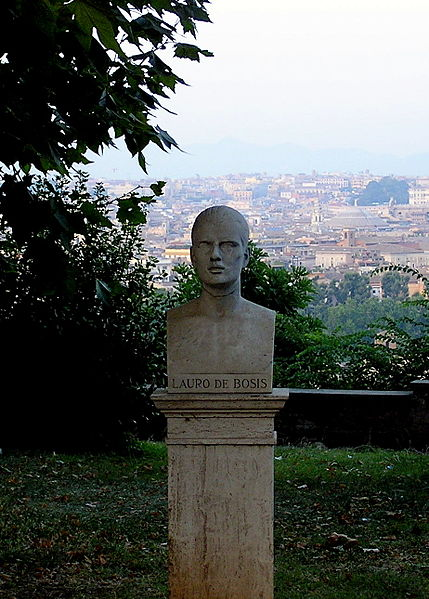
Bust of De Bosis on the Ganicolo in Rome. There is no bust of Mussolini.
What I enjoy most as a translator is bringing poetry or poets to the English language for the first time. I have enormous esteem for the many translators of Dante, Belli, Montale and other Italian poets who have benefited from the efforts of a multitude of translators. Each new translation offers up a slightly – or drastically – different take on the same poem or author. Taken together, they create a composite portrait of the original work, not unlike reading multiple biographies of the same person written from different perspectives and points in history. But there are so many important voices still lurking in the shadows of literary history, stalking the margins, and that’s where I like to spend most of my time.
Much of my translation work has dealt with the poetry of Mario dell’Arco, a poet almost completely unknown in the English-speaking world a quarter century after his death. He is not much better known in his native Italy, or even in Rome, his birthplace. This despite the fact that he had a six-decade long career, published dozens of collections of original verse as well as versions of classical Roman poets like Martial and Catullus, and wrote books of prose including biographies of his Romanesco predecessors Belli and Trilussa. The point being, I noticed a gaping hole in the literature and made a conscious effort to fill it. My hope is that others may take up the gauntlet and try their hand at Dell’Arco, adding something to the portrait I’ve begun to sketch into English of this great poet’s work.
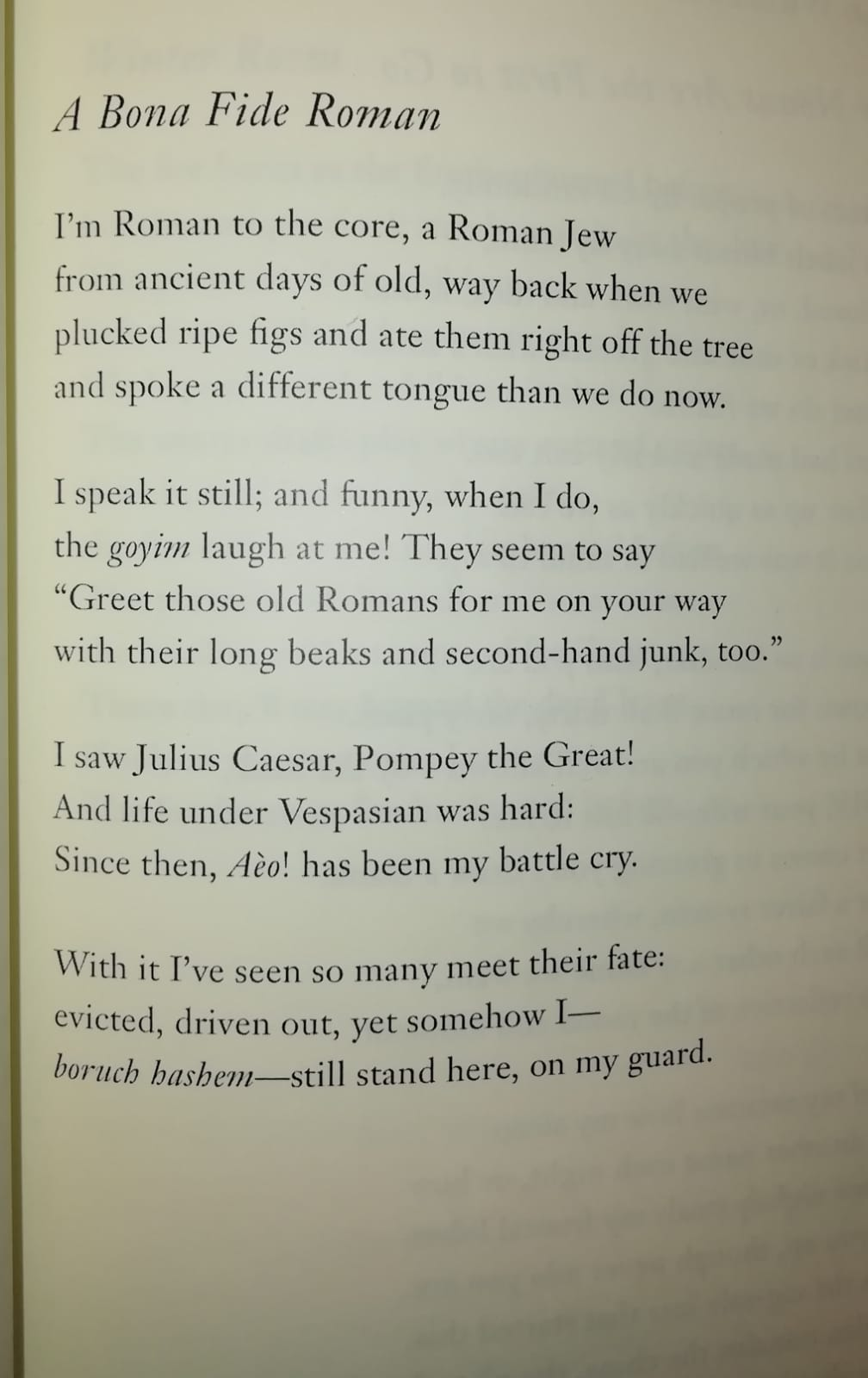
What has any of this to do with Crescenzo Del Monte, you ask? Well, Del Monte is another poet who has gone the way of the dodo, to put it bluntly. Yet he is arguably one of the five major Romanesco poets: Belli, Pascarella, Del Monte, Trilussa and Dell’Arco, in order of birth. Del Monte differed from the others in that he was Jewish, and wrote in Giudaico-Romanesco, the dialect of Roman Jews. He was a versatile writer who wrote in Romanesco and Italian as well, and did many translations of others’ work into Giudaico-Romanesco, such as a version of the first canto of Dante’s Inferno.
Like Belli, Del Monte can be forbidding because of his meticulous renderings of his characters’ actual speech patterns, as can be seen in “O’ ‘nvitato a pranzo” (below), and the surfeit of Hebrew words which are often half-masked through transliteration (chalomme is the Hebrew word for ‘dream’, ืืืื, pronounced chalom). Also like Belli, he offered up copious notes to his poems; practically every one has a glossary of terms to help the reader along. He knew it wouldn’t be easy, but he was preserving a world in his work, a world that now exists encoded in the poetry he wrote between the destruction of the Roman ghetto and the Fascist racial laws. (To hear a reading of Del Monte’s “La Cena de Purimme” – “Purim Dinner” – which bears a close resemblance in both theme and language to “The Lunch Guest”, including the same rhyme of chalomme/makomme, click here.)
I was lucky enough to have been able to study Hebrew in at the Jewish Cultural Center in Trastevere as well as in the ghetto, where for a time classes were being held in the local bookshop, Menorah. I’m by no means fluent, but I have enough of a grasp on the language and its historical-cultural milieu that I can find my way through the jungle with a candle and a machete.
As far as I know, there have been no other translations of Del Monte’s work into English. If I’m wrong, please reach out and let me know! Sgrรนulla!
*an alternate ending to the above poem – one more faithful to the original – might read: A cup of coffee and then nighty-night/tomorrow it’ll end up in the toilet.
Published in THINK
*line 8 of the above poem should read “with your long beak…”
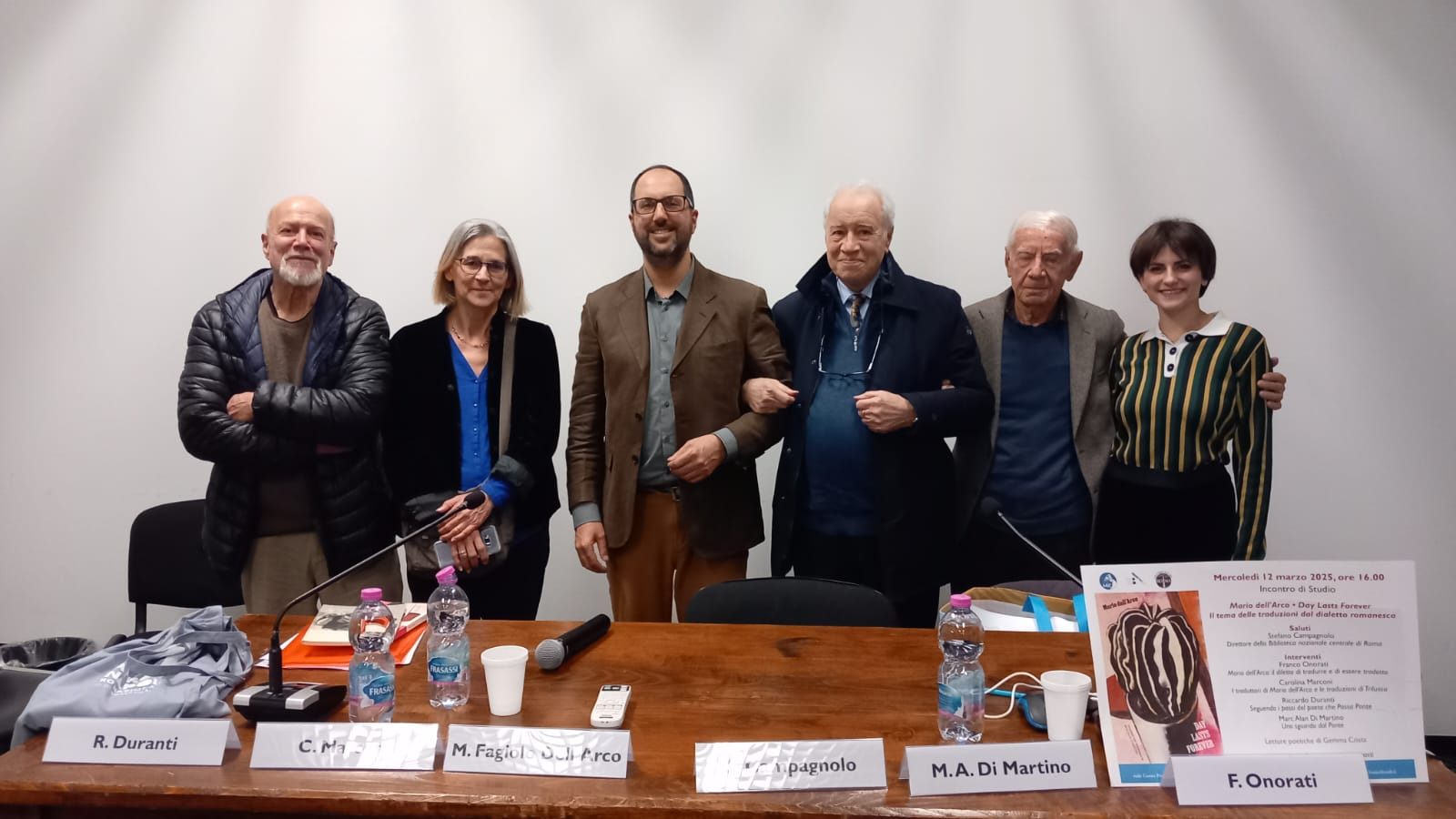
L to R: Riccardo Duranti, Carolina Marconi, me, Marcello Fagiolo dell’Arco, Franco Onorati & Gemma Costa
Mario dell’Arco was born in Rome on March 12, 1905 in Via dell’Orso, not far from Piazza Navona. Last Wednesday would have been his 120th birthday. We spent it at the Biblioteca Nazionale di Roma (National Library of Rome) in Castro Pretorio, celebrating his poetry and his life. Ostensibly, much of this was also a celebration of Day Lasts Forever, which has the distinction of being the first book of Dell’Arco’s work to be translated into English or, to my knowledge, any other language. This has been cause for some celebration among the Romanisti – scholars and enthusiasts of Romanesco and its culture – as Dell’Arco was the last of the “four greats” of Romanesco poetry – Belli, Pascarella and Trilussa being the other three according to no less an authority on the subject than Leonardo Sciascia – to have ‘crossed the bridge’ into English.
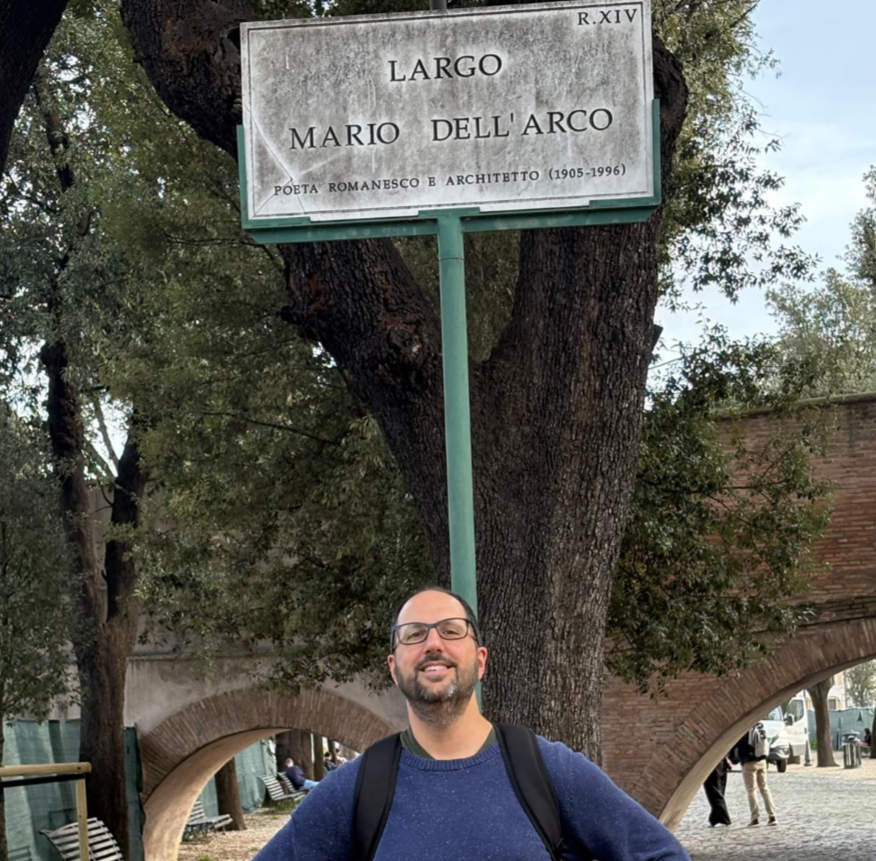
I am honored to have been invited to participate in this conference, hosted by Marcello Fagiolo dell’Arco, the poet’s son. My co-presenters are all accomplished scholars of Romanesco poetry – and Dell’Arco’s work in particular – who have been doing incredible work for decades to get him the recognition he deserves, including erecting commemorative plaques in Via dell’Orso (above) and at Castel Sant’Angelo (below), where a section of the gardens now bears his name.
When I began reading and translating Dell’Arco’s work, I spent most of my time in a vacuum. I had no inkling any of this existed outside of a few books published for his centenary. Suddenly, now it feels like it must have felt for Dorothy when her house landed in Oz; the world has gone from black-and-white to Technicolor in a very short time.
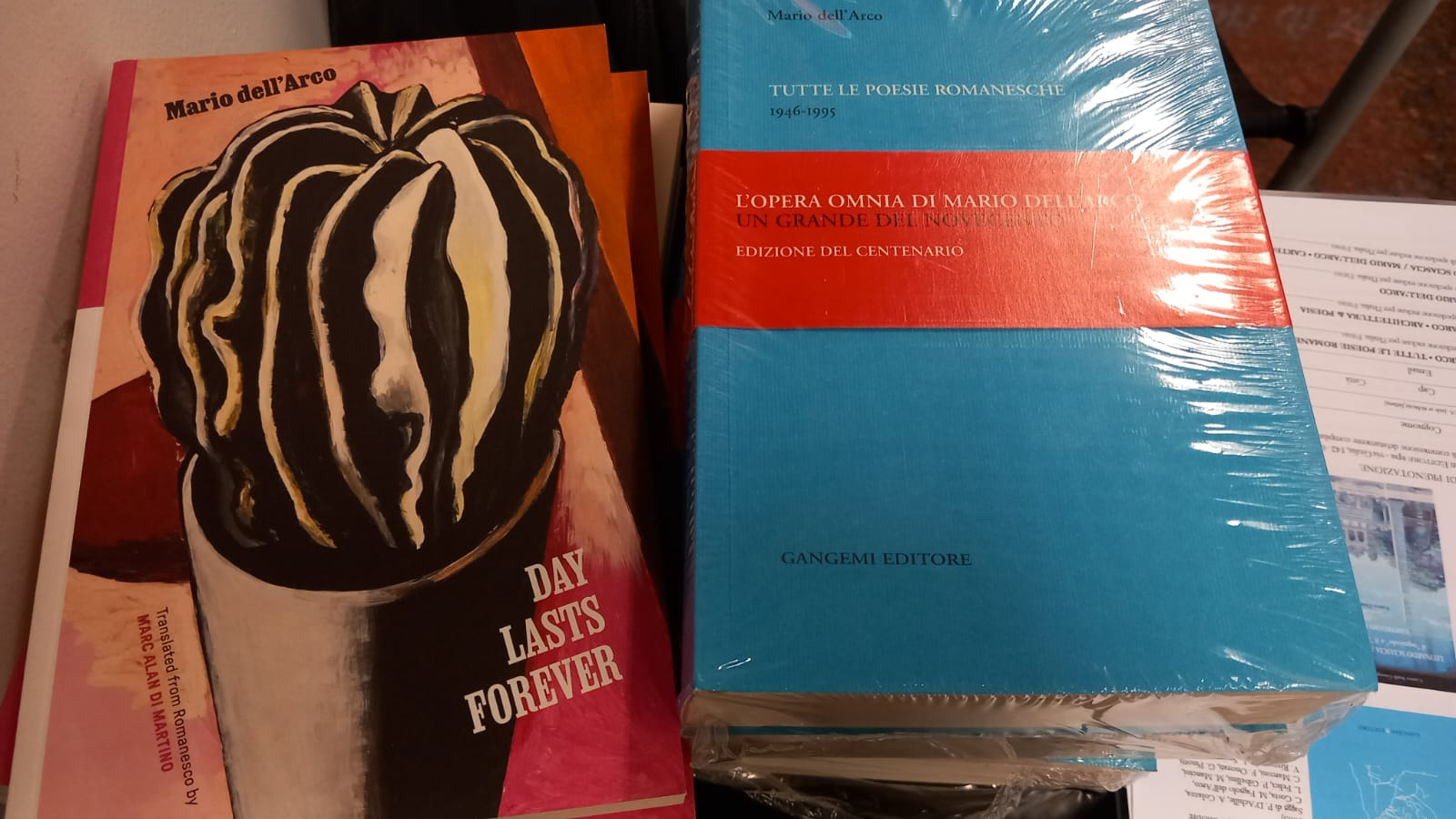
Day Lasts Forever, side-by-side with the opera omnia
There is so much I could say about the event. Each presentation was distinct and rich in detail, ranging from a biographical portrait of his father and the deeply personal nature of much of his work (Fagiolo dell’Arco) to the playfulness of Dell’Arco’s encounters with the Latin poets Martial, Catullus and Horace, which he ‘Romanescoed’ (Onorati), to the second lives of Dell’Arco and Trilussa in translation (Marconi) and reflections on the art of translation (Duranti). My contribution was an essay I wrote in Italian – no ChatGPT – about my experience discovering Dell’Arco’s work and attempting to usher it to the other side of the Atlantic by hook or by crook. The curious reader can listen to the entirety of the presentations, where they were recorded and archived for posterity by Radio Radicale (click image below). The presentations are, of course, in Italian with readings of Dell’Arco’s Romanesco poems by the wonderful Gemma Costa and in English translation by Riccardo Duranti and myself. (You can click on the names in the sidebar to skip to the English-language content if you wish.)
As an added bonus, my sister filmed a couple of videos of me reading my translations of the poems “I Built a Wall” and “Heads or Tails?”. You can read selections from the book here.
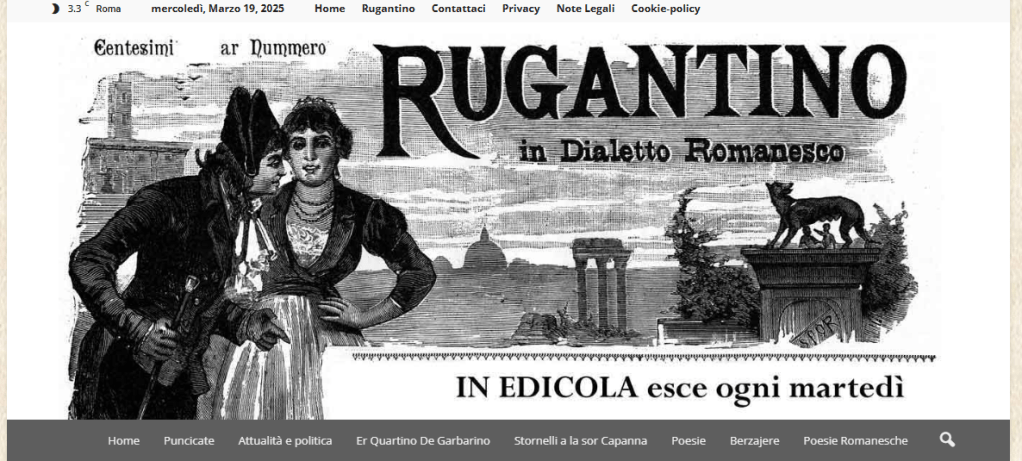
Finally – and I could go on! – the event received a write up in Rugantino, a satirical paper published in Romanesco, founded in 1848 with the newly won freedom of the press (click image below). Bbona lettura e bbon ascolto!
Monica and I with Dell’Arco’s writing desk in the Spazio ‘900.
If you’d like to orderDay Lasts Forever – Selected Poems of Mario dell’Arco, click this link or pester your local bookseller into ordering it.
Anthony Madrid has written a review of Day Lasts Forever for RHINO. This is the fourth review so far and the third in the month of February! Madrid has this to say:
This is my kind of thing. Seventy-one poems, all but one, this big: [pincer fingers emoji]. I just checked: almost every single poem is five lines. Many are four. Soโฆepigrams!
Yes, epigrams! and some other things like short lyrics about cats and wine as well as laments for the loss of loved ones. Many of the poems are indeed five lines, though some push seven or eight lines. The thing to notice is just how much Dell’Arco packs into those few lines, a dense imaginative space. Madrid happily quotes five poems in full, and still manages a brief review. He takes issue with one poem, a translation of a translation of Martial. It’s fair game. Read the poems and decide for yourself.
Day Lasts Forever: Selected Poems of Mario dell’Arco can be ordered from World Poetry Books or from you finest local booksellers.
Across the collection, many themes abound: the art of laziness, the nature of language, good architecture and the weather, the moonโs propaganda strategy, the heart of the scarecrow or the sunflower or the sundial, Jove and the deadly sins, the importance of lifeโs simple pleasures, self-isolation and the longing for reconnection, the absurdity of the artistโs life, watermelons and summer nostalgia, the history of Rome, light and darkness, a few unique felines. . . Is there hunting? Yes: some birds get shot. Is there wine? Plenty.ย
What’s not to like? Walker concludes with what I take as the highest praise:
As such, this modest, rewarding selection from a vast corpus should be required reading for any serious student of translated poetry, and [Mario dell’Arco]โhonorably resolute in the dissemination of his Roman dialectโought to be placed on the shelf next to Italian legends like Italo Calvino and Eugenio Montale.ย
On March 12 – Mario dell’Arco‘s 120th birthday – I will take part in a presentation at the National Library of Rome with Marcello Fagiolo dell’Arco, Franco Onorati, Carolina Marconi, Riccardo Duranti& Gemma Costaon the topic of poetic translations from Romanesco. Below is the flyer for the event (in Italian). It is a great honor to be invited to speak about my experience translating the poems of Mario dell’Arco. If you’re in Rome or environs, feel free to drop in!
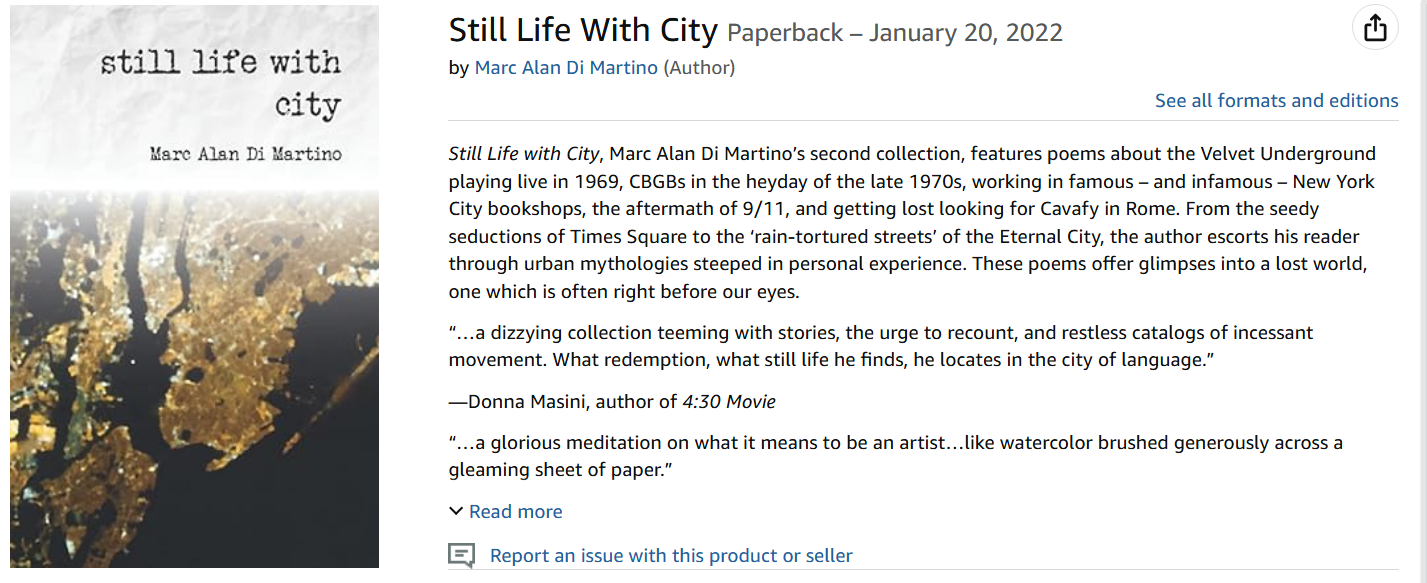
January 20, 2025 will be remembered for many reasons, and most of them bad. As we brace for whatever’s coming, I’m celebrating Still Life with City‘s third birthday! In summer 2022, my sister and I organized a book drive to send aid to Ukraine. Somehow we were able to drum up a few hundred dollars with this book, which we sent to beleaguered writers in Odesa. It may not be much, but one does what one can. It’s pretty affordable for a poetry book, so why not take a chance on it? ะกะปะฐะฒะฐ ะฃะบัะฐัะฝั!
Anglo American Book, Rome’s oldest English-language bookshop – founded in 1953 by Dino Donati and run by the Donati family for 70 years – is shuttering for good this week. This is a profoundly sad piece of news, though not unexpected. Skyrocketing rents have buried yet another temple of culture.
I worked at the AAB for five years, from 2005 to 2011. Like the Gotham Book Mart before it, it was a unique place where I met many unforgettable people. One friendship I struck up at the AAB was with Alexander Booth. He would come in often, and we always got to talking about literature, music and Richmond, Virginia in the 1990s. (We had both gone to VCU, a year or so apart, and ended up expats in Rome.) Alex and I were (and very much still are) both poets and translators, and remain close friends to this day despite living in different countries. Alexander published a lively translation of the poetry of Sandro Penna a couple of years ago. I remember seeing it in the storefront window at AAB, not long before they moved to the windowless upstairs location removed from street traffic. Without the Anglo American, would we ever have met?
I remember the evening when we had just closed up and were turning off the lights, and two ghostly faces appeared at the door. It was poet Moira Egan and her husband, the translator Damiano Abeni. I had to tell them to come back during opening hours. We became friends over time, though, and I interviewed them for The American in 2009. When my first collection Unburial came out, Moira was gracious enough to partner with me for the book launch at AAB (photo above).
AAB storefront window – December 7, 2019
Here are the recordings of Moira and me reading on 12/7/2019 at the AAB:
Moira:
Marc:
___
It was also there that I met Mike Stocks, poet and translator of Giuseppe Gioacchino Belli. Mike walked in one day with a handful of copies of his newly published translation. Of course, I had to interview him. We went out for pints near Piazza Trilussa while I recorded our conversation on my wife’s handheld recording device. (This was pre-smartphone.) Mike revealed to me his secrets for approaching the great Romanesco poet, notoriously forbidding both for his 19th century Roman dialect and for the volume of his output: over 2000 sonnets (the critical edition of his poems runs over 5000 pages.) That meeting with Mike influenced my approach to translating Mario dell’Arco, convincing me that one didn’t need to have academic chops in order to get the job done. It was an important lesson, and if he hadn’t fallen off the grid I’d buy him a beer and thank him.
Piazza Trilussa, Trastevere (Rome)
The list could go on, as lists do. Bookstores have played an outsized role in my adult life. It has been dawning on me for some time that I have lived at the edge of a disappearing era, a time when independent bookshops were places people went in their free time to meet other people, not unlike a neighborhood pub. They were like secular houses of worship. Relationships could be forged there. Lives could be altered. You were in the realm of curiosity, always bracing for the unexpected thrill of discovering a new book. Those born too late may never know this way of being in the world.
I spent many years working in bookshops on two continents: Strand, Gotham Book Mart, Anglo American Book. It was never a swank job with a good paycheck, but the summation of that experience was for me the equivalent of a university degree. I’ll always remember the names of people who worked at those NY bookshops before me: Tennessee Williams, Allen Ginsberg, Patti Smith, Tom Verlaine, Richard Hell. It seemed like it might almost be preparation for a future in the arts. Maybe it was.
It seems apropos to round out this reminiscence with a poem about another of my favorite gone bookstores, Chop Suey Books in Richmond. It was my go-to bookshop whenever I was in town visiting the old haunts in Careytown. The poem was published in the Hollins Critic, a quirky little literary journal from Virginia which – but of course – ceased publication last year. It seems like our losses are neverending. All we have is art to push back against the rising tides of oblivion.
Well, this is embarrassing. Under the influence of a highly tumultuous summer, I completely forgot to mention the reading I gave in Rome with Francesca Belland Alessandra Bava. It was my first reading ever, unless you count the time I murmured a few poems under my breath at a bar in NYC just after my very first publication in 1999 or so.
It was a miracle this reading even happened – on June 29, which is Roman holiday. Francesca was in town on vacation, and – after a little fancy footwork – we organized this reading at Otherwise Bookshop with Alessandra, a poet and translator who has rendered some of Francesca’s poems in Italian.
It was an amazing experience to walk from my family’s home near St. Peter’s up Via del Governo Vecchio, to read a poem that takes place in that very stretch and which is the gravitational center (and title) of my book. So many important events in my life have happened in that little tangle of streets along the Tiber, and I’ve tried to get some of it into my poems.
Below you can listen to me read four poems from Unburial: “Runaway“, “Unburial” “The Skaters” and “To the Horned Moon” from the June 29th reading. (Warning: I sound like Carnegie Hall-era Lenny Bruce at times.) Somewhere, there is video…