In which the author reminisces about skate videos and goes off on a tangent

Ollie by Alan Gelfand, skateboarding’s ur-trick.

Anyone reading this blog can tell that I’ve gotten pretty much sucked into the world of skateboarding once again. When I was a teenager skating the streets and mini ramps of suburban Maryland, there was no such thing as social media. The internet was just being invented. You were lucky to have a friend with a handheld video camera. There were no mobile phones, much less ones with decent cameras. So, apart from a few rough-and-tumble videos which haven’t survived well over the past two decades, and a photograph or two lost in a box of old photos, nothing at all exists to document what was at one time an all-consuming passion of mine.

Which is kind of a shame. One of the things a skater coming back to skating after a long time does is watch all the old skate videos (many of them are now available, at least until they are pulled, on YouTube). Because that’s what we did back then on a rainy day, watch videos and study tricks, making mental notes for the next day. I had a collection of them on VHS cassette: beginning with Powell-Peralta’s Search for Animal Chin and Santa Cruz’s Wheels of Fire and Streets on Fire, Streetstyle in Tempe (a contest video from 1986 which illustrates the light-speed progress street skating made in the next few years; just compare it with Blind’s Video Days a mere five years later), Powell’s Ban This! and Public Domain, H-Street’s Shackle Me Not (that Matt Hensley sequence was my favorite) and Hokus Pokus , all culminating with Plan B’s Questionable in 1992. This last sounded the death knell for many of us at the time, I believe. Watching it again, it seems clear that we recognized that what those guys – Mike Carroll, Pat Duffy, Danny Way, Rodney Mullen, etc… – were doing had gone so far beyond what we could realistically hope to emulate, had become such a terrifying mix of technical prowess and sheer courage, that there was almost no point in trying to keep up with them. Skating had moved beyond us, had left us out in the East Coast cold. Unless you were willing to risk your very life for the lens, you were out. Skateboarding had become – perhaps always had been – a kind of poker. The ante was high, too high, and I folded.

But as any skater will tell you, it’s all about having fun. That’s the main thing, sure, but parallel to having fun is pushing yourself. It’s a kind of evolution, the way nature pushes itself into endless forms and niches. It can’t sit still and just do the same thing forever. Similarly, a skateboarder gets fed up after a while doing the same three tricks. Skateboarders push themselves, and each other, into new realms, new possibilities. That’s how skateboarding went from where it was to where it is, from Tony Alva doing the first air in a pool to Alan Gelfand doing it without hands (the first “ollie”), to Rodney Mullen doing it on flat ground, and then Natas doing it over a trash can. Then it branched out in a million different directions like the tree of evolution, adding infinite variations, to the point where today the ollie is the ur-trick of street skating, a discipline which has essentially cannibalized what was once called “freestyle” and brought its technical virtuosity to places like monster ramps and 30-stair handrails. The world of skateboarding is not for the weak-willed. It is a place where you could crack your skull open for the sake of landing a trick which has never been done.

These thoughts are on my mind as I nurse my most recent injury, a pulled muscle around my rib cage. At 40, you don’t need to attempt to tre flip a double set to get hurt. All you need is one wrong movement, to twist your torso just a touch in the wrong direction, and you are off skating for a few weeks. There is no room any longer to contemplate keeping up with the latest tricks. That is no longer what it’s about (and, as much as it was “all about having fun,” it was also about not falling behind the changing times). Now it really better be about having fun, getting your mind off work and money and car repairs and your in-laws, taking a much-needed break from adulthood. But the tricks, the impulse to push and move beyond where you are, never really goes away. I remember thinking, just a few short weeks ago, “I’ll be happy just to roll around without falling off.” That lasted for about five minutes. By the end of my first session I was already attempting pop shuvits. There’s no getting around it, skating is about moving forward, always and inexorably, from wherever you happen to be at the moment. Like life.

Oh, and I finally began landing the pop shuvits.
View this post on Instagram

Frontside pop shuvit. Landed it! #skateboarding

A post shared by Marc Di Martino (@marcadimartino) on

Talismans

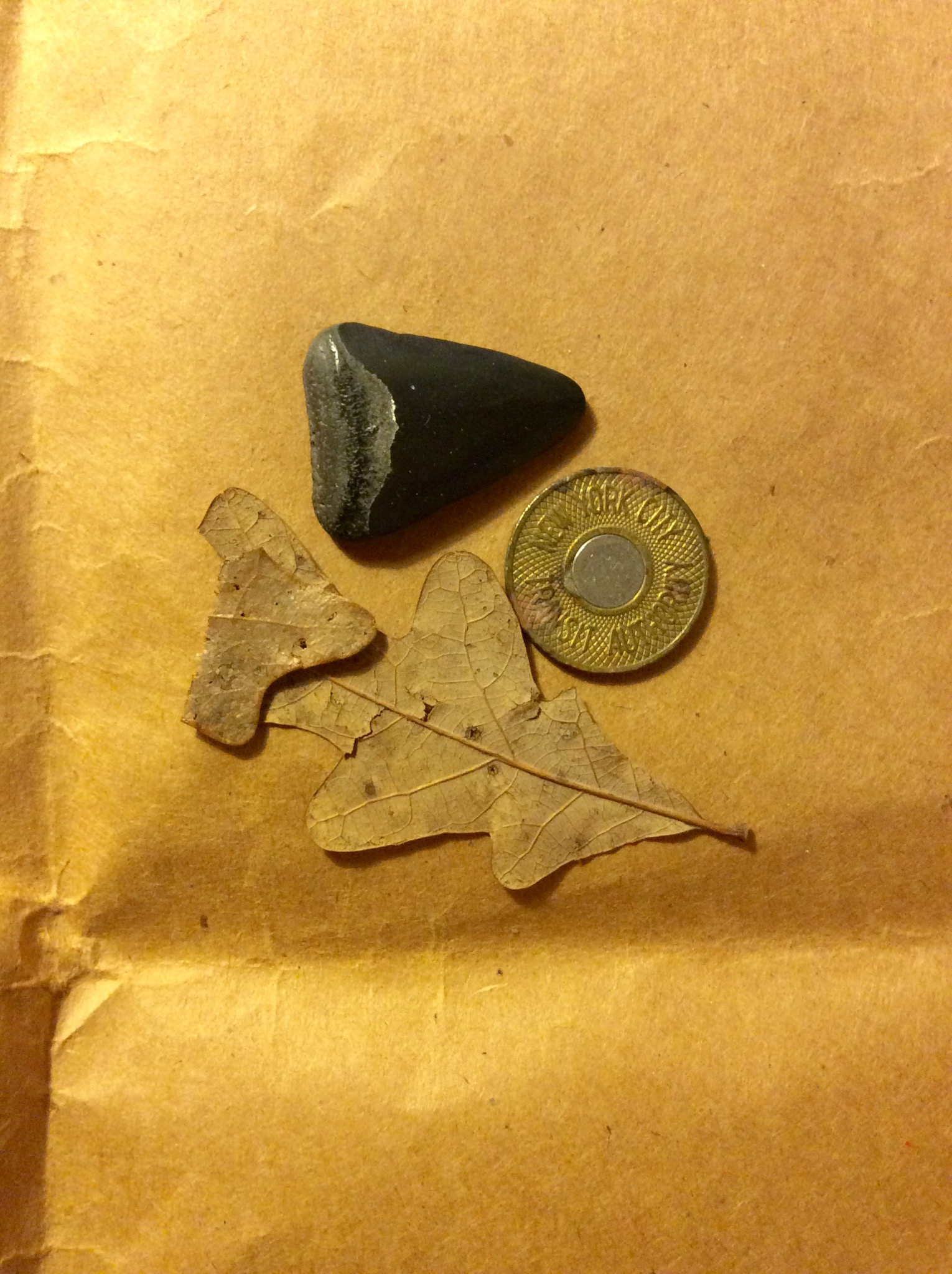
Or whatever you call them. I’ve been hanging on to this small packet of ‘mystery’ objects since 1994, when I received it as a parting gift on the last day of classes at college. It was a painting class, and we were supposed to have a critique of our end-of-the-year projects. The teacher, being an artist, decided not to show up, leaving instructions that we were to critique each others’ work. He also left a box with a bunch of little brown paper packets, instructing each student to take one at random. Inside we were to find what was there and draw whatever conclusions we could from it. Say what you will, it was a memorable gesture.

Inside mine there were the following things:

  • a shark tooth
  • a New York City subway token (remember those?)
  • a dried leaf

IMG_0171.JPGIn the years that immediately followed, I  moved to New York City, dealt with a plethora of dangerous people and – yes – grew up. If I were of the mystical persuasion I’d probably think it was a real talisman. The truth is, I imagine any three objects could be imbued with narrative importance and adapted to any life, especially in the hands of a college art student with a yen for travel.

I’ve managed to keep this gift with me for twenty years, through innumerable addresses in various cities on two continents and assorted upheavals. I’ve never really consciously made a point of conserving it, but somehow there it is in my desk drawer, a quiet reminder of the streets I’ve walked.

Skateboarding

My friend Pat has started a blog about his return to skateboarding after a hiatus of over 20 years. I met Pat in 1989 when we began going to the same high school together in a suburb of Maryland. We were part of the same skate circle and together we followed all the fashions and developments of skateboarding through the early 90s. We were dedicated to and passionate about the sport. Neither of us were good enough to have imagined a future in skateboarding, though, and when we left for college we put our boards aside and moved on to other things. (I’ve written about my experience here.)

But skating never really left either of us, apparently. I can attest that I have always mentally skated my surroundings. The ex-skater is always silently scanning the landscape for skateable surfaces. There was a time I attempted to bury these tendencies, somewhat embarrassed about their unintellectual nature. But it wasn’t really up to me; the mind, as we know, has a life of its own. It’s not easy to tell yourself what to think about and what to block out. So when Pat began posting videos of himself re-learning to ollie, I took it as carte blanche to dust off the skateboard of my imagination once and for all.

A lot of this involves finding clips of old skate videos on You Tube, videos I used to watch on a daily basis on our VHS player. Trying to remember all the details is a challenge: what boards did I ride? I can only remember the first two: a Mark “Gator” Rogowski was my first board, in 1987. Sometime after that I got a bit more sophisticated and bought a Santa Cruz/SMA Natas Kaupas, the one with the black panther. I still remember the excitement of getting that one. I can’t for the life of me, however, recall any of the other boards I had between 1989 and 1992.

I do recall that the shape of the boards was changing constantly. In fact, the basic shape of a skateboard in 1992 is essentially the same as today: the nose and tail are indistinguishable from one another. There are minor variations, I suppose, but nothing like the variety of shapes one saw in the late 80s. I guess skateboard evolution selected the model which works the best for the most people. Here is a good breakdown of this evolution (via Pinterest)

Skateboard Shape Evolution

Suffice it to say that I have been getting more and more into watching and thinking about skateboarding. I’ve heard that this is a not uncommon phenomenon for those hitting forty, but so be it. Today I ordered a new skateboard online and a I really can’t wait to finally learn tre flips, a trick I could never get down even back when that was all I wanted out of life. Stay tuned for further updates!

Not a Halloween costume

Just as I was beginning to feel comfortable creating text-on-images (and having a lot of addictive fun) my Phonto app went poof. Now the app won’t load a photo. While they fix the glitch I’ve been trying Font Candy, but it’s less intiuitive and automatically puts the Font Candy logo at the bottom of your pictures. That’s lame (I suppose that goes away if you purchase the app). I’m hoping Phonto comes back to life soon, because I have a lot of ideas I can’t wait to try out.

In the meantime, here’s another one from my Toture Museum series. Just in time for Halloween.

IMG_0133.JPG

I did a drawing today

I studied painting and sculpture in college and used to be rather passionate about (making) art. I’ve always been passionate about viewing and thinking about it, but it’s been a good long while since I bothered trying to make anything more than a cartoon character for my daughter.

This evening I got the urge to try something a bit different. So I found a painting more or less randomly and decided to make a copy of it. All I had handy were some magic markers and graph paper, but it felt good to swim in the warm waters of impresssionism for a while.

Art is a habit, like writing. If you make time for it regularly, it becomes like second nature. Let it drift for too long and there it goes. You’re lucky if you ever get it back again, too.

The original artist is Elmer Bischoff. I don’t know what this painting is called.

IMG_0127.JPG

Red flags

I constantly find myself using the term ‘red flag’ whenever I notice something suspicious. I’m not at all sure many people know what I mean when I say it, though. It’s a skeptical term meaning, “Watch out, there is something fishy here.” Here is an amusing entry from RationalWiki citing some common red flags. I made this today.

IMG_0125.JPG

Making memes

When I was in college I was there to study graphic design. When I began to study, however, I realized I wanted nothing to do with the graphic design crowd (and my teacher and I mutually loathed each other) so I opted for “sculpture”, a loosely-defined major which basically included anything you could invent in three spatial dimensions. We sculpture majors looked down our noses at our ad-agency peers. “They aren’t real artists,” we’d scoff. “They just want to get a good job one day.” We still believed real artists lived in broken-down lofts without plumbing and ate ramen noodles for lunch and dinner (black coffee for breakfast, please). This, of course, made them artists.

Of course, I’m no longer eighteen. I have developed an – ahem – appreciation of other forms of creativity that don’t perforce involve splattered paint and vodka. One of them is the internet meme. Meme is an interesting word because most people who use it use it to mean ‘internet meme’, or photos with catchy slogans or witty quotes. Memes, of course, were coined by Richard Dawkins in The Selfish Gene in 1976. They are a bit more complex than lolcats, but we can love them both.

I have recently taken to reworking some of my photos via cool apps that make it simple to do. Here’s one I like – made with Phonto – which uses a photo taken at the Museo della Tortura in Montepulciano, Tuscany to make a point I feel is worth stating. I’ll upload some of them here from time to time. I hope you enjoy them. Feel free to spread them.

IMG_0113.JPG

Last sunset of summer in Tuscany

This is a photo I took last weekend in Tuscany. Farewell to another beautiful summer.

IMG_0067.JPG

The Velvet Underground

I remember a time before there was such thing as the Velvet Underground. It appears in my memory as a time before music, a time in my life before music was important, relevant, defining. And then, at some point when I was around nineteen, they took over my attention. The world was then divided into pre-Velvets and the contemporary world, a world in which Sweet Jane and Heroin were part of the landscape (soundscape?) There were always other groups, other music. There was Sonic Youth. They came before the VU, but were overshadowed and engulfed by their predecessors. There was (and is) Dylan, who had influenced the young Reed and has now outlived him, and whose songs (Memphis Blues Again, Visions of Johanna) were and are capable of inducing in my post-adolescent imagination something unique and hard to describe, something akin to influence. After those songs you are not the same again. They change you. The Velvets changed me. Patti Smith did, too, when I first heard Piss Factory. Marquee Moon changed me. Heart of Darkness. And all of them were indebted most to the Velvets and, perhaps less directly, Dylan. But it’s the VU I go back to, who’ve never left me. CDs, vinyl, cassettes, iPod, YouTube, streaming…I keep them close no matter where I am listening.
I remember a time when nobody I knew would listen to them. (They do now, of course.)
I miss you Lou.

What I’ve been reading

First, a lot of articles about reading: e-reading versus paper reading, are people losing their ability to read long, involved texts? is reading dead? That kind of thing. Also, books. E-books, paper books, whatever. I’ve finally opened my four-volume Montaigne from the Limited Editions Club (1946) and begun The Satanic Verses to see what all the hoopla was about firsthand. Montaigne is sobering and delightful; Rushdie is funny and surreal. I recommend both to anyone looking for a cure to monotony or ennui. I also read a lot of Dr. Seuss with my daughter. She loves Horton the Elephant.

I’m also trying to write again. As anyone can see, I’ve only written six posts in the last year. Now that I’m no longer writing my monthly column, I have no writing obligations. That means no writing. Say what you will about obligations, they do keep you doing things. So I’m trying to revive this blog which has spent two years gathering dust. (I think I’ve said this before.)

I’ve changed the look and feel of the blog. I’ve gotten rid of all the sidebar links (half of them linked to dead pages anyway) and images. There is a search bar and an archive for those who wish to go back and read what I’ve written since March 2009, when I started this blog. Gone, too, is the header. Now it’s just good old-fashioned text. That’s what writing has always been about, right?