A few days ago Rattle published a poem of mine in itsPoets Respondseries. Like most poems inspired by the news cycle, it was written at lightning speed and sent off almost immediately and with minimal revision. I’d like to write a post on the phenomenon of “news poetry” when I have more time, but right now I’m just bookmarking this one for posterity. Rattle is a fantastic journal and it’s an honor to be in such good company.
Bookstores are somethingIknow from, as my grandmother might’ve said it. I worked in some of the most famous bookstores in the world, and accumulated a large backlog of anecdotes and memories which have served me well since I moved on to other things. They are a constant source of material for my poetry, for one thing. But then again, so is every experience in a poet’s life. Take a recent example: the other day I was writing a poem on the kitchen table – which is my writing desk for all intents and purposes – and one of the lines became something about my grandfather’s prosthetic leg. My grandfather – who had been born in Vilnius (Vilna, in Yiddish) – died when I was eight, and I had only ever seen him infrequently. That is to say, I have no conscious memory of his fake leg. My sister, however, confirmed that he had indeed lost his leg to gangrene and used an artificial limb to walk. There is no end to the surprises we find out about ourselves, and sometimes in the most surprising ways.
The following memory was written in 2007, after the Gotham Book Mart had finally closed its doors. I hope some of the flavor of the place comes across. There will never be another bookstore like it anywhere.
_____
Everyone’s mother has some tidbit of wisdom that stays with them throughout their adult life. Here’s mine: when a person dies, an entire library dies with them. Therefore, it stands to reason that when a bookstore dies, an entire fleet of readers dies with it.
The Gotham Book Mart was, by some accounts, an ordinary bookshop in the venerable old style. Founded by Frances Steloff in 1920, it was there on 47th St. in midtown Manhattan before the diamond and watch merchants moved in. In its final days, it was the only remaining oasis on the block, a place where one could duck in amid dusty volumes of forgotten poetry and tumbleweeds of orange cat fur in order to escape the rabble. It was also a haunted house of literary legends. It was there that Steloff may or may not have scolded Marilyn Monroe for climbing on a ladder in high heels. It was there that Ezra Pound reportedly refused to enter because Steloff was Jewish. It was there that Ulysses and Lady Chatterley’s Lover were sold under the counter when you could still get into trouble for such things. Rumor has it they used to assemble the loose pages of Joyce’s masterpiece copy by copy in the store, making it a kind of literary speakeasy. It was there that they filmed the bookstore scene in Rosemary’s Baby. It was there that Robert Crumb reportedly rode a woman down the stairs like a mule during his own book signing party…
As of 2005 the store’s bookmarks boasted “85 Years of the Best in Literature”, followed by a cascade of illustrious clients: Katharine Hepburn, Woody Allen, Jackie Onassis, John Updike. I can personally attest that the store’s Rolodex contained the very private addresses of Greta Garbo and Lou Reed, both of whom lived on the same block on the Upper East Side in the 1970s. All this was part of the fun. The Gotham swept up all kinds in its wake: writers, artists, culture mavens, gossip columnists, executives, bookaholics, even the occasional schnorrer with his handfuls of change and a rehearsed joke: “A rabbi walks into a bar…”
After decades in the limelight, times changed. Days could often pass in the presence of no one but a few old-timers and a gaggle or two of tourists straying from Times Square. Steloff died in 1989, at the age of 101. Up to its ears in debt in one of the most expensive neighborhoods on earth, the store’s second owner, Andreas Brown, was constantly under pressure to sell. Finally, having no choice, he did. In 2004 the bookstore moved from W. 47th St. to E. 46th St (just across 5th Ave., for those unfamiliar with Manhattan’s nexus of streets and avenues.) Away from the whirlwind of Times Square, Rockefeller Center, the Diamond District and – significantly – a very convenient subway stop, the store battled bravely on for another two years. It closed, almost without a word, in late 2006.
This is not the place to do justice to the Gotham Book Mart’s legacy. One day there will be a full-length book to do just that. Word has it that they are still “negotiating a deal” with some business bigwigs, which means – in newyorkspeak – that there is almost no chance of the store’s ever reopening its doors again for business. The loss of the Gotham Book Mart is one of those things one would like to blame on the internet or chain-style bookstores. We could even try to blame the fact that “no one reads anymore”, but then they never really did. The store was a kind of unofficial New York City monument, the kind of place one was proud to shop – or browse – if only to admire the signed photos of Dylan Thomas and Anais Nin, the creaky wooden floor and the thirty-pound feline named Pynchon lazing in the window. It was, as it still says on the bookmark (quote courtesy of Woody Allen): “…everyone’s fantasy of what the ideal bookshop is.”
Emmes*, as my grandmother might’ve said.
*Emmes is Yiddish for emet – the Hebrew word for “truth”. It means something like “damn straight”.
When I was there it was still only “8 Miles of Books”.
It’s 2018, folks, and it’s time for an update. I haven’t published anything on this blog in almost two years. Frankly, it’s just too much work at times, and there are always more important things on my to-do list, like cobbling together poetry manuscripts, writing new poems, raising a family and – yes – work.
My intention is to use this space to track new writing as it is published. Last week, Poets Reading the News ran a poem of mine about the Strand Bookstore which was written on the occasion of the death of its owner, Fred Bass. The Strand was my alma mater, in a way. There is a lot to say about that time and place, about New York City in the mid-1990s. There is probably a novel in there somewhere down the line. But let’s let poetry do its work. Suffice to say it took 20 years to write this.
______
The King Is Dead
Employees stocked the fridge with beer, pocket
bottles of Smirnoff tucked
behind stacks for easy nipping. Lunch-
breaks were drinking contests, pounding
pints to dull ourselves before re-entry,
turbulent and dazed. After our shifts
we’d hit the bars along the Bowery
fueled on Chinese takeaway and pizza
by-the-slice. We were ‘bodies’
in their jargon, useful mannequins
for schlepping boxes full of books –
ten floors of them and counting.
The intricate small man sat at the desk
glasses clasping the bridge of his nose
bald pate shining like a headlamp.
“I need a body,” he would say. Someone
would pick up a phone, request
a body, one would be sent up
from the nether world. We were paid
minimum wage to build labyrinths
of boxes made of books made
of paper, miles of it, enough to pave
Broadway with a pelt of snow. Walls
went up between us, block after block after block,
a city within a city. Like Theseus,
I wandered through them endlessly in search
of my Minotaur. The king is dead.
My father – like all Italian fathers – thought it was important that I learn to ski at a young age. Perhaps this comes from growing up in a country with an Alpine border. So he took us to the local bunny slopes in Pennsylvania where I learned to coast gently on the powder and sip steaming hot cocoa by the fireside in my wet jeans. As a teenager I became a skateboarder, and so naturally in winter I began to snowboard. One winter we even took a trip – friends only! no adults! – up to the slopes for a weekend. While my friends were getting trashed and wrecking the room at the Days Inn, I hooked up with a girl I had never seen before, resulting in an unexpectedly hot night. The next day on the slopes I remember thinking, “Do I have a girlfriend now?” When we got home I promptly discovered she had moved in with my friend Jeff. At least I had an answer: I did not have a girlfriend now.
Years later, after I had moved to Italy, I was visiting a cousin in Zurich when I found myself again on the slopes. This time they were real Alpine slopes with staggering views of what appeared to be the entire continent of Europe. I was on borrowed skis for the occasion. With the Swiss there is no dilly-dallying on the beginner slopes. These people race right up to the top of a mountain and down the other side like rabbits. When I found myself on a slope, which for all intents and purposes seemed liked like a mountain-sized vert ramp made of ice, I began to have second thoughts. “There are only two ways down this hill,” I was told by my Swiss companion. “On your skis or on your ass.” I seriously contemplated the second option for what seemed like years, staring down at the infinite whiteness. A knot formed in my stomach. When I finally thrust myself from my shaky perch, I made it some part of the way down the mountain before hearing a distinct “craaaack!” and feeling my leg twist around like a rubber Gumby doll. I lay there sure I had broken my leg. The pain was intense. I had no phone, spoke no German and had no idea where my cousin or his family were. I was three hours outside of Zurich, eight hours from Rome, an ocean and a mountain range away from New York City (still home to me then), alone and writhing in pain on a mountainside in deepest Switzerland.
I spent the rest of the week reading Nietzsche’s The Gay Science in the lodge and obliquely chasing after Italo-Swiss ski bunnies. I wrote a lot of poetry in those days, continuing work on a Don Juan-esque epic I was writing (to be published after my death) and musing on what the fuck I was going to do when I got back to Rome. My leg, it turned out, wasn’t broken.
I haven’t touched a slope since then. When people ask why I don’t go skiing in the winter – settimana bianca is an Italian tradition – I say I don’t like having things fastened to my feet. Of course, as a skateboarder it’s becoming more difficult to make excuses for not wanting to ski. And now that our daughter is old enough to begin taking ski classes I envision having to return to the dreaded mountains again soon. Seeing the distorted smirk on my face, my wife says, “You can snowboard, you know.”
“I don’t like having things attached to my feet,” I repeat, changing the subject.
Anyone reading this blog can tell that I’ve gotten pretty much sucked into the world of skateboarding once again. When I was a teenager skating the streets and mini ramps of suburban Maryland, there was no such thing as social media. The internet was just being invented. You were lucky to have a friend with a handheld video camera. There were no mobile phones, much less ones with decent cameras. So, apart from a few rough-and-tumble videos which haven’t survived well over the past two decades, and a photograph or two lost in a box of old photos, nothing at all exists to document what was at one time an all-consuming passion of mine.
Which is kind of a shame. One of the things a skater coming back to skating after a long time does is watch all the old skate videos (many of them are now available, at least until they are pulled, on YouTube). Because that’s what we did back then on a rainy day, watch videos and study tricks, making mental notes for the next day. I had a collection of them on VHS cassette: beginning with Powell-Peralta’s Search for Animal Chin and Santa Cruz’s Wheels of Fire and Streets on Fire, Streetstyle in Tempe (a contest video from 1986 which illustrates the light-speed progress street skating made in the next few years; just compare it with Blind’s Video Days a mere five years later), Powell’s Ban This!and Public Domain, H-Street’s Shackle Me Not(that Matt Hensley sequence was my favorite) and Hokus Pokus , all culminating with Plan B’s Questionablein 1992. This last sounded the death knell for many of us at the time, I believe. Watching it again, it seems clear that we recognized that what those guys – Mike Carroll, Pat Duffy, Danny Way, Rodney Mullen, etc… – were doing had gone so far beyond what we could realistically hope to emulate, had become such a terrifying mix of technical prowess and sheer courage, that there was almost no point in trying to keep up with them. Skating had moved beyond us, had left us out in the East Coast cold. Unless you were willing to risk your very life for the lens, you were out. Skateboarding had become – perhaps always had been – a kind of poker. The ante was high, too high, and I folded.
But as any skater will tell you, it’s all about having fun. That’s the main thing, sure, but parallel to having fun is pushing yourself. It’s a kind of evolution, the way nature pushes itself into endless forms and niches. It can’t sit still and just do the same thing forever. Similarly, a skateboarder gets fed up after a while doing the same three tricks. Skateboarders push themselves, and each other, into new realms, new possibilities. That’s how skateboarding went from where it was to where it is, from Tony Alva doing the first air in a pool to Alan Gelfand doing it without hands (the first “ollie”), to Rodney Mullen doing it on flat ground, and then Natas doing it over a trash can. Then it branched out in a million different directions like the tree of evolution, adding infinite variations, to the point where today the ollie is the ur-trick of street skating, a discipline which has essentially cannibalized what was once called “freestyle” and brought its technical virtuosity to places like monster ramps and 30-stair handrails. The world of skateboarding is not for the weak-willed. It is a place where you could crack your skull open for the sake of landing a trick which has never been done.
These thoughts are on my mind as I nurse my most recent injury, a pulled muscle around my rib cage. At 40, you don’t need to attempt to tre flip a double set to get hurt. All you need is one wrong movement, to twist your torso just a touch in the wrong direction, and you are off skating for a few weeks. There is no room any longer to contemplate keeping up with the latest tricks. That is no longer what it’s about (and, as much as it was “all about having fun,” it was also about not falling behind the changing times). Now it really better be about having fun, getting your mind off work and money and car repairs and your in-laws, taking a much-needed break from adulthood. But the tricks, the impulse to push and move beyond where you are, never really goes away. I remember thinking, just a few short weeks ago, “I’ll be happy just to roll around without falling off.” That lasted for about five minutes. By the end of my first session I was already attempting pop shuvits. There’s no getting around it, skating is about moving forward, always and inexorably, from wherever you happen to be at the moment. Like life.
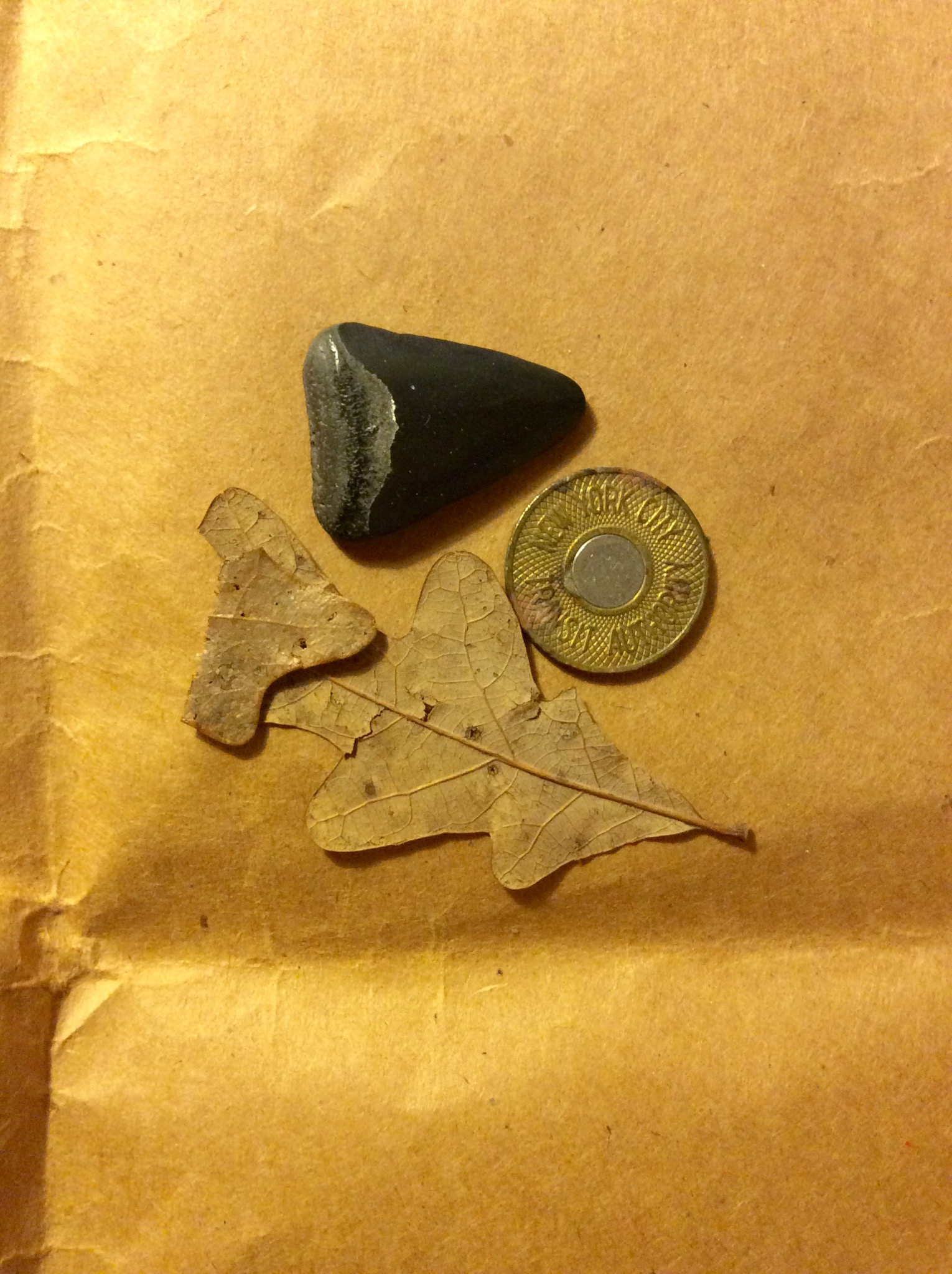
Or whatever you call them. I’ve been hanging on to this small packet of ‘mystery’ objects since 1994, when I received it as a parting gift on the last day of classes at college. It was a painting class, and we were supposed to have a critique of our end-of-the-year projects. The teacher, being an artist, decided not to show up, leaving instructions that we were to critique each others’ work. He also left a box with a bunch of little brown paper packets, instructing each student to take one at random. Inside we were to find what was there and draw whatever conclusions we could from it. Say what you will, it was a memorable gesture.
Inside mine there were the following things:
a shark tooth
a New York City subway token (remember those?)
a dried leaf
In the years that immediately followed, I moved to New York City, dealt with a plethora of dangerous people and – yes – grew up. If I were of the mystical persuasion I’d probably think it was a real talisman. The truth is, I imagine any three objects could be imbued with narrative importance and adapted to any life, especially in the hands of a college art student with a yen for travel.
I’ve managed to keep this gift with me for twenty years, through innumerable addresses in various cities on two continents and assorted upheavals. I’ve never really consciously made a point of conserving it, but somehow there it is in my desk drawer, a quiet reminder of the streets I’ve walked.
My friend Pat has started a blog about his return to skateboarding after a hiatus of over 20 years. I met Pat in 1989 when we began going to the same high school together in a suburb of Maryland. We were part of the same skate circle and together we followed all the fashions and developments of skateboarding through the early 90s. We were dedicated to and passionate about the sport. Neither of us were good enough to have imagined a future in skateboarding, though, and when we left for college we put our boards aside and moved on to other things. (I’ve written about my experience here.)
But skating never really left either of us, apparently. I can attest that I have always mentally skated my surroundings. The ex-skater is always silently scanning the landscape for skateable surfaces. There was a time I attempted to bury these tendencies, somewhat embarrassed about their unintellectual nature. But it wasn’t really up to me; the mind, as we know, has a life of its own. It’s not easy to tell yourself what to think about and what to block out. So when Pat began posting videos of himself re-learning to ollie, I took it as carte blanche to dust off the skateboard of my imagination once and for all.
A lot of this involves finding clips of old skate videos on You Tube, videos I used to watch on a daily basis on our VHS player. Trying to remember all the details is a challenge: what boards did I ride? I can only remember the first two: a Mark “Gator” Rogowski was my first board, in 1987. Sometime after that I got a bit more sophisticated and bought a Santa Cruz/SMA Natas Kaupas, the one with the black panther. I still remember the excitement of getting that one. I can’t for the life of me, however, recall any of the other boards I had between 1989 and 1992.
I do recall that the shape of the boards was changing constantly. In fact, the basic shape of a skateboard in 1992 is essentially the same as today: the nose and tail are indistinguishable from one another. There are minor variations, I suppose, but nothing like the variety of shapes one saw in the late 80s. I guess skateboard evolution selected the model which works the best for the most people. Here is a good breakdown of this evolution (via Pinterest)
Suffice it to say that I have been getting more and more into watching and thinking about skateboarding. I’ve heard that this is a not uncommon phenomenon for those hitting forty, but so be it. Today I ordered a new skateboard online and a I really can’t wait to finally learn tre flips, a trick I could never get down even back when that was all I wanted out of life. Stay tuned for further updates!
Just as I was beginning to feel comfortable creating text-on-images (and having a lot of addictive fun) my Phonto app went poof. Now the app won’t load a photo. While they fix the glitch I’ve been trying Font Candy, but it’s less intiuitive and automatically puts the Font Candy logo at the bottom of your pictures. That’s lame (I suppose that goes away if you purchase the app). I’m hoping Phonto comes back to life soon, because I have a lot of ideas I can’t wait to try out.
In the meantime, here’s another one from my Toture Museum series. Just in time for Halloween.
I studied painting and sculpture in college and used to be rather passionate about (making) art. I’ve always been passionate about viewing and thinking about it, but it’s been a good long while since I bothered trying to make anything more than a cartoon character for my daughter.
This evening I got the urge to try something a bit different. So I found a painting more or less randomly and decided to make a copy of it. All I had handy were some magic markers and graph paper, but it felt good to swim in the warm waters of impresssionism for a while.
Art is a habit, like writing. If you make time for it regularly, it becomes like second nature. Let it drift for too long and there it goes. You’re lucky if you ever get it back again, too.
The original artist is Elmer Bischoff. I don’t know what this painting is called.
I constantly find myself using the term ‘red flag’ whenever I notice something suspicious. I’m not at all sure many people know what I mean when I say it, though. It’s a skeptical term meaning, “Watch out, there is something fishy here.” Here is an amusing entry from RationalWiki citing some common red flags. I made this today.
 A few days ago Rattle published a poem of mine in its Poets Respond series. Like most poems inspired by the news cycle, it was written at lightning speed and sent off almost immediately and with minimal revision. I’d like to write a post on the phenomenon of “news poetry” when I have more time, but right now I’m just bookmarking this one for posterity. Rattle is a fantastic journal and it’s an honor to be in such good company.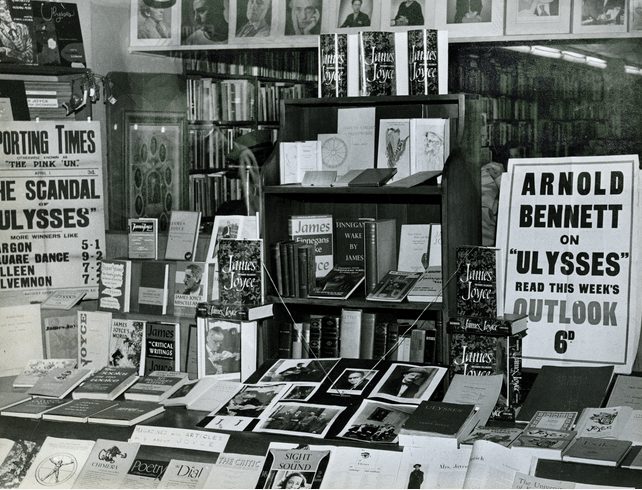




 Marc Di Martino