Postcard from Ectoville

Spooked out

In June we made our first trip to the United States with our baby daughter. After a trying week at the beach, we settled into a rented cottage immersed in the lush green of Hanover County, Virginia. Cows grazed next door. A family of chickens wandered over the grass to visit us each morning. In the evening, an industrious spider materialized on the porch, spinning its web anew, only to vanish by dawn.

By the standards of small town Virginia, we immediately became local celebrities. (My sister compared us to Jennifer Aniston, who is reportedly dating a man whose mother lives nearby.) A buzz built up around us: “The Italians are here!” We brought them real Parmigiano cheese (compare with “parmesan”), olive oil from Umbria (compare with “Goya”) and taralli laced with fennel (incomparable). We didn’t want to disappoint anyone.

The pinnacle was Ashland’s July 4th parade. My brother-in-law was named honorary parade marshal, giving him and his family had the right to ride in a horse-drawn carriage with the mayor — an exciting prospect for my 10-year-old niece.

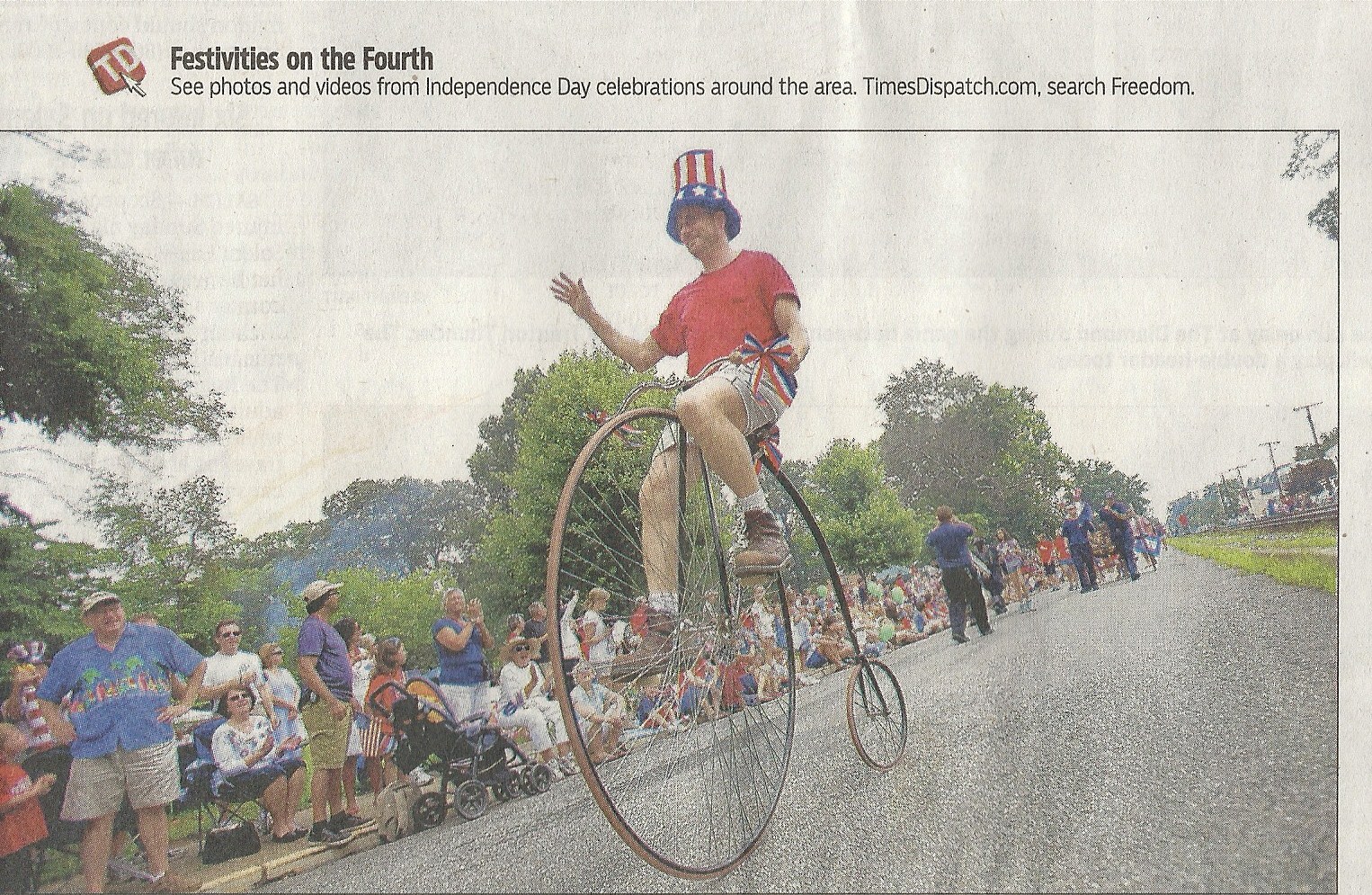
The whole town — except the misanthropes, if there are any — gathers yearly along Main St. to watch inventively named “brigades” march from one end of the township to the other. We saw the Lawn Chair Brigade composed of people doing a kind of Full Monty routine with, well, lawn chairs. There was also a Latin brigade, whose members mouthed the Roman greeting “Salve” and sported white togas. A man pedaled an old-time penny-farthing and an eccentric doctor marched on stilts. Then there was the patriotic dog contest…

The next day, my sister gave me a copy of the Richmond Times-Dispatch. “Look,” she said, “you’re in the paper!” And there I was, looking on as the antique Big Wheel rolled along, part of the annual crowd. It’ll make a nice clipping for the family archive.

But it was a meeting at the barbecue the night before that most struck me. Over a plate of South Carolina peach cobbler, in an enormous, white antebellum home, I met a woman who introduced herself to me as a “ghost-buster.” I soon learned that she had cleansed the place where we were now standing of ectoplasm. It was a perfect setting for the conversation that followed.

I kindly probed as to just what is was that she did. Given the choice between a rational, materialistic explanation and a paranormal one, she told me, one should always choose the latter. “Why close oneself to the possibilities?” she said.

As I patiently listened to tales of angels and spirits I began wondering if there was anything she didn’t believe in. I proposed unicorns. Maybe they were making the strange puttering noises that came from the attic. She dismissed the thought. Given her credulity, I wondered how she could shut out unicorns.

It was a weird conversation, hung with dusty spider webs, creaky staircases and relics of haunted house lore. She even spoke of a mysterious “third” dimension (spooky!). But when she knocked on a wooden bookcase we’d both been leaning on and announced, “This isn’t real,” I decided that further inquiry was pointless. Where do you go from there?

To save any embarrassment, I came clean. I told her I was skeptical, that I didn’t believe in angels, demons or the paranormal in general. I told her there was not a shred of evidence for any of the things she’d described. As she’d been frank with me, I’d return the favor. We parted amiably, returning to our respective beer coolers.

I love visiting Ashland. It’s like some long lost town in an America that probably never existed except on celluloid and the covers of the Saturday Evening Post. An overwhelming feeling of innocence, of childhood, creeps up on me.

Now that I have a daughter I’m coming to better appreciate innocence. Think about it: here is a human being with almost no sense of danger. She trusts people. She’ll put anything into her mouth. We, her parents, must keep watch over her lest she tumble down a flight of stairs or swallow a tack. I’ll be happy when Melissa is a jaded cynic, though; innocence is dangerous. It isn’t meant to last.

This observation illustrates the way I look at Ashland. Every time I visit, I wonder if it will still be the same. When will it morph into just another Richmond suburb? When will it shed that special cocoon of simplicity that so fascinates me, and which Ashlanders work to protect?

The moment we move into town, no doubt.

Published in The American

Spousal advice

My wife ripped this off and handed it to me. “You’ll appreciate it,” she said. I think she meant I might learn something from it.

The Italian Parliament is not secular

Italy’s Northern League wants a crucifix in Montecitorio, the Italian Parliament. They’re taking the Lautsi vs. Italy decision as carte blanche to impose their religious views in every angle of Italian life. The problem is, according to Cronache Laiche, they’re right:

Hanging a crucifix in Parliament is an act of coherence. The opposition, istead of lashing out, should have approved – even raised the bid – asking to hang a crucifix, a huge crucifix, in every angle of the Chamber and Senate as a warning to anyone who still thinks that the secular State functions independently of religion. A provocation? No, just the unavoidable truth. So that Europe and the entire world can see who we are, not that which we pretend to be.

Seriously, I thought they already had crucifixes in Parliament. How did they not get them on the walls before now?

A poison apple

Today my wife is attending a funeral for a young man – twenty five! – who recently died of a brain tumor. He was diagnosed only a month before.
My aunt died of cancer a few years ago, after a four year struggle. She was a very religious Catholic, went to church, kept statues of Padre Pio in her home and pictures of the Virgin Mary on the wall of her bedroom. She took trips to sanctuaries. She counted priests among her friends. And yet…she withered away to almost nothing. She lived in tremendous pain. Then she died.

So where is this great God believers speak of? Either he is fucking with us – in which case he is an evil God – or he just plumb don’t exist. Why it would give anyone solace to have faith in  such a thing baffles me. Even some atheists I know talk of the “gift of faith” with not a little nostalgia (that they never received it.) All I can think is, What’s wrong with you people? We can do better than this!

We all suffer, atheist and religionist alike. No one is exempt. Life will end in death for all of us, with no regard for our belief systems, education, successes and failures. We all know this. It does no good to pretend that there is a benevolent being who is looking out for us, who is amenable to prayer and flattery, and who will save us when the going gets rough. It does no good because this is quite obviously not true.

Let’s stop pretending it is, and that faith is a gift. It’s a poison apple if it’s anything.

Of sacred cows and sacred unicorns

Meet Paisley, my pet unicorn

Ophelia Benson wrote a post yesterday about sacred cows. In it she asks readers what their cows are, and the responses are fairly typical of what one would expect from skeptical rationalists: democracy, the “golden rule*”, equality, etc…of course no reader of B&W holds actual cows to be sacred, or Jesuses or golden calfs (or is it “calves”?). That’s what you get when you ask a question like that to a gaggle of atheists.

My understanding of the term “sacred cow” is something beyond question, a thing we know is probably undeserving of intellectual protection yet which is protected, shielded from inquiry. It’s not necessarily something which we have fairly good reasons for holding dear, such as basic human rights or hygiene. Those make sense under even the most severe scrutiny (unless you are a sociopath or a pope.)

“David” – perhaps the one who sparked Ophelia’s post – posted a comment along these same lines:

I have a friend for instance who is a skeptic in almost all things but she wants so bad to believe in life after death so that she can think her mother is still somewhere that [sic] she believes in ghosts. She wont discuss it with anyone she does not go ghost hunting or anything but she simply will not consider any evidence against it.

Which is kind of funny because I’ve been thinking about ghosts lately; so I mentioned on Facebook that I have a sacred unicorn.

Here’s a little background:

Last week I had the opportunity to meet a ghostbuster at a 4th of July barbecue in Virginia. After a while of patiently listening to her tales of ectoplasm on walls, angels, spirits and other dimensions (she spoke of an imperceptible “third” dimension…spooky!) I mentioned that maybe what she thought were ghosts were really invisible unicorns. She let slip a telling smile, as if to say, “Nonsense!” I thought, “Gotcha!” Why are unicorns, invisible or not, any less plausible than what she believed were the real causes of unexplained noises in an old wooden house?

This woman was not a skeptic in any sense. In fact, she told me straight out that, when given the choice between a rational, materialistic explanation and a paranormal one, one should always choose the latter. “Why close oneself to the possibilities?” she said. Then why chuckle at unicorns?

So that’s how my sacred unicorn came into this world. She grazes imperceptibly with all those cows in a field of golden wheat somewhere beyong the horizon. If you see her, do me a favor: shoot.

* The “golden rule” is appropriately ridiculed in the comments section of the original post.

Ahh, freedom

That’s me at the Ashland 4th of July parade (standing, with baby carriage). Dressed to the nines, as usual. We struck up a conversation with the photographer, Eva Russo, who grew up in Turin. Perhaps she ran this photo out of solidarity, or pity, I’m not sure which.

Europe, less secular than you think

It sometimes surprises Americans to learn that “secular” Europe isn’t as secular as it might seem. It has less to do with Italians attending church on Sunday (which they do in ever-fewer numbers) than just how pervasively the state ensures Europe’s religious infrastructure. Europe has no American-style church-state separation. Even two of the world’s most secular nations — Denmark and Sweden — have state-funded churches.

Italy gave up Roman Catholicism as its official state religion in 1984. In its place came the obligatory “8 per mille” (eight one-thousandths) religious tax, which permits the state to apply .8 percent of all taxable earnings to charitable religious works.

But the “8 per mille” concept so bewilders taxpayers that most don’t even bother choosing who gets their “donations.” In a recent poll conducted byOcchiopermille, a website created by the Italian Union of Rationalist Atheists and Agnostics (UAAR), 60.4 percent of a sample of 2,000 people said they simply ignored the question of where the money should go. Another 4.07 percent choose the state, while 34.56 percent indicated the Catholic Church. This in a country that’s often labeled “95 percent Catholic.”

At first glance the “8 per mille” sounds reasonable, even fair. Eight one-thousands of what you earn is a pretty small amount of money, right? And you get to choose your confession (if you have one), right?

Well, yes and no.

The form is friendly if you’re Jewish, Waldensian, Adventist, Catholic, Lutheran or a member of the Assemblies of God. But what if you’re Muslim, Hindu, Buddhist, Methodist, Wiccan or one of thousands of other religious confessions? None of these religions are represented on tax forms. They can’t receive your money (at least not your tax money.)

What if you happen to be an atheist, agnostic, or simply don’t want to participate in tax structure dedicated to supporting religion? You can give your money to the state. But based on UAAR polling figures only about four percent of Italians actually choose that option (just as well, since the state turns funnels a part these earnings to none other than the Catholic Church). The 60 percent who stand pat probably do so because they have no idea what they’re expected to do or why it matters. The Italian state is notoriously corrupt, which doesn’t make contributing to it particularly appealing.

So what happens if you don’t choose? The state distributes the income in proportion to the percentage of people who actively choose a specific confession. That works out to roughly 87 percent for the Catholic Church, 10 percent for the state, and about three percent split by the other five confessions allowed to partake. In essence, the Catholic Church ends up with the lion’s share of the money, about €1 billion a year — even when most people don’t explicitly want them to have it.

It’s an elegant system, at least in the way viruses may be said to be “elegant.”

But how does the Catholic Church spend the money? On the poor and needy, surely? As Raffaele Carcano writes, in the magazine L’Ateo:

“The billion euro that the Church obtains thanks to the 8 per mille is destined for things like the salaries of priests, the building of new churches, etc. for which the state already provides financial help. Nonetheless, the annual report of the CEI (Italian Episcopal Conference) is succinct, opaque and doesn’t mention the enormous amount spent on the relentless ad campaigns… misleading ads, focused as they are exclusively on charity and relief in developing countries, on which only a fifth of the received funds is spent.”

Carcano concludes:

“The picture is so negative that the UAAR has no choice but to intensify its information campaign… the 8 per mille is an authentic calamity for non-believers…who have to pay to explain a mechanism that discriminates against them in every way.”

For the skeptical UAAR, the discrimination consists in citizens being forced to finance a religion that is not theirs, which they do not want, and which discriminates against them at every opportunity.

As bleak as this reality may be, the website Concordat Watch suggests that the situation in Germany isn’t much better:

“In Germany church and state are interwoven such that the sacrament of baptism automatically places you in a tax category. That ceremony can oblige you later on to pay taxes to the church and force your employer to withhold church tax prepayments from your income. In 2010 this brought the German churches €4.794 billion. The only way to end this is to formally leave the church.”

In Switzerland “church tax is levied by each canton for the religious groups it recognizes. And it’s not just people who have to pay. In 18 of the 26 cantons firms must also subsidize the churches, even though they’ve never been baptized and they can’t leave the church. This is now being challenged by a computer specialist who belongs to no church himself, but must still pay church tax for his one-man company. In September 2010 the Swiss Supreme Court ruled that [the law] was constitutional and now he is taking his complaint before the European Court of Human Rights.”

Given the European court’s March ruling that the presence of crucifixes in Italian schools was perfectly consonant with secular principles and didn’t violate the European Convention on Human Rights, I wouldn’t get my hopes up that legal challenges are going to get very far any time soon.

Published in The American

Self-portrait of a homophobic politician

Carlo Giovanardi of Italy’s PDL (that’s Berlusconi’s party) had a few things to say about Lady Gaga’s upcoming appearance at the EuroPride parade in Rome:

“…all the surveys prove scientifically that the majority of Italians are against gay marriage.” 

“It’s wrong to allow the Coliseum, symbol of the death of thousands of Christian martyrs, to be dressed in so-called rainbow colors. The Coliseum is where the pope celebrates the Via Crucis, the place of Christ’s martyrdom.”

“Isn’t it possible to find another monument to light up for the gay cause without offending anyone’s sensibilities?”

“I’ll attend the Gay Pride parade when it’s a civil demonstration and no longer an exuse to jeer at the Holy Father, make fun of the religious and those who dedicate their lives to others, and prance around in fancy costumes – things which have all happened so far. Don’t get me wrong, everyone is free to do what they want, but I won’t go as long as they overdo it.”

I guess that about sums it up, doesn’t it? Everyone is free to do what they want, as long as it doesn’t offend the religious sensibilities of a bigoted clique of fundamentalist Catholic politicians and their overseers in the Vatican. They, of course, may offend whomever they wish and even prevent other people’s happiness by law in the name of their creed.

There’s no better way to drive intelligent people from the faith, guys – keep it up! Your churches are empty, and our numbers are swelling.

Do you not use your brains?

The videos of the World Atheist Convention in Dublin are being uploaded on YouTube. Here’s a gem: P.Z. Myers and Aron Ra debate two Muslim creationists on embryology. Basically, these guys believe:

◊ The Qur’an states things nobody could’ve possibly known in Muhammad’s day – because pre-Muslim Arabs were just too stupid.

◊ There were only seventeen literate people in Muhammad’s hometown (and he clearly wasn’t one of them.) And no scholars.

◊ Pre-Muslim Arabs were desert cave people who knew nothing of the world, conjectured nothing and thought nothing. This view is consonant with the popular Christian propaganda that “pagans” were essentially amoral beasts, and the Jewish view with regard to Canaanites etc…otherwise what they call prophecy would carry no weight, if one could just as easily have plagiarized Aristotle as channel the Word of God.

“Do you not use your brains?” is a key quote from the Qur’an they which keep throwing at P.Z., which is hilarious. It’s an excellent example of how religious faith can distort your perception and turn otherwise intelligent people into blathering zombies. And it’s completely lost on them that they are making the exact same claims as Christian creationists, but coming to a wholly different conclusion.

Google considers me an authority on crackpots

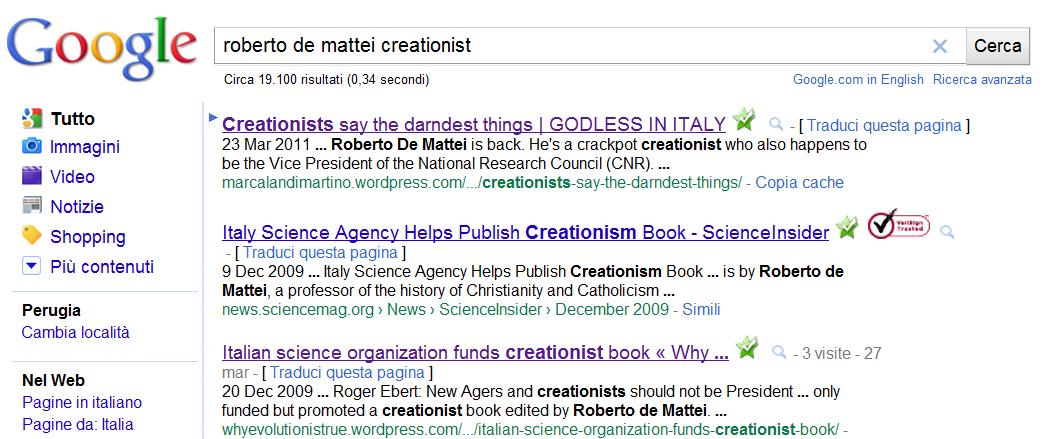
When I google “Roberto De Mattei” and “creationist” this is what I see:

I’m not an authority on many things, but this is kind of cool.