R.I.P. Anglo American Book (Rome, 1953-2025)

Photo by Laura Weinstein

Anglo American Book, Rome’s oldest English-language bookshop – founded in 1953 by Dino Donati and run by the Donati family for 70 years – is shuttering for good this week. This is a profoundly sad piece of news, though not unexpected. Skyrocketing rents have buried yet another temple of culture.

I worked at the AAB for five years, from 2005 to 2011. Like the Gotham Book Mart before it, it was a unique place where I met many unforgettable people. One friendship I struck up at the AAB was with Alexander Booth. He would come in often, and we always got to talking about literature, music and Richmond, Virginia in the 1990s. (We had both gone to VCU, a year or so apart, and ended up expats in Rome.) Alex and I were (and very much still are) both poets and translators, and remain close friends to this day despite living in different countries. Alexander published a lively translation of the poetry of Sandro Penna a couple of years ago. I remember seeing it in the storefront window at AAB, not long before they moved to the windowless upstairs location removed from street traffic. Without the Anglo American, would we ever have met?

I remember the evening when we had just closed up and were turning off the lights, and two ghostly faces appeared at the door. It was poet Moira Egan and her husband, the translator Damiano Abeni. I had to tell them to come back during opening hours. We became friends over time, though, and I interviewed them for The American in 2009. When my first collection Unburial came out, Moira was gracious enough to partner with me for the book launch at AAB (photo above).
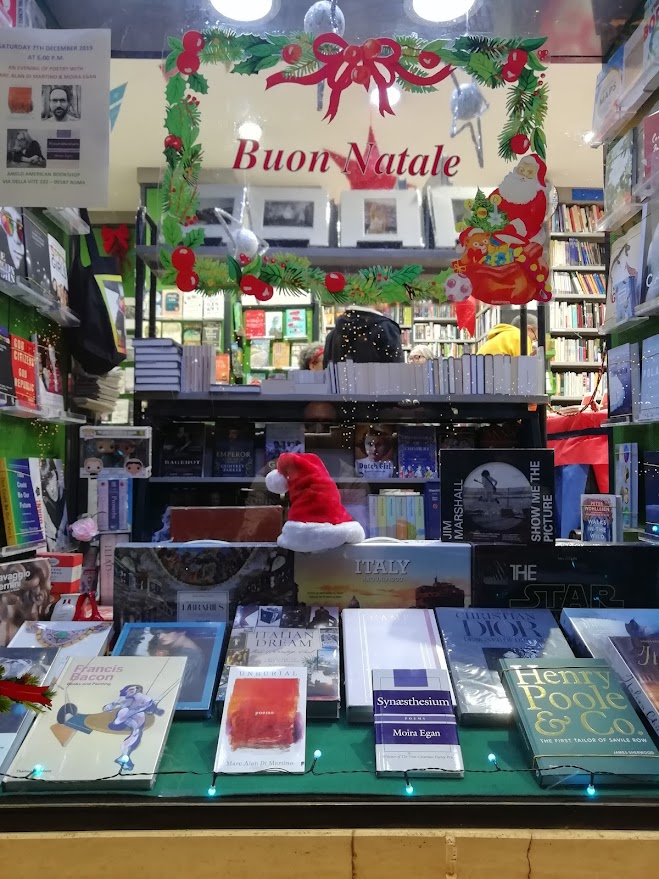
AAB storefront window – December 7, 2019

Here are the recordings of Moira and me reading on 12/7/2019 at the AAB:

Moira:

Marc:

___

It was also there that I met Mike Stocks, poet and translator of Giuseppe Gioacchino Belli. Mike walked in one day with a handful of copies of his newly published translation. Of course, I had to interview him. We went out for pints near Piazza Trilussa while I recorded our conversation on my wife’s handheld recording device. (This was pre-smartphone.) Mike revealed to me his secrets for approaching the great Romanesco poet, notoriously forbidding both for his 19th century Roman dialect and for the volume of his output: over 2000 sonnets (the critical edition of his poems runs over 5000 pages.) That meeting with Mike influenced my approach to translating Mario dell’Arco, convincing me that one didn’t need to have academic chops in order to get the job done. It was an important lesson, and if he hadn’t fallen off the grid I’d buy him a beer and thank him.
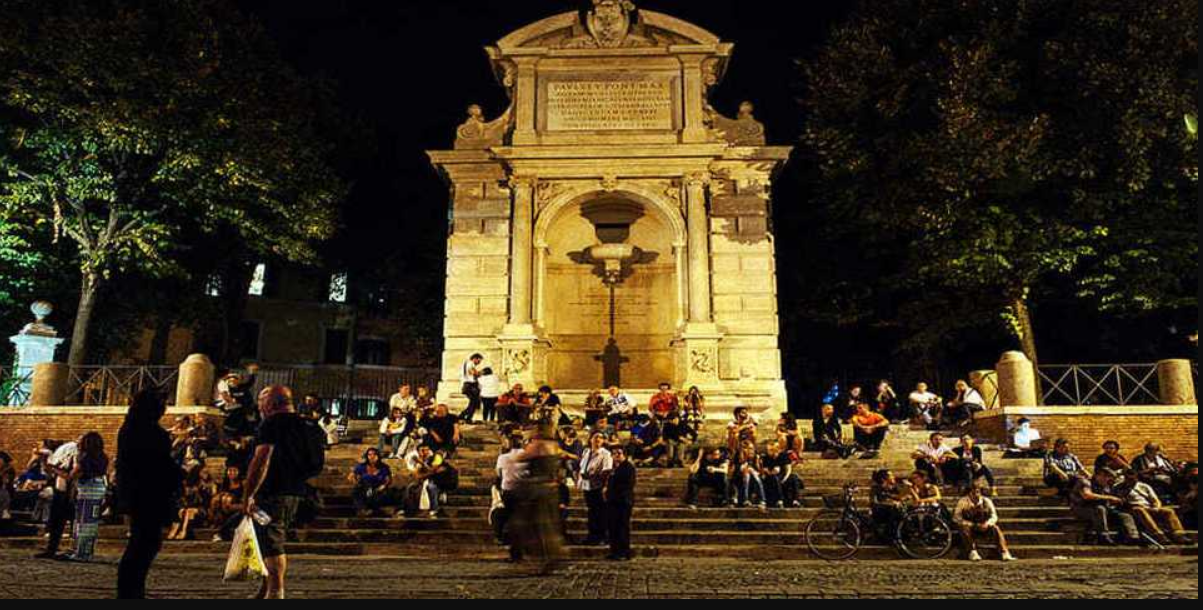
Piazza Trilussa, Trastevere (Rome)

The list could go on, as lists do. Bookstores have played an outsized role in my adult life. It has been dawning on me for some time that I have lived at the edge of a disappearing era, a time when independent bookshops were places people went in their free time to meet other people, not unlike a neighborhood pub. They were like secular houses of worship. Relationships could be forged there. Lives could be altered. You were in the realm of curiosity, always bracing for the unexpected thrill of discovering a new book. Those born too late may never know this way of being in the world.

I spent many years working in bookshops on two continents: Strand, Gotham Book Mart, Anglo American Book. It was never a swank job with a good paycheck, but the summation of that experience was for me the equivalent of a university degree. I’ll always remember the names of people who worked at those NY bookshops before me: Tennessee Williams, Allen Ginsberg, Patti Smith, Tom Verlaine, Richard Hell. It seemed like it might almost be preparation for a future in the arts. Maybe it was.

It seems apropos to round out this reminiscence with a poem about another of my favorite gone bookstores, Chop Suey Books in Richmond. It was my go-to bookshop whenever I was in town visiting the old haunts in Careytown. The poem was published in the Hollins Critic, a quirky little literary journal from Virginia which – but of course – ceased publication last year. It seems like our losses are neverending. All we have is art to push back against the rising tides of oblivion.
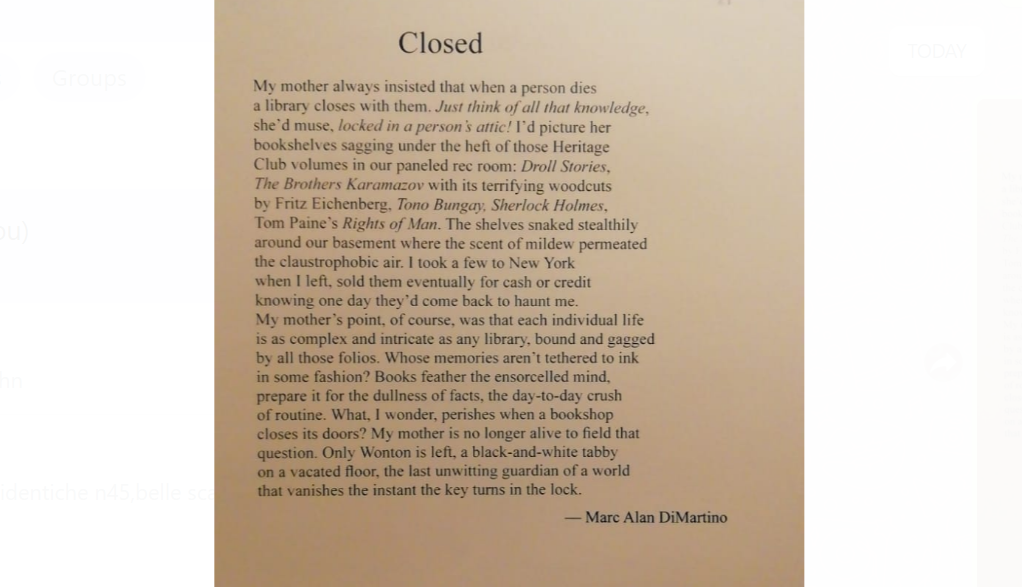
from The Hollins Critic, Oct. 2022

Rome Reading with Francesca Bell and Alessandra Bava

Well, this is embarrassing. Under the influence of a highly tumultuous summer, I completely forgot to mention the reading I gave in Rome with Francesca Bell and Alessandra Bava. It was my first reading ever, unless you count the time I murmured a few poems under my breath at a bar in NYC just after my very first publication in 1999 or so.

It was a miracle this reading even happened – on June 29, which is Roman holiday. Francesca was in town on vacation, and – after a little fancy footwork – we organized this reading at Otherwise Bookshop with Alessandra, a poet and translator who has rendered some of Francesca’s poems in Italian.

It was an amazing experience to walk from my family’s home near St. Peter’s up Via del Governo Vecchio, to read a poem that takes place in that very stretch and which is the gravitational center (and title) of my book. So many important events in my life have happened in that little tangle of streets along the Tiber, and I’ve tried to get some of it into my poems.

Below you can listen to me read four poems from Unburial: “Runaway“, “Unburial” “The Skaters” and “To the Horned Moon” from the June 29th reading. (Warning: I sound like Carnegie Hall-era Lenny Bruce at times.) Somewhere, there is video…

Barney’s Version

We watched “Barney’s Version” last night. It didn’t really render the uproarious nature of Richler’s novel and it was a bit sentimental. Much sadder than the book. And where in the novel Barney married his first wife in Paris, in the movie it happened in Rome. Here’s the scene, which is hilarious for Clara’s shiksa spiel.

(Two generations of my family were married in that same red room on the Campidoglio!)

Rome burns – get used to it

Here’s a video of today’s “protests” in Rome. There’s a pattern to these protests, which basically boils down to a group of masked marauders getting in the middle of things and burning shit, throwing rocks through storefront windows and antagonizing the police. This typically destroys whatever force or function the protest might have had to begin with. The result is that everyone blames everyone else for the riots for days and weeks afterwards. Nothing is ever resolved. They never make a point. It’s just photos and videos of idiots with scarves over their faces throwing Molotov cocktails at the cops while those who came to actually demonstrate are sent hightailing it over the nearest fence. So much for the constitutional right to a peaceful protest. Enjoy your gelato.

A skeptic’s eye view of Rome

image

I found this right near the Vatican. Where else?

An embarrassment

I still haven’t seen the controversial statue of Pope John Paul II at Rome’s Termini Station. Next week I’m taking a train in and hope to gawk at it as it deserves.

Openly criticized across the political spectrum, on social networks and by commuters, the statue has also brought dim views from the Vatican’s daily newspaper itself. L’Osservatore Romano said it ”resembles a sentry box” and that its head is ”excessively spherical”. The city commission has listed several points it sees in need of intervention. Among them are the statue’s face, the head’s welding and inclination, the arm, the cloak, and the shoulder.

And that it reminds not a few of a very famous Italian dictator:

Some Romans and tourists think the giant artwork looks more like Fascist dictator Benito Mussolini.

”That bullet-like head on top, it reminds me of Mussolini,” said Enrico, a 42-year-old computer programmer who commutes from Latina south of Rome.

American tourist Sandra Hillhouse, 24, from Arizona, said: ”I don’t understand it at all. He looks more like one of those weird creatures from Star Trek”.

Well, anyone but the conservative religious leader Karol Wojtyla. But here’s the surprise:

Rome Mayor Gianni Alemanno has since been facing calls from political and cultural figures to ”do something” about a statue some think gives visitors an embarrassing impression of Rome’s contemporary cultural scene.

He said he would bow to popular opinion.

”If public opinion coalesces around a negative view, we’ll have to take that into consideration”.

So, presumably, if popular opinion were to express a largely negative view of the Vatican, Mayor Alemanno would have it renovated. It seems a negative view has been steadily coalescing for a few centuries around the papal palace, and has taken a turn for the worse in recent years.

But who ever took a politician at his or her word?

Is Rome a Nazi lager?

An unnamed artist thinks Rome is a modern-day Nazi death camp, apparently. He even put up a sign in the Pigneto neighborhood saying so.

Like any self-deprecating artist he began to backpeddle as soon as he was accused of anti-Semitism. That’s not what he meant, at all. His apparent reasoning is that the neighborhood in which his sign appeared is a neighborhood of immigrants. Immigrants are oppressed. Hence the analogy to Nazi oppression of the Jews, forced labor and, well, extermination. If you’re finding this a bit far-fetched a comparison, I’m not sure the artist is much help in explaining his position.

Why did you need to use [the gate at Auschwitz] to make your point?

My installation is different…I used different materials. They used iron [at Auschwitz] and I used industrial pipes. Even the fonts are different! And mine is in English.

Oh, that makes sense now. It was written in English because that’s the language of immigrants. (Certainly not because the media would pick up on it and make him an overnight enfant-terrible. No, not that!) And certainly he meant no disregard to the actual people who were murdered in Auschwitz and other Nazi death-camps for the sole crime of being Jewish. Why on earth would people be so upset at his ingenious artistic rendering of immigrant suffering? Why do people accuse him of that most damnable of prejudices? Can’t they read his universal proletariat message loud and clear?

Ah, the plight of the misunderstood genius! Or has Auschwitz become the new crucifixion?

Pizza and goats

Supplì al telefono

Nostalgia is never an entirely pleasant sensation, especially when you’re being nostalgic about the present. But this is what happens when you’re leaving a place you’ve lived for long enough to have developed a complex attitude to it. It happened to me in New York City on the eve of my departure: suddenly the rundown storefronts on 10th Avenue began to look otherworldly, poetic, somehow different than they’d looked before. The same is happening now as I stroll through Rome as through a museum exhibit, knowing that in a few weeks it will no longer be home.

I can think of nowhere else people go — except France — for the sole purpose of eating their way through a vacation. There is more art in Italy per square foot than any other place; there are mountains, beaches, an enchanting countryside, medieval castles, ancient stone homes, hilltop townships and historic centers full of fountains and churches and arches that stretch back to Roman times. There are roads that will take you north and south, up to Europe and down to the edge of the Mediterranean. But what makes people really happy is a plate of spaghetti with garlic and oil.

My earliest memories of Rome are, predictably, food-related. They begin when I was seven, slurping grattachecca (a snowball) and chewing coconut slices while hanging around St. Peter’s Square with my family. My father had grown up just down the street. That was when I was introduced to the supreme Roman street food, supplì (or “rice balls” in the parlance of American pizza purveyors), and pizza rossa, which my father could never order in the United States because no one understood why anyone might want pizza without cheese.

At eleven I spent a summer here. Pretty much all I did was eat and read Garfield comics, toting around my Walkman and a handful of cassettes (Bill Hailey springs to mind). I refused to speak Italian, which is surely one of the reasons my parents sent me to Italy in the first place. I was an enigma to my relatives; the only words they could get out of me were the parolacce. I remember stunning people with blasphemy before I could say, “Mi chiamo Marc.” I went home supersized in August, and my family re-branded me “mozzarella.”

Not on pizza

Ten years later there was another spurt of visits with a friend, then with my then- girlfriends. We always followed the same triangular route: Rome, Florence, Venice, Rome. (We once ended up in Greece, but that’s another story). It turns out that all of my cousins did exactly the same thing, year in and year out, a kind of Grand Tour for second-generation Italian-Americans.

I once ordered, to my great embarrassment, pizza with goats. We were sitting in the lovely Piazza della Maddalena, near the Pantheon, and I was showing off a bit. “Vorrei una pizza con capre e alici.” The waiter smirked, catching my error. “I think you mean capperi, capers. Unless you actually want goats.” That’s largely how I learned Italian, through table talk.

But to get back to that supplì, or rice ball, I mentioned earlier. In my book, this is the quintessence of the Roman nosh. A few observations:

    1) It should never cost more than €1.

    2) It should never be larger than your fist.

    3) It should be fried, not baked.

    4) It is not an arancina, which is a similar — but entirely different – rice ball specialty from Sicily. The most delicious supplì are simple, tomato-and-mozzarella-based affairs, though an elegant variation I’ve encountered substitutes squash for tomato.

I suppose I should mention a few things I don’t eat, just to cure the distant reader of envy. My aunt once offered me golden fried mule testicles. How do you turn those down? Tripe is a favorite of many, but might be unfavorably compared to stewed bicycle tire. Lard, or fatback, is up there with pickled pigs’ lips on my list of nausea-inducing delicacies. Add sanguinaccio, or blood sausage. Non-kosher atheist that I am, I still find the Levitican injunction against eating blood insuperable. It’s just sort of gross.

Finally, this is as good a space as any to lament the demise of Rome’s best pizza, which just happened to be kosher. It was not excellent because it was kosher, but because it was unique. The pizzeria was called Zi’ Fenizia, and it was in the Ghetto for years before moving to a lukewarm location near Fontana di Trevi. They served only cheeseless pizza, and their best creations were sopping with tender marinated vegetables, called concia: eggplant, peppers and zucchini.

Everybody I took there raved about it. I was a regular customer until they lost their kosher certification (read: community infighting); then, in the worst-calculated move in pizza history, they began throwing ham and cheese on everything. They called it “giving tourists what they want.” Anyway, they lost heart and the pizza lost its raison d’etre. It was a case of commercial suicide.

And all I could think was, “Do vegetables even need kosher certification?”

– From The American

Blood on the tracks

I was late to work this morning because some guy decided to lie down on the tracks and get himself killed by an oncoming train. In Rome. I remember when there was a flurry of “pushers” in New York around ten years ago.

I asked my colleague, “Do you think he may have been pushed?”

He replied, “I wish he’d just shot himself in the fucking mouth in the privacy of his own home.”

Suicide can be so inconvenient.

Kimchi blues

It’s early July and I’m sitting with Alex in a Korean restaurant in Rome’s Esquilino neighborhood. There is no air conditioning, and the place is empty except for a table in the back room occupied by what looks to be a Korean family having a special occasion meal. It is a very plain restaurant, neither clean nor dirty. Alex is a vegetarian, and I’m one tonight for the simple reason that I’m distrustful of the kitchen’s hygiene. Why are we seated there at all, one might be inclined to ask?

Alex and I both grew up in the Washington, D.C. area, and both of us have been flirting with Rome for much of our adult lives. Alex has dual American-German citizenship, and for a while taught at a university in Beyreuth, Germany. He made his way back to Rome eventually. I haven’t left since I moved here in 2003, which is beginning to feel like a long time.

I feel I speak for many Americans abroad when I add that we are hungry for what we call “ethnic food.” So hungry are we that we will sit down in a Korean joint about which we know nothing just to feel like we’re in New York for an hour or two. The fiction works, if you disregard the waiter’s choppy Italian. My eyes keep veering off during conversation to a Korean news station on the TV behind Alex.

Talk revolves around the usual topics: racism, conspiracy theories, literature (Alex is reading Roberto Bolaño) and of course food. I begin telling him about a woman named Layne Mosler who writes a blog called Taxi Gourmet. The idea is that she makes her way into various NYC taxis, asks the driver where the best place to eat is, and pays him — or her — to whisk her off to a great meal. I add that our restaurant is just the kind of place Layne would write about.

What is it about taxi drivers? Do they possess what might be called food wisdom? Mosler began Taxi Gourmet in Buenos Aires, moved to New York City, and last year embarked on a voting campaign among readers for her first European destination. Rome was on the list of possibilities, but Berlin won out and now she’s writing up her summer adventures in the German capital.

It has been suggested to me that I turn this column into a similar venture. Part of me has always wanted to be a food writer. It’s the same part of me that has always wanted to be an astronaut. It’s a vocation I find fascinating. I briefly toyed with the genre when I was in New York, penning a six-line poem — on commission — praising a midtown falafel chef named Muhammad Rahman. It ended up, fortuitously, in the New Yorker. But do I really need to eat that much? Do I really want to look like A.J. Liebling?

And that’s not even to consider funding such a project. Layne Mosler has recently become a cabbie herself, perhaps to earn spending money for her blog exploits. She has also raised money directly from her readers. They, in effect, are sending her to Berlin. Now she is working on a book based on her considerable experience.

In Joseph O’Neill’s recent novel “Netherland,” a minor character is a New York food writer whose job it is to eat in taxi driver-frequented holes in the wall. He is unimpressed. “‘Cab drivers?’ he said. ‘Have you ever heard one of these guys express an opinion that wasn’t complete bullshit?'”

For my part, I once jested in this column that I could cook as well or better than most of the restaurants I’ve eaten at in Rome. Some accused me of hubris, and I understand why. But of course I don’t normally eat at five-star restaurants. I eat at cheap to mid-priced places that should offer better fare than they often do. That was my gripe, and it still is.

Back to Alex and me and our Korean dinner. There isn’t much on the menu for vegetarians. The waiter appears perplexed when I ask for help. He points me to a bean curd soup, which looks benign enough. I hear my wife’s voice in my head, “Don’t order the anaconda!” We had a bad experience in a Chinese restaurant in Portugal on our honeymoon, and she subsequently struck all Far Eastern cuisine from the shrinking list of non-Italian foods she will consider eating. Bean curd it is.

We pick at the kimchi, the marinated cucumbers and shrimp omelet. Alex scarfs his Korean pizza. I raise up my spoon to find a mysterious clamshell in the midst of the tofu mess. It is still burning hot. We pour more Tsingtao into our glasses and discuss Hitler, blogging and the paranormal. When our meal is over we head for the metro, where the train doors close on us in mid-debate.

The next day I write Alex an email: “Next week I choose. Ever tried Ethiopian?”

Published in The American