Proselytizing, again

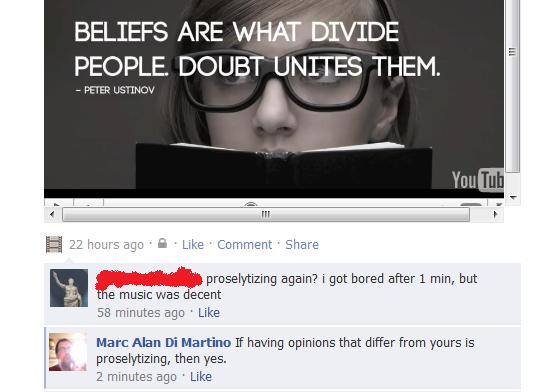
The meme is gaining ground. How does one combat the accusation that expressing one’s views is a form of proselytizing? Funny word, that; it’s clearly picked to draw a parallel between the ways of religious missionaries and the ways of outspoken non-theists. (We’re apparently unable to remember the Golden Rule: If you don’t believe in god, shut up and keep it to yourself. Doh!)

Here’s one answer I came up with, though:

Yep.

The homeopathy illusion

This is an awesome optical illusion which serves to teach us a little lesson not just about homeopathy, but everything else as well. Don’t trust your perceptions; they are very probably missing something. When it really matters – i.e. when you need a doctor, etc… – remember that just because the lines seem bent doesn’t mean they are. Apply ruler!

For the full experience you must go here. (Via Edzard Ernst)

This is an illusion. The lines are straight.

Good Times

Remember this show? Who knew there were sophisticated debates about atheism? It was just after school television. But, beyond the canned laughter, they were dealing with “serious” issues. I wonder if the same can be said for today’s shows.

Via Freethought Kampala.

Today I embraced the Lord Jesus Christ

APRIL FOOLS’! Well, you knew that was coming, right? Now I’m going to enrich that predictably adolescent gag with a tidbit of extra trivia. “April Fools'” is called “Pesce d’aprile” in Italy – “April Fish.” I can only imagine it has something to do with this:


Fooled ya!

There’s a sucker born every minute. Save yourself; be skeptical.

More fun with comments

The following brief exchange is from the comments section to my recent post. I’d mentioned that Martin Yanosek – a commenter from Stanley Fish’s original NYT piece – wasn’t being clear. Did he agree with Fish, or did he agree with the judges? Or, improbably, both?

Anyway, he found my blog and cleared things up as best he could. I admit I’m still in the dark about his reasoning, though, and I’ve begun to suspect he may have been one of the judges in Strasbourg.

Martin Yanosek says:

Hello there, Mr. Di Martino! I agree with the court and, although I admire Dr. Fish’s analysis, I think Italian parents should be allowed to let their kids study in the presence of the crucifix. You’re right, though. I don’t know about “all” Italian parents. Only God does! You do believe in God, dontcha!?*

Oh, Mr. Di Martino, I see that I missed answering your question about how the crucifix is Christianity’s greatest symbol. In its evolution as a symbol one must take into consideration the cosmic irony of the crucifix’s meaning over time. The crucifix’s meaning has evolved from that of a purely utilitarian implement of torture to today’s meaning of everlasting life. I think the tremendous irony inherent in the evolution of the crucifix’s meaning is what makes it Christianity’s greatest symbol. I hope I answered your question. Regards, Martin Yanosek

Marc Alan Di Martino says:

Martin, I appreciate you taking a moment to clarify your stance. That said, your position is still unclear. You wrote, “If the Vatican was headquartered on Long Island I would probably disagree with the court’s ruling.” Why is that? Were that the case, and by your logic, American parents would have the right to have their children educated “in the presence of Christianity’s greatest symbol.” Or is it okay if it’s in a country you don’t live in, but not okay when it’s in yours?

As for the symbol itself, does it matter at all that most Christian denominations don’t recognize the crucifix as their symbol? Not to mention non-Christians and non-theists – which is quite a lot of us, even here in Italy. Don’t we have the right to have our children educated in the presence of our symbols? Or are we expected to submit before the irony of the holy Roman torture device?

Martin Yanosek says:

Long Island doesn’t have the tradition of Roman Catholicism that Italy does. Long Island has more of a Great Gatsby tradition. Without our traditions life would be as shaky as a fiddler on the roof of St. Peter’s Basilica! We should submit to the irony of everlasting life! Peace be with you, Mr. Di Martino! Amen.

Marc Alan Di Martino says: 

Just to recap, Italy has numerous traditions other than Roman Catholicism. It’s still just another religious confession, and it’s not even the oldest one we have. Shalom, Mr. Yanosek.

*No.
A letter from John Updike

I found this among my papers. Have a giggle.

Tell me, what is a "she-male"?

Come out, come out wherever you are!

Hemant Mehta has an interesting post on a study suggesting that the greater the presence of atheists – or even the perceived presence – the less prejudice there is in their regard. It’s counterintuitive, which is cool; apparently it goes the other way for most minority groups. It’s a good reason – if you still needed one – to come out as an atheist (if you are one, that is).

This paper confirms what many of us have known for a long time: If people know an atheist personally — or realize there are more of us out there than churches or popular culture would have them believe — the distrust, unelectability, and don’t-you-dare-marry-into-my-family mentality decreases.

So what are you waiting for?

Tell the people in your life that you don’t believe in a god.

Start the conversation.

Destroy their negative stereotypes about us.

There’s no better time to do it.


Roberto De Mattei responds to his critics

From today’s Corriere della Sera:

The attacks on me are a typical example of the relativistic dictatorship denounced by Benedict XVI. I’ve done nothing other than reaffirm the traditional Catholic doctrine of providence.

First of all, I wasn’t speaking as Vice President of the CNR but as a citizen and a believer. I limited myself to quoting a 1911 book written by Monsignor Mazzella, Archbishop of Rossano Calabro, who was commenting on the 1908 earthquake in Messina and the mystery of evil*. The point is, as St. Thomas Aquinas taught, nothing happens in the universe that isn’t willed – or at least permitted – by God for precise reasons. And we can’t exclude the hypothesis of divine punishment, even if we can’t be sure.

There’s a short interview which follows this tasty tidbit. It’s the same old music about persecution of Catholics by the scientific establishment for belief in “anti-scientific” doctrines like transubstantiation.

Then the standard invective against atheists, who refuse to debate him (he’s a creationist). Maybe they won’t bother because his ideas are worthless – did he ever think of that? Then a word or two on “practical Catholic atheism,” “for whom God is absent from history, and who created the universe only to wash his hands of it.”

It’s a great interview, really. It says so much about the warped mentality of believers. If I find time, I’ll translate the whole thing; it could be useful.

*De Mattei, if you’re reading, I will resolve the mystery of evil in four words: There is no God.


Two rabbis walk into a dialogue

I’m delighted to see that two rabbis have entered into a dialogue on religion. One is Jeffrey Falick, the Atheist Rabbi, whose blog is hosting the debate; the other is Frederick Klein, an Orthodox rabbi who took up Falick’s challenge.

Lately HuffPo, or PuffHo, or whatever it’s called, has been hosting various rabbinical voices attempting to talk sense to us new atheists. There’s David Wolpe and Adam Jacobs, and there was that debate where Hitchens and Harris were terribly rude and gnuish to Wolpe and his colleague Bradley Artson Shavit.

I’m thrilled about all this. As a Jewish atheist I’ve had endless discussions with Jewish friends about atheism, faith, God, morality and tradition. It’s been tough to find many other Jews who will stand up and say, “I’m an atheist.” My guess is that they would somehow feel un-Jewish, and that for them Jewishness is at some level sustainable only through passive acceptance of rabbinical tradition. Even if they don’t believe a word of it.

I remember once asking a Lubavitch rabbi what his position on evolution was. He sent me a link to another Lubavitch rabbi rambling on for an hour before a room full of Lubavitchers. His point was that anything that conflicted with the Torah was, well, unacceptable. End of discussion.

Let the Lubavitchers wall themselves off from reality until moshiach arrives. In the real world, the dicussion continues unabated.


Robert Ingersoll on theocracy

Robert Ingersoll was one of the most eloquent voices for reason the English language has ever known. His words ring as true as ever today:

The government of God has been tried. It was tried in Palestine several thousand years ago, and the God of the Jews was a monster of cruelty and ignorance, and the people governed by this God lost their nationality. Theocracy was tried through the Middle Ages. God was the Governor — the pope was his agent, and every priest and bishop and cardinal was armed with credentials from the Most High — and the result was that the noblest and best were in prisons, the greatest and grandest perished at the stake. The result was that vices were crowned with honor, and virtues whipped naked through the streets. The result was that hypocrisy swayed the sceptre of authority, while honesty languished in the dungeons of the Inquisition. […]

If God is allowed in the Constitution, man must abdicate. There is no room for both. If the people of the great Republic become superstitious enough and ignorant enough to put God in the Constitution of the United States, the experiment of self-government will have failed, and the great and splendid declaration that “all governments derive their just powers from the consent of the governed” will have been denied, and in its place will be found this: All power comes from God; priests are his agents, the people are their slaves. […]

We have already compared the benefits of theology and science. When the theologian governed the world, it was covered with huts and hovels for the many, palaces and cathedrals for the few. To nearly all the children of men, reading and writing were unknown arts. The poor were clad in rags and skins — they devoured crusts, and gnawed bones. The day of Science dawned, and the luxuries of a century ago are the necessities of to-day. Men in the middle ranks of life have more of the conveniences and elegancies than the princes and kings of the theological times. But above and over all this, is the development of mind. There is more of value in the brain of an average man of to-day — of a master-mechanic, of a chemist, of a naturalist, of an inventor, than there was in the brain of the world four hundred years ago. […]

These blessings did not fall from the skies. These benefits did not drop from the outstretched hands of priests. They were not found in cathedrals or behind altars — neither were they searched for with holy candles. They were not discovered by the closed eyes of prayer, nor did they come in answer to superstitious supplication. They are the children of freedom, the gifts of reason, observation and experience – – and for them all, man is indebted to man.

Read the rest here.