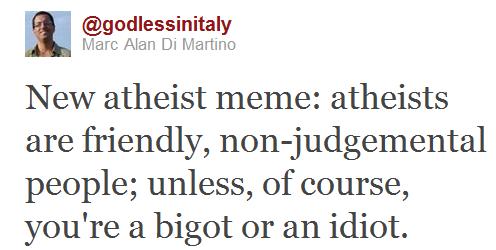
Greta Christina has an ongoing series of atheist memes on her blog. I’m sure she’s proposed this or something similar already, but this kind of thing can’t be stressed too much or too often. If you like it, please RT (or print it out and paste it to your car bumper). We need to fight this thing.
Picture a miniscule centro storico — really just a few blocks of old stone houses — the kind with a church and a butcher and a funeral parlor, and a road leading to the next town a few kilometers away. As in every such town, there’s a café where the elders and youth gather at separate tables to smoke cigarettes and watch the days fizzle into evening. It’s a quiet existence. Separation of the sexes and all.
It’s in such a town that we have landed, at the feet of Assisi, Italy’s “holy city” (as my wife keeps reminding me). Assisi, from our vantage point, crouches majestically on its hillside; behind it looms the Subasio, capped with snow. The sky broadens outward in every direction. It’s a marvelous landscape.
Somewhere in the “The Gay Science,” Nietzsche wrote that a mountain is impressive from far off. Once you’re on top of it, though, your perspective changes. It’s no longer so stately. It’s just a collection of trees, rocks and paths. I am reminded of this every time we go to Assisi. If you’re not in the market for holy relics or religious trinkets, there’s not much to do except stroll around and have a bite to eat.
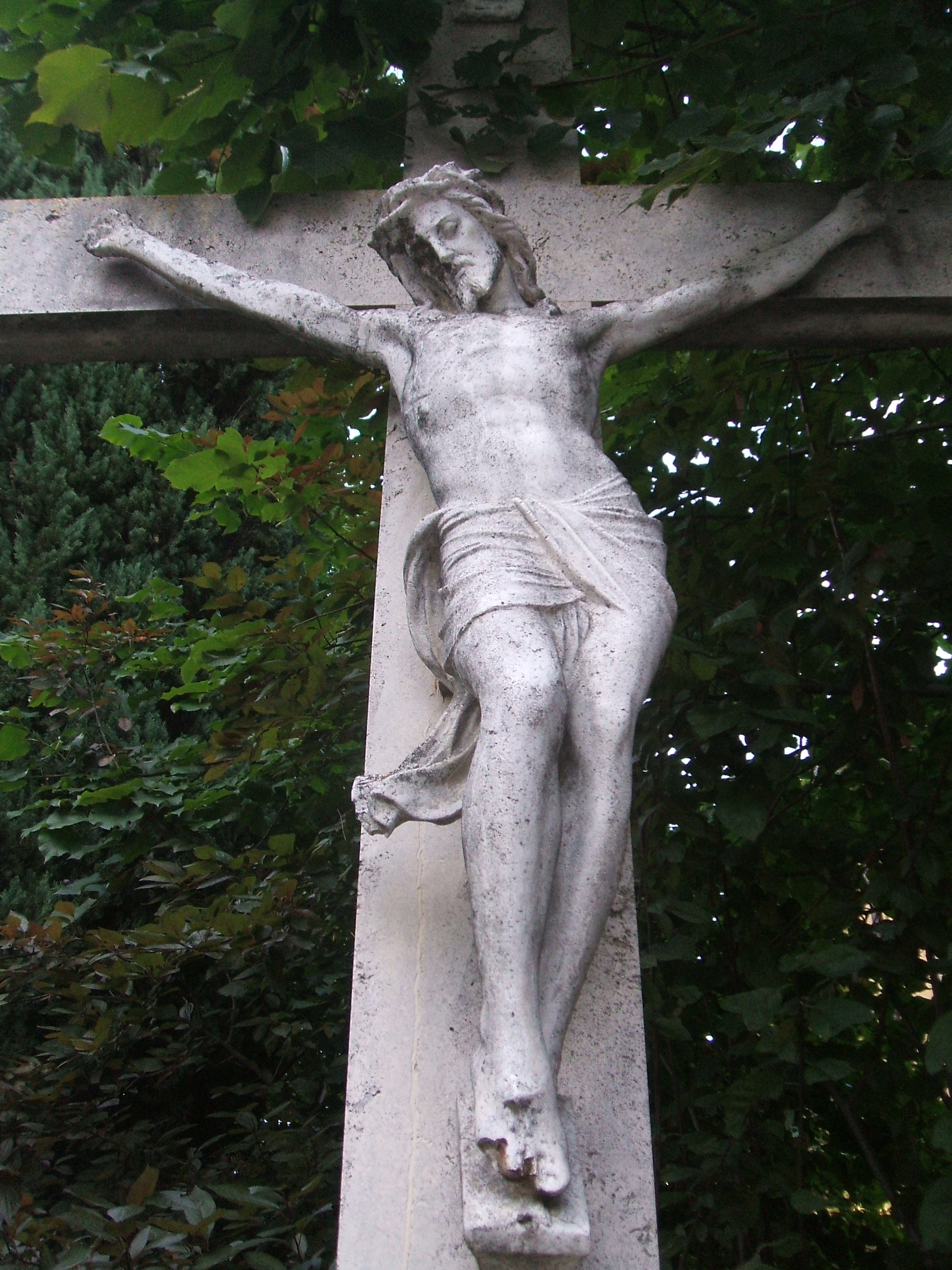
In our town there is a 10-foot-high crucifix in front of the elementary school. As an atheist I can deal with religious imagery. Such things don’t put me off because to me they lack meaning. But I am adamant about such symbols not being part of the civic realm. They don’t belong in police stations, in courtrooms or — make that especially — in public schools.
To paraphrase a friend: Did I think living in a small village in central Italy, nestled in the region of St. Francis of Assisi, would be a secular cakewalk?
No, of course not. But what about the rest of the country? The Catholic religious saturation of public life isn’t an Assisan problem. It’s an Italian problem. You can’t go anywhere in this country without the crucifix being — excuse my French — shoved down your throat. It’s literally everywhere you turn. It’s even on the peaks of mountains (yes, there are even mountain climbers who attempt to “convert” nature). It’s so prevalent that most people — even most secularists — think its normal. It isn’t.
Thankfully, there is a proper place for the crucifix. It’s called a church. Or a home. Or a Catholic school (though one may rightly question the very idea of “faith schools”). It is emphatically notthe public classroom, which should be a haven for secular education and social integration. If Italy is ever to hold its head high in the European Union, it must break its mischievous pact with the Vatican and stop ransoming its youth to the bishops. It must give up its de facto state religion once and for all. It must regain its independence and integrity, in short.
March 17, 2011 is a national holiday. We’re supposed to celebrate 150 years of the unification of Italy. Many Italians smile awkwardly at the thought of Italy being united because they know it isn’t. Not really. But it’s worth remembering that one of the fundamental freedoms won by the Risorgimento was the secular state. It was an exercise in putting the Catholic Church in its place by restricting its sphere of influence (and its landholdings). Of course, the Vatican bounced back under Fascism — and never went away.
I love this country. I’m proud of its rich cultural heritage, its contributions to art, science and gastronomy. But the world is laughing at us right now. Italy’s two most powerful men are a fount of endless shame and embarrassment. One lives like a gluttonous sultan out of the “Thousand and One Nights”; the other, in the words of Christopher Hitchens, is “a mediocre Bavarian bureaucrat… responsible for enabling a filthy wave of crime.” Both of these men, prime minister and pope, have virtually unlimited power to do as they please with this country. It is their plaything.
I don’t mean to assert that if the Catholic Church is politically hobbled the crooked will be made straight. That’s just one example, albeit a pervasive one. There’s also widespread nepotism, organized crime, political corruption and a countless other shortcomings. And every one of them takes cover in the shade of the church. Perhaps folding that umbrella would prove a promising start to further reform. It’s worth a try.
Contrary to widespread belief, Italy doesn’t need a violent revolution to right its wrongs. It doesn’t even need an Egyptian-style popular uprising. It needs a revolution of legality, which may prove far more difficult than beheading kings.
I’m always happy to see atheists coming out in minority communities. My advice: be honest. If others can’t deal with it, try to talk about it openly. If that still doesn’t work, resort to humor. Eventually, they’ll come round. And if not, it’s not your problem anymore; it’s theirs.
The other day I was catching up on the latest brouhaha in the atheist blogosphere (Jeremy Stangroom vs. Badnewatheists). I hadn’t really been keeping up, you see, as we just moved and have a seven month old daughter. Not ideal conditions for up-to-date blogging. But the internet works fine here, so I dipped my big toe in and…ouch! The water was scalding.
Stangroom is upset that gnu atheists are occasionally rude. Make that nasty. Make that abhorrent. Find the worst adjective you can and apply it to Jerry Coyne, the most evil motherfucker on the web. He just ran over your blind grandma with his Triumph, then stopped to watch her writhe and bleed to death on the pavement. Did I mention he was smoking a Cuban cigar at the time? And listening to Black Sabbath on his iPod? That’s pure gnu atheist style devilry at work.
I don’t really want to get in the middle of this debate. Yes, I do. Sort of. The issue is, do people have the right to be occasionally rude? I think so. You may disagree, of course. But you’d better disagree with a gentleman’s manners.
The comments are closed to most of Stangroom’s recent posts. And don’t bother twittering at him, because he has little patience for that kind of thing. His essential gripe is that the gnus have written things on their blogs that make people upset, and apparently some of those people write him emails kvetching about the horrible manners of a handful of science bloggers. So maybe he’s getting sick of playing school counselor. I don’t know. But it seems odd to me that the words of Jerry Coyne or P.Z. Myers carry such tremendous weight in the psyches of their debate partners (or that anyone debating them is unprepared for their style). If they are too rough and tumble, why are these tender souls even in the ring?
Stangroom surprised me, though, in a brief email exchange. After his pounding the nail on the head about how terribly nasty the gnus are, I expected him to be the very picture of politeness. Especially with his critics. But right out of the gate (on Twitter, no less) he told me I was making a fool of myself, intimated that I was out of my league, and that my opinion “wasn’t worth 2 cents.” One step short of telling me I had a stupid face, really.
I haven’t asked him for permission to quote his emails; and I don’t expect he’d give it to me, either. I don’t even want to play his game and point the finger at his sense of exquisite incivility. I did point out to him this one little thing, though. I wrote:
“I might just break out in tears because you told me I was making a fool of myself on Twitter. Has that thought occurred to you? Do you give a damn?”
I hope it gives him pause for thought, at least. He doesn’t know me. For all he knows I might be a basket case. I might even write to Ophelia Benson in tears that I’d been reduced to emotional oatmeal and my life had been rendered meaningless. But maybe he was having an off day. Or maybe he found my inquisitiveness nauseating. I don’t know and I really don’t care. He was rude to me and I don’t hold it against him.
And he should stop holding it against the gnu atheists. As far as I can tell his is nothing more than a sanctimonious pose. Given the chance to be an example of decorum, he blew it in one tweet.
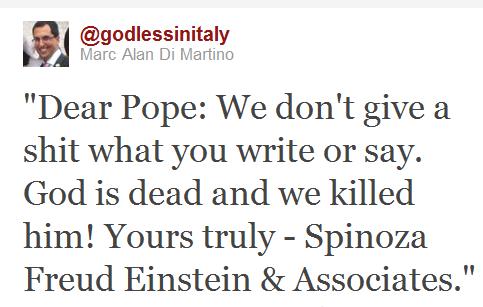
The pope, in his new book, apparently asserts that the Jews didn’t kill Jesus. So what? Who cares anymore? Are we really going to let the pope decide our opinion on such matters as, Are Jews intrinsically evil? That sounds pretty ridiculous today, but for centuries the pope’s opinion on such matters really mattered. Thankfully, his words are now grist for the mill of Twitter jokes. Here’s my attempt at an elegant controbattuta:
Nostalgia is never an entirely pleasant sensation, especially when you’re being nostalgic about the present. But this is what happens when you’re leaving a place you’ve lived for long enough to have developed a complex attitude to it. It happened to me in New York City on the eve of my departure: suddenly the rundown storefronts on 10th Avenue began to look otherworldly, poetic, somehow different than they’d looked before. The same is happening now as I stroll through Rome as through a museum exhibit, knowing that in a few weeks it will no longer be home.
I can think of nowhere else people go — except France — for the sole purpose of eating their way through a vacation. There is more art in Italy per square foot than any other place; there are mountains, beaches, an enchanting countryside, medieval castles, ancient stone homes, hilltop townships and historic centers full of fountains and churches and arches that stretch back to Roman times. There are roads that will take you north and south, up to Europe and down to the edge of the Mediterranean. But what makes people really happy is a plate of spaghetti with garlic and oil.
My earliest memories of Rome are, predictably, food-related. They begin when I was seven, slurping grattachecca (a snowball) and chewing coconut slices while hanging around St. Peter’s Square with my family. My father had grown up just down the street. That was when I was introduced to the supreme Roman street food, supplì (or “rice balls” in the parlance of American pizza purveyors), and pizza rossa, which my father could never order in the United States because no one understood why anyone might want pizza without cheese.
At eleven I spent a summer here. Pretty much all I did was eat and read Garfield comics, toting around my Walkman and a handful of cassettes (Bill Hailey springs to mind). I refused to speak Italian, which is surely one of the reasons my parents sent me to Italy in the first place. I was an enigma to my relatives; the only words they could get out of me were the parolacce. I remember stunning people with blasphemy before I could say, “Mi chiamo Marc.” I went home supersized in August, and my family re-branded me “mozzarella.”
Not on pizza
Ten years later there was another spurt of visits with a friend, then with my then- girlfriends. We always followed the same triangular route: Rome, Florence, Venice, Rome. (We once ended up in Greece, but that’s another story). It turns out that all of my cousins did exactly the same thing, year in and year out, a kind of Grand Tour for second-generation Italian-Americans.
I once ordered, to my great embarrassment, pizza with goats. We were sitting in the lovely Piazza della Maddalena, near the Pantheon, and I was showing off a bit. “Vorrei una pizza con capre e alici.” The waiter smirked, catching my error. “I think you mean capperi, capers. Unless you actually want goats.” That’s largely how I learned Italian, through table talk.
But to get back to that supplì, or rice ball, I mentioned earlier. In my book, this is the quintessence of the Roman nosh. A few observations:
1) It should never cost more than €1.
2) It should never be larger than your fist.
3) It should be fried, not baked.
4) It is not an arancina, which is a similar — but entirely different – rice ball specialty from Sicily. The most delicious supplì are simple, tomato-and-mozzarella-based affairs, though an elegant variation I’ve encountered substitutes squash for tomato.
I suppose I should mention a few things I don’t eat, just to cure the distant reader of envy. My aunt once offered me golden fried mule testicles. How do you turn those down? Tripe is a favorite of many, but might be unfavorably compared to stewed bicycle tire. Lard, or fatback, is up there with pickled pigs’ lips on my list of nausea-inducing delicacies. Add sanguinaccio, or blood sausage. Non-kosher atheist that I am, I still find the Levitican injunction against eating blood insuperable. It’s just sort of gross.
Finally, this is as good a space as any to lament the demise of Rome’s best pizza, which just happened to be kosher. It was not excellent because it was kosher, but because it was unique. The pizzeria was called Zi’ Fenizia, and it was in the Ghetto for years before moving to a lukewarm location near Fontana di Trevi. They served only cheeseless pizza, and their best creations were sopping with tender marinated vegetables, called concia: eggplant, peppers and zucchini.
Everybody I took there raved about it. I was a regular customer until they lost their kosher certification (read: community infighting); then, in the worst-calculated move in pizza history, they began throwing ham and cheese on everything. They called it “giving tourists what they want.” Anyway, they lost heart and the pizza lost its raison d’etre. It was a case of commercial suicide.
And all I could think was, “Do vegetables even need kosher certification?”
I don’t have a great deal of time this morning – or really any morning – to blog (thus, Twitter). So, to celebrate Charles Darwin’s 202nd birthday and his enduring contribution to modern creationism (anyway something about apes – I can’t be bothered with the details), here is an intelligently designed cartoon depicting the errors of modern evolutionary thought for which Darwin is so deliciously to blame. Via Atheist Cartoons. (I’m sure this will pop up on a thousand other blogs today. Enjoy.)



 Marc Di Martino