Can friendship survive Facebook?

Anti-Semitic graffiti on a wall in Italy. 2014.

Until the most recent flare-up in Gaza, I had been conducting a kind of friendship experiment. Through a mutual interest group I had become friends with a woman who holds extremely negative views on Israel – and, as I would discover on Facebook, Jews as well.

I like to think my own views on Israel are moderate, and I suppose I wouldn’t shrink from the label “liberal Zionist.” Politically, I’m a liberal secularist. I’m a big fan of religious-political-sexual freedom and things like that. I’m not remotely conservative on any issue I can think of. I think the existence of Israel is a good thing for both Jews and non-Jews and have argued for years with those who hold the view that Israel is, well, not a good thing. So I guess that makes me a Zionist, too, though I don’t support the more hawkish positions of the Israeli right or fall for the seductive idea that “Israel is always right.” I admire people like Amos Oz. I seek a coherent, balanced position that doesn’t sacrifice my core beliefs. You get the idea.

So back to my friend. Early on in our friendship we realized it was going to be rough.  She would always make a point of sporting her keffyah every time we got together. We knew there was an elephant in the room. We generally avoided the topic of Israel, but at times we would very politely discuss this or that, trying oh-so-hard not to step on each others’ toes. One evening at dinner I noticed she had displayed a thank-you-for-your-support card from the Italy-Palestine Friendship Association prominently on the mantle. Did she want me to comment? If she did, I didn’t. It might’ve given her too much satisfaction and provided the perfect setup for the anti-Israel rant I knew was waiting to happen. Seeing as we enjoyed each other’s company (and, more importantly, the kids were best friends), it would’ve spoiled the soup. And, as this was an experiment – I believe on both our parts – to see if a friendship could weather such polarizing differences, I thought it best to avoid the topic whenever possible.

Facebook was another story, though. I tend to discuss politics ever more sparingly on Facebook precisely because that’s where friendships tend to go sour. Her feed, in contrast, was  a weapon in the propaganda war against Israel. I had decided to write her posts off as “we agree to disagree”, but when Operation Protective Edge erupted her page exploded in an uninterrupted feed of anti-Israel hatred.

It was all there, every meme from the Israelis-as-Nazis to the Apartheid Meme, from the Blood Libel to the Zionist World Conspiracy. There were calls to boycott Israeli products and articles by (nearly always Jewish) anti-Zionist authors denouncing genocide and ethnic cleansing. Worse, there were backhanded jibes at me (“Look how the Zionists excuse genocide”, snarkily linking an article I had posted a few minutes before), presumably in order to garner favor among her like-minded “friends.” So this is what it’s come to, I thought. Ad hominem attacks.

At first I thought the whole thing would blow over, but as the conflict persisted  her vitriol only worsened. I stopped following her posts. Out of sight, out of mind. Then one day my wife said, “Come see what she’s posted now,” and there was some article by Gideon Levy saying that Israel is just about the shittiest society on Earth. The comment to her post read something like, “What a sickening people. Levy is the only Jew you can trust.” She had “liked” the comment. I unfriended her without another thought. No phone call, no email, no explanation.

I still wonder if what I did was rash. I still want to give her the benefit of the doubt. I search my mind for reasons to excuse her. But when I consider the lengths to which I had gone to accommodate her ranting, and to ignore it for the sake of our friendship (or at least that of our daughters), I realize I did the only thing possible. We haven’t spoken since.

A failed experiment is still a successful experiment, however. You can still learn something from it. I think I learned that Facebook can undo friendships as easily as it can do them. Even the kind where you see people in real life and go to their houses and cook together and your kids are close friends. And I can tolerate political differences, however unsavory. That hasn’t changed. But I cannot and will not tolerate prejudice, racism, homophobia, misogyny or – yes – anti-Semitism. That’s graffiti that just won’t wash.

Ratzinger’s blood libel against atheists

Not exactly a denial of God, is it?

It reminds me of Durban: a gathering of peace-minded folks from all over the globe getting together to discuss problems which afflict us all. But all they can talk about is Israel. The love-fest turns into a blood libel against the Jews.

Joseph Ratzinger knows that he can’t aim his pious invective at the Jewish people as his predecessors did. So this most contemporary pope takes aim at the next best enemy of his faith: atheists. It’s another blood libel in the making. Here are his words from Assisi yesterday*:

The enemies of religion…see in religion one of the principal sources of violence in the history of humanity and thus they demand that it disappear. But the denial of God has led to much cruelty and to a degree of violence that knows no bounds, which only becomes possible when man no longer recognizes any criterion or any judge above himself, now having only himself to take as a criterion. The horrors of the concentration camps reveal with utter clarity the consequences of God’s absence.

Do we really demand that religion disappear? Or do we just demand that it know its place and stay in it, and not meddle in things which aren’t its business? And there in that last line is the blood libel: that Nazism was the outcome of atheism. But Ratzinger was in the Wehrmacht as a young man, and knows perfectly well that Nazi anti-Semitism was a Christian inheritance. Adolf Hitler was a Catholic who has never been excommunicated and Mein Kampf was never added to the Index Librorum Prohibitorum as, say, Kepler, Voltaire, Locke, Mill and Galileo were. Kettle black enough for ya’?

The absence of God leads to the decline of man and of humanity. But where is God? Do we know him, and can we show him anew to humanity, in order to build true peace? Let us first briefly summarize our considerations thus far. I said that there is a way of understanding and using religion so that it becomes a source of violence, while the rightly lived relationship of man to God is a force for peace. In this context I referred to the need for dialogue and I spoke of the constant need for purification of lived religion. On the other hand I said that the denial of God corrupts man, robs him of his criteria and leads him to violence.

See? There it is: “the denial of God corrupts man, robs him of his criteria and leads him to violence.” While religion can be used either as a means to violence – as Ratzinger knows only too well – or peace, atheism inevitably leads to the degredation of humanity and the violent corruption of society.

He’s telling fibs again. The happiest societies on Earth are the most secular. Sociologists know this. Ask anyone who has escaped from religion and they will likely tell you they are happier and feel “free” for the first time in their lives. This is not uncommon at all, no matter which religion is being left behind.

This knowledge is making the pope shit his pants.

______________________________________________________________

* One year ago, almost to the day, Italian Foreign Minister Franco Frattini said some disturbingly similar things about atheists. And he published them in a Vatican newspaper, to boot.

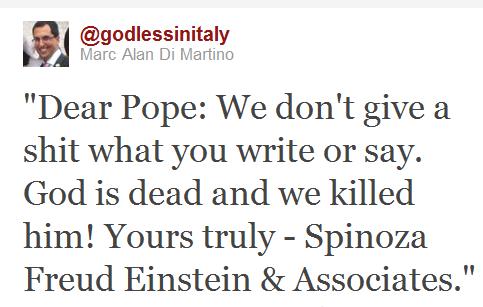
Dear Pope: God is dead, and we killed him

The pope, in his new book, apparently asserts that the Jews didn’t kill Jesus. So what? Who cares anymore? Are we really going to let the pope decide our opinion on such matters as, Are Jews intrinsically evil? That sounds pretty ridiculous today, but for centuries the pope’s opinion on such matters really mattered. Thankfully, his words are now grist for the mill of Twitter jokes. Here’s my attempt at an elegant controbattuta:

The War Against the Jews

An incomparable description of Hitler’s mental world:

“The Jews inhabited Hitler’s mind. He believed that they were the source of all evil, misfortune and tragedy, the single factor that, like some inexorable law of nature, explained the workings of the universe. The irregularities of war and famine, financial distress and sudden death, defeat and sinfulness – all could be explained by the presence of that single factor in the universe, a miscreation that disturbed the world’s steady ascent towards well-being, affluence, success, victory. A savior was needed to come forth and slay the loathsome monster. In Hitler’s obsessed mind, as in the delusive imaginings of the medieval millenarian sectarians, the Jews were the demonic hosts whom he had been given a divine mission to destroy.”

(Dawidowicz, The War Against the Jews p. 21)

I find this passage utterly chilling.

Blame the Jews (it’s a comedy sketch)

The really funny thing is that what people occasionally say is no more absurd and far-fetched than this little ditty by Pope Anti-Semiticus. I mean, I know you know someone who really thinks this way.

Please forward to your favorite Jew-baiter or jihadi cousin. (Via kinoppete.)

Wading through the muck

Lee Smith is back this week with a response to the readers of his article last week in Tablet about Israel’s critics, their commenter hoardes and the “mainstreaming” of anti-Semitic invective by respectable purveyors of information. Wait, who wrote what again?

It’s complicated.

I don’t think anyone in the Sully-Walt-Greenwald camp is going to be canoodled into the Smith-Goldberg-Dershowitz camp, but you’ve got to give Lee Smith credit for actually wading through all the muck around Stephen Walt’s posts.

Highlight: One commenter on Smith’s article claims to have secret access to a Smith-inspired death-threat, but his hands are tied.

“Not only can I source the comment, I can quote it in full here and now. But Tablet Magazine has requested that I not do so.”

I guess that puts Tablet Magazine right up there with AIPAC and Jeffrey Goldberg on the “Jews Who Run the World” list.

Oy, Saramago

While the literary world and the world of far left European politics are mourning Jose Saramago’s death, others are unearthing things about the great novelist they don’t like much. I don’t have time now, but David Frum wrote a summary of Saramago’s visceral dislike of Jews and Israel. It makes for uncomfortable reading.

Saramago won his prize in 1998. He put his new global fame to the service of a new cause: denunciations of Israel. But unlike other European anti-Zionists, Saramago explicitly connected his dislike of Israel to his feelings about Jews.

In a speech in Brazil on Oct. 13, 2003, Saramago reportedly unburdened himself of this thought about the world’s Jews: “Living under the shadows of the Holocaust and expecting to be forgiven for anything they do on behalf of what they have suffered seems abusive to me. They didn’t learn anything from the suffering of their parents and grandparents.”

That last phrase is so myopic I have to keep reading it to believe he really said it. These things, too, must be remembered.

Ecclesiastical Chutzpah

Honestly, I didn’t think even the Vatican was capable of stooping so low. Father Raniero Cantalamessa, while speaking today before Pope Benedict XVI, read a letter he had received from “a Jewish friend.” The letter expressed its author’s sympathies with the Church, and went on about the historic coincidence of Easter and Passover overlapping, as if that were some sort of divine message to be decoded by both parties. In fact, if you believe in divine messages, even the number of words in the letter might have profound significance. Nonbelievers have a word for this kind of thing: apophenia, meaning “the spontaneous perception of connections and meaningfulness in unrelated phenomena,” according to Skepdic.

“I follow with disgust the violent, concentric attacks against the Church, the Pope and all of the faithful by the entire world,” the letter reads. “The use of stereotypes, the transference of guilt and personal responsibility to the collective remind me of the most shameful aspects of anti-Semitism.”

Let’s look at this a bit closer. The entire world? All of the faithful? I am fairly critical of the Church, but I have never for any reason allowed that criticism to leak out onto those friends and family members who might be counted as being among the faithful. If they want to believe things I personally find ridiculous or adolescent, that’s their business and I respect it. Even Christopher Hitchens, one of the Pope’s most distinguished critics, has never to my knowledge spoken out in favor of persecution of the Catholic faithful for the sins of the corrupt clergy. Here is a recent piece from the Washington Post:

Joseph Ratzinger may be a mediocre and corrupt Bavarian official but he is acclaimed by his flock as the holder of the chair of Peter and the vicar of Christ on earth. Their choice. Their responsibility. Let them say that their redeemer has chosen such a person as his spokesman. They must still be made aware that as long as this outrage persists, they will never, ever, hear the end of it. Justice is coming.

Now, Hitchens is using characteristically strong language. One might even infer that he wishes the Catholic faithful to accept some measure of responsibility for their undisputed (and unelected, by them) leader. We are talking about a huge, an incredibly huge scandal of systematic sexual abuse of minors by Catholic priests. That the Pope has been personally implicated in its cover-up only amplifies the gravity of these crimes. What Hitchens did not write was, “Rough up the Catholics wherever you find them. Make them pay in blood.” That, I agree, would have been somewhat closer to what our letter-writer called “the most shameful aspects of anti-Semitism.” But that is not what is being said by Hitchens or anyone else, much less “the whole world.”

What is being said is that it is time to hold the Church accountable for its crimes. The rhetoric of “sin” and “repentance” is not enough. The fires of hell are not enough, not least of all because they do not exist. What is needed is accountability here and now for crimes committed against real human beings, not against gods and holy spirits. If there be such beings, they can look after themselves.

I watched Father Cantalamessa read this letter on television with a frowning, stony Joseph Ratzinger seated behind him. Who knows what was going through his head? The letter is a laughable piece of propaganda, however. After centuries of immunity from the law and public opinion, the Catholic Church is finally being treated like any other institution on (and of) this earth. It is in no way the object of discrimination or violence. Criticism of the Pope, the Church and its actions have nothing to do with their being Catholic and everything to do with their actions. To equate such criticism with anti-Semitism is laughable, inaccurate and dangerous. It distorts the meaning of what anti-Semitism is while simultaneously granting the Church immunity from criticism. That the letter was written by a “Jewish friend” adds insult to injury, and only serves to give an ounce of credibility in the public mind to an otherwise offensive analogy. Who would have taken such words seriously had they been credited to the Pope himself?

Susan Jacoby writes,

I am not sorry that the Catholic Church is finally being revealed for the morally bankrupt, bureaucratic institution that it is. But I am sorry that this is happening because of the suffering of generations of children. I am sorry for those who still love the Catholic faith–I grew up with them–and must reconcile that love with the terrible acts of the men who run their church. I am deeply grateful that, as an atheist educated in the Catholic Church, I no longer bear that burden. I also feel a deep sympathy for good priests–and I know many of them–who have never betrayed the trust of loyal Catholics. But for this pope, and all of the other church officials who knew what was going on and did nothing to stop it, I have nothing but contempt. They ought to resign and walk a personal via dolorosa every day of their lives. But they won’t do it. They will continue to cling to worldly power with all of their might, even as the moral power of their institution diminishes.

The Church could not ask for fairer or more elegant criticism than this.
Crete Synagogue Burned Down

We visited this synagogue, Etz Chayyim, on our trip to Crete in 2008. It was a beautiful, tranquil, unpretentious place open to the public. Apparently, they used to boast that it was one of the last Jewish buildings in Europe (or elsewhere, for that matter) without 24/7 surveillance. This will change, of course, once they get the synagogue up and running again.

There aren’t many Jews in Crete. Most Greek Jews live in Athens. And there aren’t many of them there, either. Why anyone feels threatened by Jews is a mystery to me; why anyone feels threatened by a reconstructed synagogue (it had been used as a pigsty until the 1990s) is an equal mystery. The BBC reports.

Debating the Catholic Church

How did I miss this???